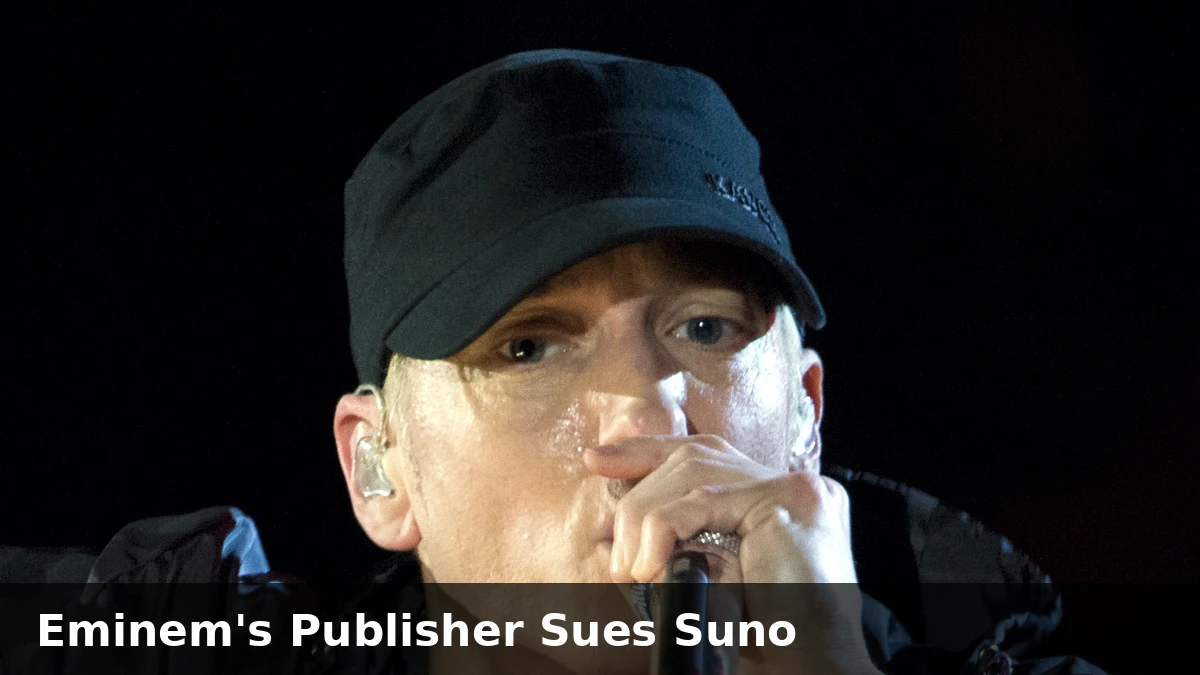
Eminem’s publisher sues Suno for allegedly training its AI music generator on 269 of the rapper’s songs without a license, in a lawsuit filed late on Friday, November 6, that seeks more than $41 million in damages. Eight Mile Style, the Ferndale, Michigan company that owns and administers the rights to nearly 270 Eminem compositions, brought the case in the U.S. District Court for the Northern District of California in San Francisco. Eminem himself is not a party to the suit, according to the Detroit Free Press, which first reported the filing.
The complaint puts some of the most recognizable songs in hip hop at the center of the growing legal fight over how AI companies train their models. The publisher argues that Suno built a music generation business on top of other people’s work without paying for it, and that the platform lets paying users create new tracks that copy Eminem’s lyrics and vocal style.
What the Complaint Alleges
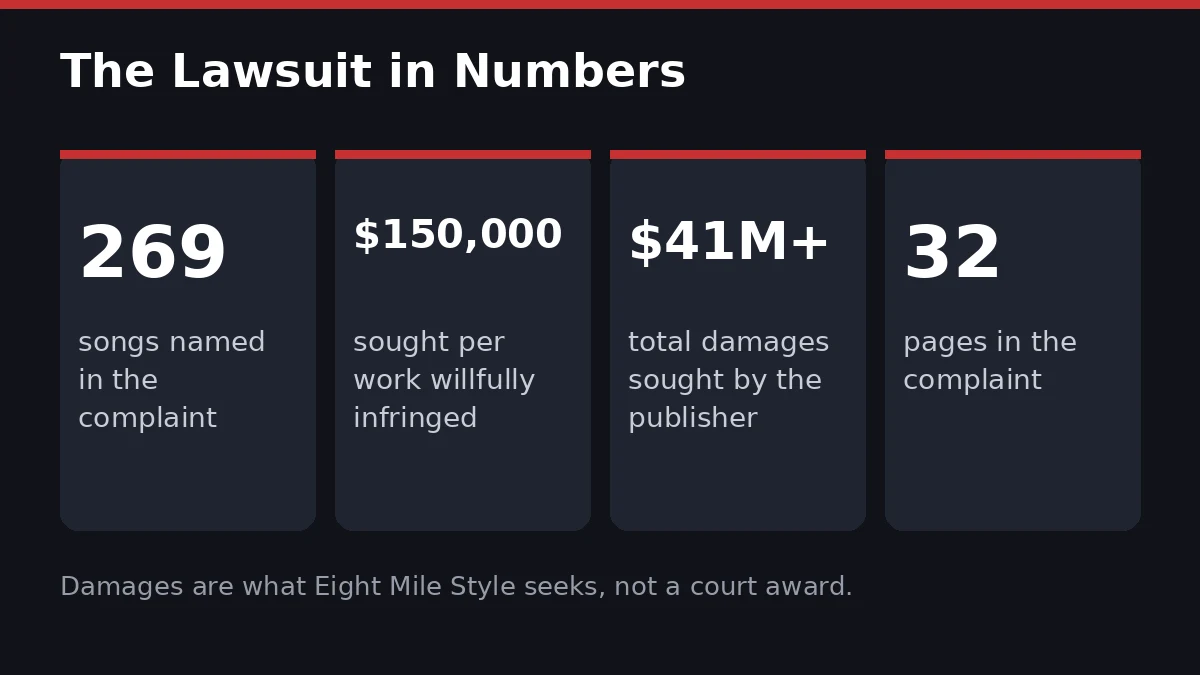
The 32-page complaint covers 269 compositions, including “Lose Yourself,” “Without Me,” “‘Till I Collapse,” “The Real Slim Shady” and “Stan.” It brings three claims against Suno: direct copyright infringement, circumvention of access controls under 17 U.S.C. § 1201, and removal or alteration of copyright management information under § 1202. The publisher also asks the court for an injunction, the impoundment or destruction of unauthorized copies, and an accounting of Suno’s training data, according to Superpower Daily.
The damages claim is built on the maximum the law allows. Eight Mile Style says it is entitled to $150,000 for each of the 269 songs it controls, or $40.35 million, plus $672,000 over copyright information it says Suno removed. The figures are what the publisher is seeking, not an award, and no court has ruled on the claims.
The filing does not hold back on its description of the stakes. “The works are some of the most valuable in the world, and Eight Mile Style is very protective of these iconic songs,” the complaint reads, as quoted by the Free Press. It contends that Suno “has built their entire business model based on copyright infringement at a scale heretofore unseen.”
The complaint also points to specific examples of what Suno’s service produced. One cited track, titled “Slim shady x Rosefalls,” uses an AI-generated image of Eminem as cover art and vocals “clearly derived from Eminem’s actual voice,” the publisher contends. Other examples include verbatim or similar versions of lyrics from “Lose Yourself,” “The Real Slim Shady” and “Houdini” in tracks generated by the service.
On training data, the publisher notes that Suno has previously disclosed in court that its AI model was trained on “essentially all music files of reasonable quality that are accessible on the open Internet.” The complaint further alleges that leaked Suno source code, reportedly obtained by an online hacker, shows the company scraped Eminem music and lyrics from sites such as YouTube and Genius.com. That allegation is the publisher’s, and it remains unproven.
How the Guardrails Were Allegedly Bypassed
Suno blocks prompts that name specific artists, so a user cannot type the cue “Eminem.” Eight Mile Style says those guardrails are easily bypassed. According to the complaint, users can prompt Suno to generate a “Slim Shady” style track using a string of descriptive terms such as “aggressive rap, rapid-fire flow, dark humor, male rapper, horrorcore, intense beat, bass-heavy, menacing, controversial.”
Suno, which launched in 2023 and offers free and paid tiers starting at $10 per month, pushed back on the claims in a statement to the Free Press on Saturday. “Suno exists to help people create new, original music, not to trade on anyone’s name or likeness, and we prohibit any unauthorized use of an artist’s work,” a spokesperson said. “To protect against this, we do not allow prompts for specific artists’ names and songs and work with third party providers to screen uploaded audio files and lyrics for potential misuse. We are always working to strengthen our guardrails and we will continue to add new safeguards that protect artists and our users.”
A Growing Pile of Music Litigation
The Eminem case lands in the middle of a wave of lawsuits against Suno. The Recording Industry Association of America sued the company in June 2024 on behalf of major record labels. Since then, two of those labels, BMG and Warner Music Group, have made licensing deals with the AI firm. Universal Music Group, Eminem’s record company, remains a plaintiff, the Free Press reported.
A separate suit arrived in early November from the rights holders of Elvis Presley, including Authentic Brands Group, who sued Suno in the same federal court. That case challenges both the alleged use of Presley’s songs in training and the reproduction of his voice, and it invokes Tennessee’s ELVIS Act, which bars unauthorized use of a person’s voice and likeness. Variety reported that other suits against Suno are also pending, from the independent publisher Round Hill Music and from Universal Music Group and Sony Music Entertainment.
The stakes reach beyond one publisher. If courts find that training a music model on copyrighted songs without a license is infringement at this scale, every AI music service will face the same question, and licensing deals like the ones BMG and Warner struck could become the price of staying in business. Suno, which Variety reported raised money in June at a $5.4 billion valuation, has so far bet that its guardrails and its reading of fair use are enough. The Eminem publisher’s suit is the latest test of that bet, and it puts the argument in front of a federal judge with some of the most valuable songs in the world on the line.
Sources
- Detroit Free Press: Eminem song publisher seeks $41M in copyright lawsuit vs. AI platform
- Superpower Daily: Eminem’s publisher sues Suno over alleged use of 269 songs in AI training
- FourWeekMBA: Eminem’s Publisher Seeks $41M From Suno Over 269 Songs
- Mubert: Eminem Suno Lawsuit: What We Know (Nov 2026)
- AllHipHop: Eminem Publisher Demands $41 Million From Suno Over Alleged AI Copying