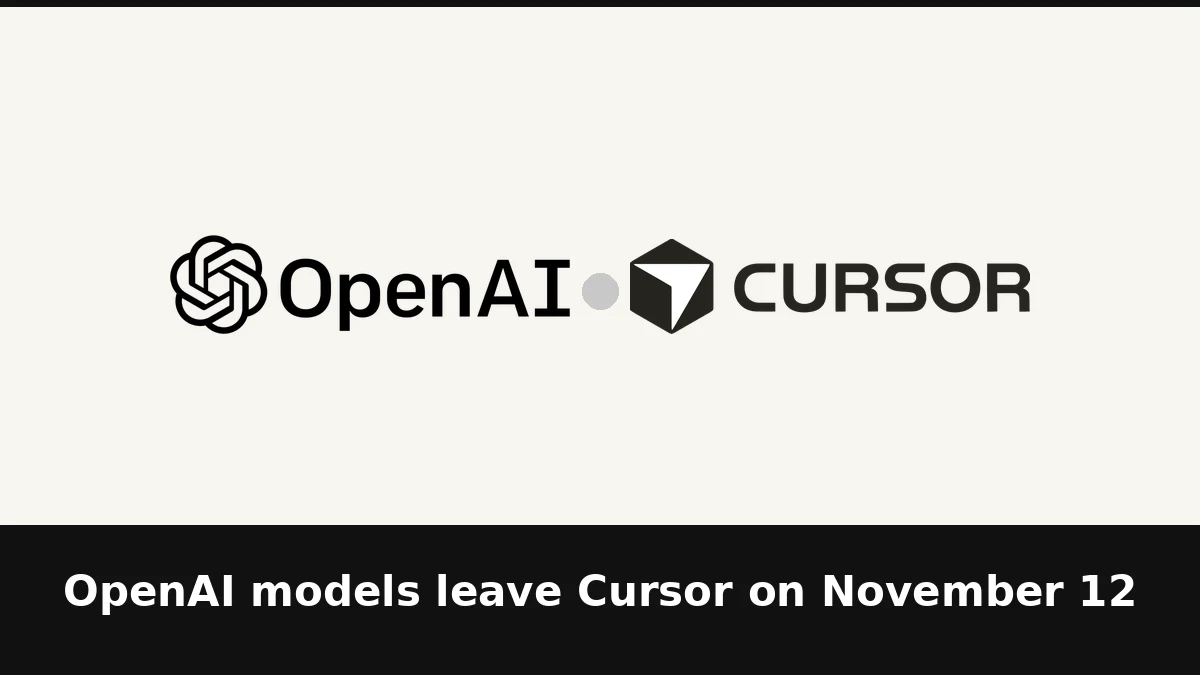
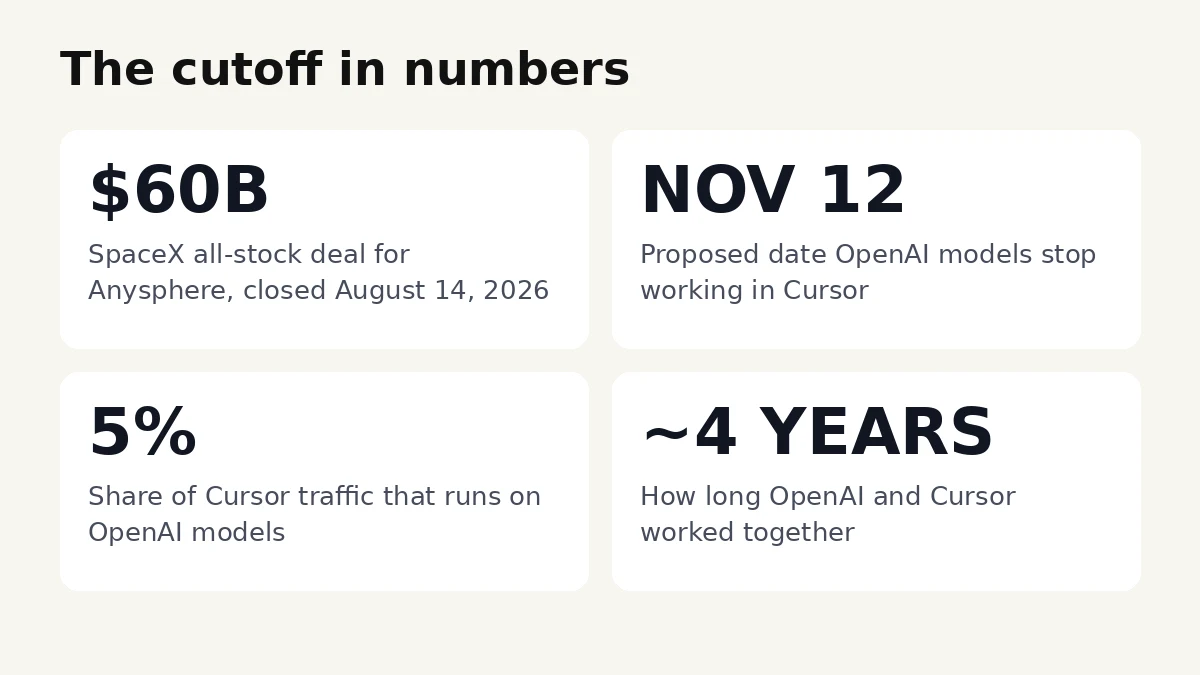
OpenAI models leave Cursor on November 12, 2026, under a proposed cutoff that turns a $60 billion acquisition into a deadline for developers. OpenAI notified SpaceX on August 28 that it intends to wind down the contract supplying its models to the popular AI coding tool, and it will not provide future models to Cursor while the agreement winds down.
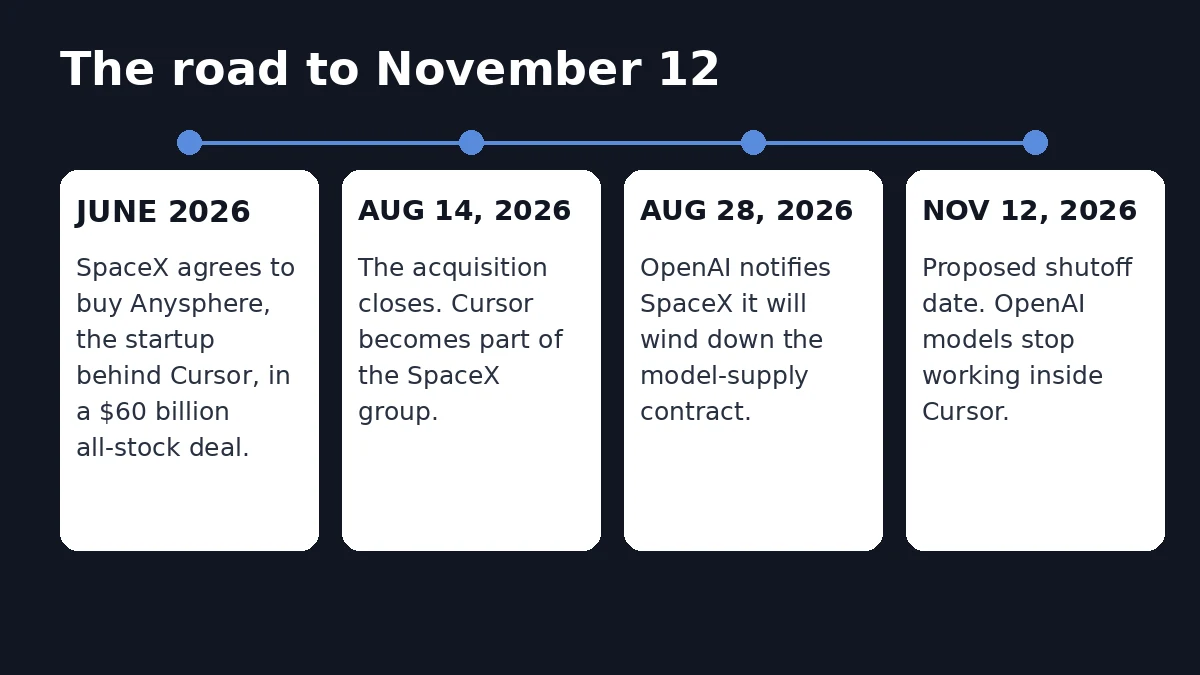
The decision lands four days before the cutoff takes effect, and it is still framed as a proposal rather than a final break. OpenAI said it gave the maximum notice its contract allows, and both companies have said talks are continuing. That leaves developers with a short window to switch models or set up a workaround before the date arrives.
What OpenAI announced
OpenAI published its decision in a blog post titled “Our decision on Cursor following its acquisition by SpaceX.” The company said it notified SpaceX that it intends to wind down the contract providing OpenAI models to Cursor, with a proposed shutoff date of November 12, 2026. CNBC reported the decision on August 29, and the story has been widely corroborated since.
OpenAI was blunt about its reason. “We are making this choice because we cannot be confident that SpaceX will use our technology within our terms of service, based on our experience with Elon Musk’s companies violating contracts,” the company wrote. The post added that the decision was difficult because OpenAI cares deeply about its models being broadly available for developers.
The company also praised the tool it is cutting off. “We’ve worked with Cursor for nearly four years and have enormous respect for their team, their product, and what they’ve built for the developer community,” OpenAI wrote. “We know that the people most affected by this decision are the developers who rely on OpenAI models in Cursor.”
One detail matters for anyone planning around the date. November 12 is a proposed date, not a confirmed one. OpenAI’s own help page still describes a proposed transition period ending November 12, notes that Cursor may choose to end access sooner, and says the official date will be shared as soon as it is confirmed between both companies. Developers should treat November 12 as the working deadline, not a guarantee of access until that day.
Why OpenAI acted
The trigger was ownership. SpaceX agreed in June to buy Anysphere, the startup behind Cursor, in an all-stock deal valued at $60 billion, and the deal closed on August 14, 2026, according to financial filings cited in reports on the acquisition. OpenAI’s custom agreement with Cursor carried a limited cancellation window after a change of control, and OpenAI used it two weeks after the deal closed.
OpenAI laid out the history behind its lack of confidence. After Musk acquired Twitter, now part of SpaceX, the company broke the terms of its contract with OpenAI, according to the post. Musk admitted under oath earlier this year that xAI, also now part of SpaceX, had violated OpenAI’s terms of service. OpenAI said a large partner like SpaceX normally needs a custom contract to ensure compliance and safety at scale, and it was not willing to extend that trust here.
The company also pointed to what comes next. “As AI capabilities advance, we also have a new level of accountability to ensure our upcoming model, Astra, is being used in accordance with our terms,” OpenAI wrote. Holding the cancellation to the latest date the contract allows, while withholding future models from Cursor, was the compromise it chose.
Graphic: GPTOnline
What changes for developers
When the cutoff takes effect, OpenAI models will stop working inside Cursor’s model picker. Cursor currently lists older OpenAI models such as GPT-5.6, while the newer GPT-6 family is already absent, so the practical change is the removal of the remaining OpenAI options. Claude, Gemini, Grok and Cursor’s own Composer models are unaffected and will keep working.
The disruption is smaller than the headlines suggest, at least by Cursor’s own numbers. Cursor chief executive Michael Truell said OpenAI models serve about 5% of Cursor user traffic, and that the companies were speaking to try to resolve the dispute. Most Cursor users already rely on Claude or Cursor’s native models.
Developers who still want OpenAI models inside Cursor have options. OpenAI said developers can continue using their own API key in Cursor, and its Codex extension works inside Cursor as another route to OpenAI models. A gateway such as Amazon Bedrock is a third path. None of these is as seamless as the built-in picker, but they keep GPT models available for teams with workflows built on them.
Cursor, meanwhile, is already moving on without OpenAI. The company has shipped Grok 4.6, its first model built with SpaceX compute, and reports say SpaceX and Cursor are preparing a jointly developed model. The tool’s future is increasingly tied to the SpaceX ecosystem rather than to OpenAI.
Graphic: GPTOnline
Why it matters
The Cursor cutoff shows that ownership now decides which models a developer tool can offer. A change of control at the top of a company can reach straight down to the model picker of a developer who never signed a contract with either side. The same pattern appeared in June 2025, when Anthropic cut nearly all of Windsurf’s first-party access to Claude with less than five days’ notice while OpenAI was reported to be buying Windsurf.
For teams that depend on AI coding tools, the lesson is practical. Provider portability is now a reliability feature, not a nice extra. Exercising the bring-your-own-key path and keeping provider-specific wiring outside prompts turns a contract change into a migration rather than a rewrite. The November 12 deadline is a live test of that advice, and it arrives in four days.
Sources
- OpenAI, “Our decision on Cursor following its acquisition by SpaceX”
- Evermx, “OpenAI to Cut Off Cursor’s Model Access Nov. 12”
- Enjoy.dev, “OpenAI plans to cut Cursor off on November 12. How to keep using GPT there”
- The Signal, “Cursor’s OpenAI cutoff turns ownership into infrastructure risk”
- Under30CEO, “Vendor Lock In Bites as OpenAI Cuts Off Cursor”