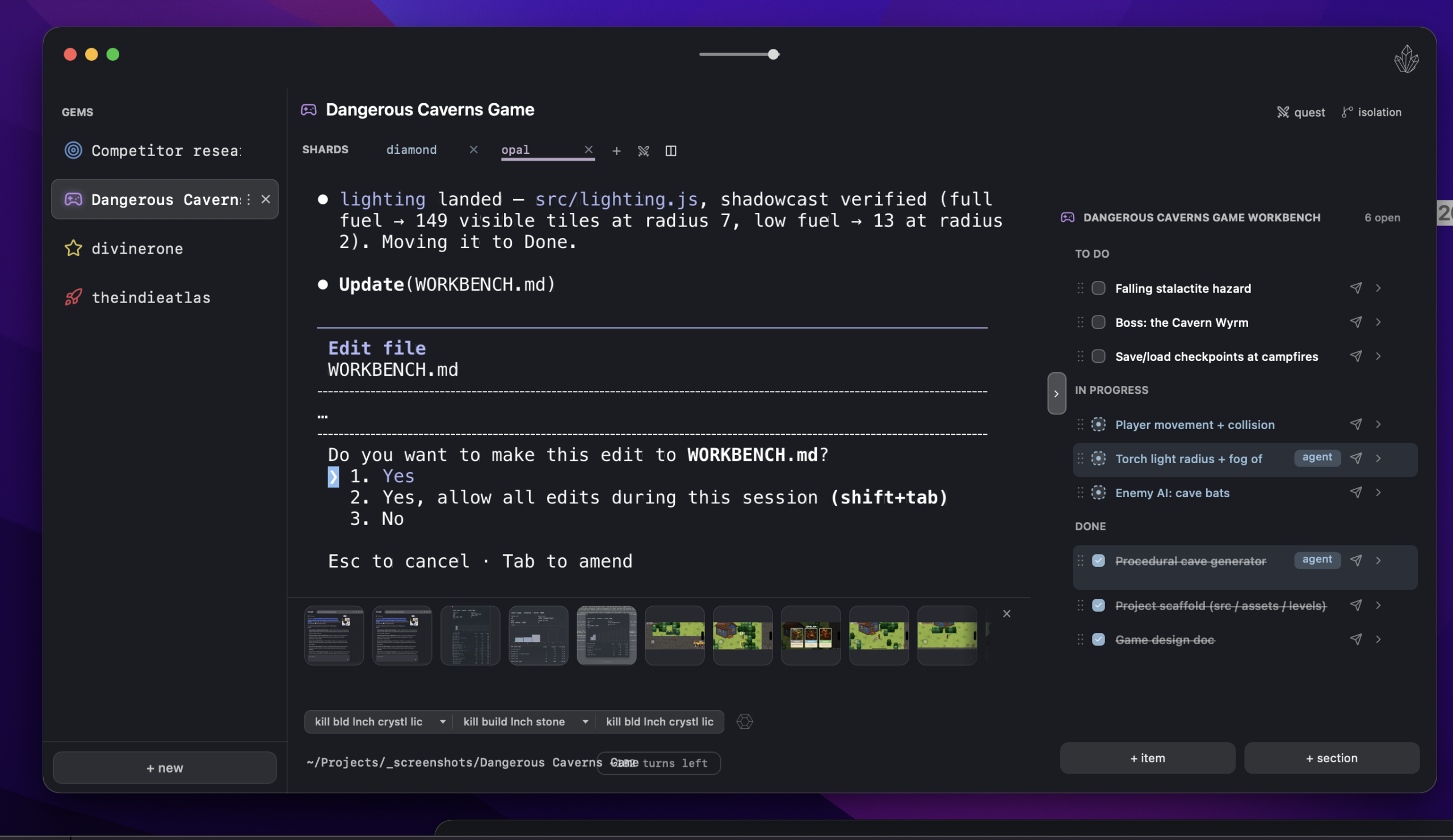
crystl is a macOS terminal for people who run several AI coding agents across projects. It puts sessions, approval requests, activity and shared task lists in one workspace. The underlying agents still do the coding: crystl organizes their work rather than replacing Claude Code, Codex or another model provider.
Its November 5–7, 2026 updates make the product especially relevant to developers juggling work and personal agent accounts. This overview draws on the vendor’s public documentation, not a hands-on performance test.
What changed in November?
The official changelog records multiple Claude Code and Codex accounts and plan-limit displays on November 5. November 6 brought update rollback and improvements for wrapper commands and custom-model context lengths. On November 7, version 2.278.0 added clearer disclosure and controls for the sections crystl writes into agent instruction files.
These are updates to an existing product, not its original launch. Its Product Hunt appearance also provided a recent discovery signal. Launch-site attention alone does not establish reliability or widespread adoption.
How the workspace is organized
Projects are called “gems,” and agent sessions are “shards.” A developer can keep several projects available in the side rail and move between their sessions. Parallel work can use separate Git worktrees, while the Workbench provides a shared list of tasks in the project.
Floating cards bring questions and approval requests forward from sessions you are not watching. The cards identify the project and session, which matters when two agents are asking to change different repositories. Support depends on the agent: the documentation says Claude Code and Codex have the necessary hooks, while Antigravity CLI does not yet provide the same card behavior.
Work accounts, personal accounts and usage limits
The accounts feature keeps named Claude Code and Codex logins in separate folders. Each session shows the account it is using. Usage information comes from the agents’ own reporting and includes the relevant reset times.
This is useful when you need to keep an employer’s work separate from a personal project. It is still your responsibility to use the correct account, repository and data permissions. crystl says a worker that reaches a limit stops until it resets; it does not automatically move the work to another account to bypass that limit.
A sensible first project
- Start with a small repository you are authorized to use and a recoverable working copy.
- Confirm which agent and account each session is running before sharing project material.
- Give parallel sessions separate tasks and review how their worktrees will be combined.
- Read each requested command or change before approving it. Check the project’s approval settings rather than assuming every action will ask.
- Review the final diff and run your normal tests before merging or deploying.
Also review the instruction-file integration. The November 7 release separates project-level and global controls and provides a way to remove crystl’s global section. Adding a coordination layer can change what your agents are told, so those files deserve the same attention as other project configuration.
Free and paid access
The pricing page lists a free Apprentice tier with parallel sessions, approval cards, activity and history views, the Workbench and up to three scheduled agents or commands. Accounts and usage meters are free features.
The displayed annual Guild price is US$170 per year, with automatic renewal. Guild adds orchestration, full agent CLI control, unlimited scheduling, running automation sequences, iPhone access from anywhere and support for up to three devices. Check the current billing selection and checkout terms before subscribing. Access to the coding agents and their model usage is separate from the terminal subscription.
Who should consider it?
crystl is most relevant if coordinating several CLI agents has become a practical problem: missed questions, confusion over projects or uncertainty about which account is active. A single-agent workflow may not need the additional setup. macOS compatibility, agent-hook support, approval configuration and the cost of the underlying models are more useful selection criteria than the number of sessions you can open.
For a small example of reviewing generated code, see our guide to testing an AI-generated regular expression before using it.
Image credit: vendor-supplied Workbench screenshot from the official Crystl press kit, accessed November 8, 2026. The image illustrates the vendor’s example workspace, not a GPTOnline product test.