Anthropic gave Claude Enterprise customers a new set of security and administration controls on November 5, headlined by a Security Center for Claude Enterprise in beta and inference hooks that are now generally available. The package lets security teams see how their Claude setup compares with Anthropic’s recommended configuration, and route prompts and tool calls through their own data loss prevention tools before Claude acts.
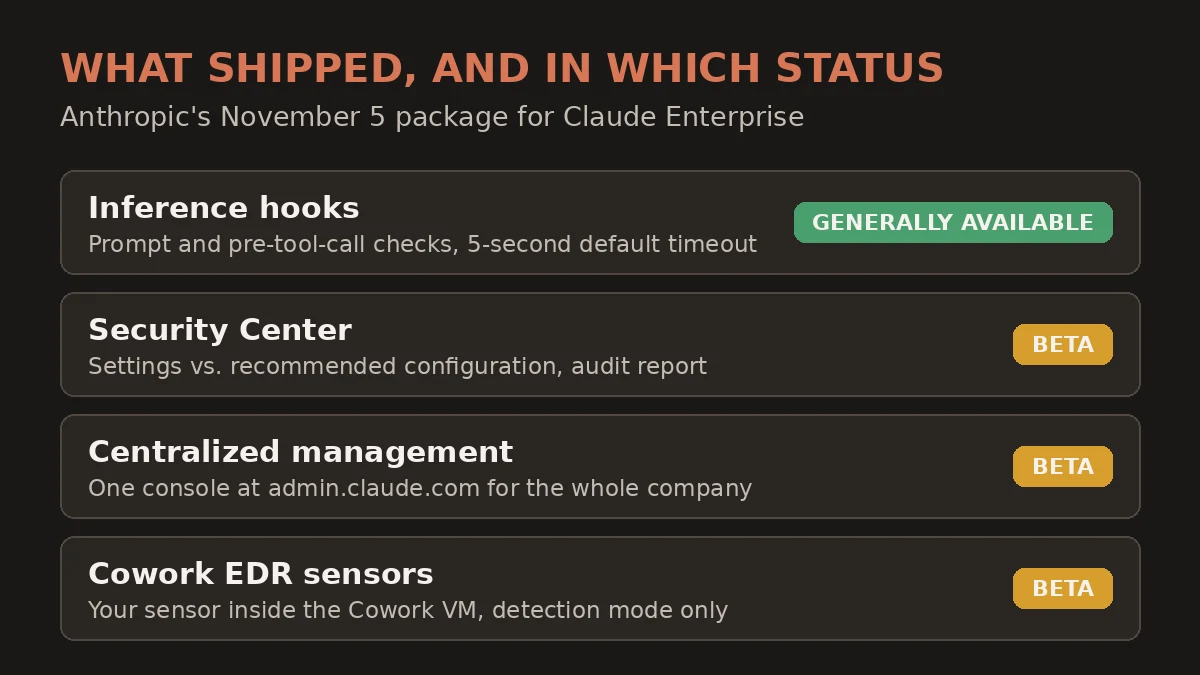
The announcement, published on Anthropic’s Claude website, covers five areas: the Security Center, inference hooks, centralized management, new access controls, and endpoint detection and response inside the Cowork virtual machine. Most of the new features are in beta, while the inference hooks are generally available for Enterprise organizations.
What Was Announced?
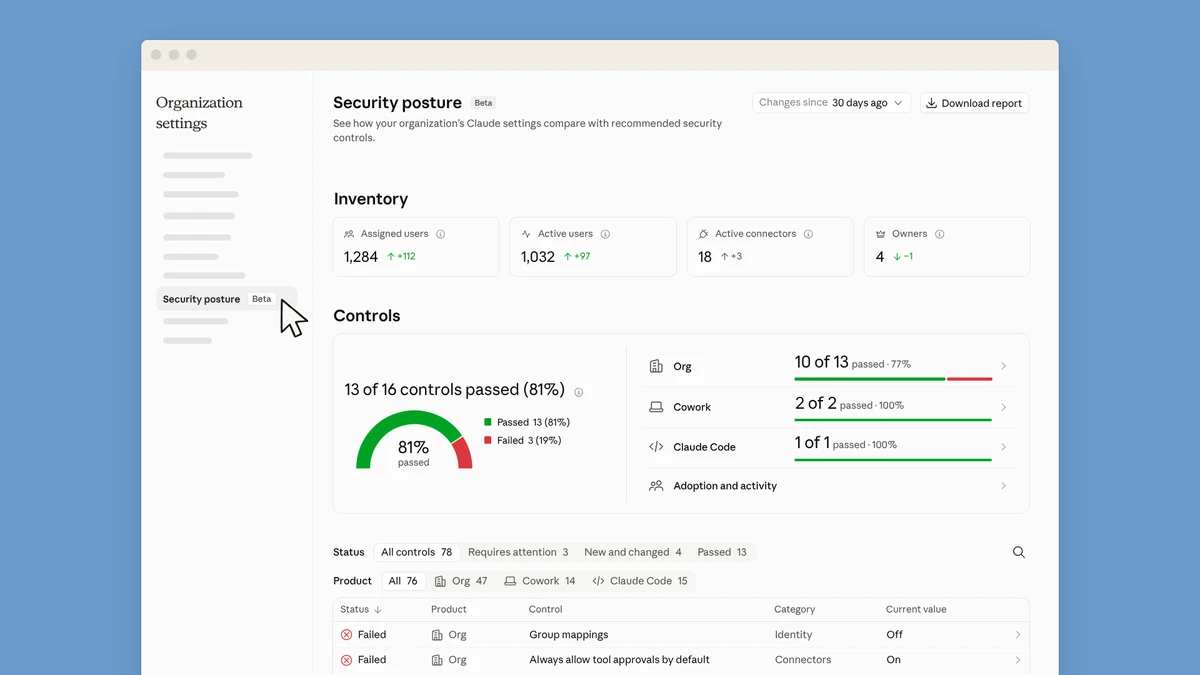
The Security Center is a new page in Organization settings that lines up an organization’s Claude settings for chat, Cowork, and Claude Code against Anthropic’s recommended configuration. For each control it shows the current value, the recommended value where one exists, and a link to the setting where the team can change it. It flags settings that are new or recently changed, and checks the configuration on each load, so results reflect current settings rather than a stale snapshot.
Organizations with the Compliance API can read the same results through that API. Attestations give admins a shared workspace to record each control’s state, accept risks, and flag issues in one place. The page can be downloaded as a report for auditors, marking which controls were checked automatically and which an owner confirmed.
Anthropic is careful about what the tool is not. The company describes the Security Center as “guidance based on Anthropic’s recommendations, not a certification or a guarantee of compliance with any law or standard.” Anthropic’s own screenshot shows an example organization with 13 of 16 controls passed (81%).
Inference Hooks: A Veto Before Claude Acts
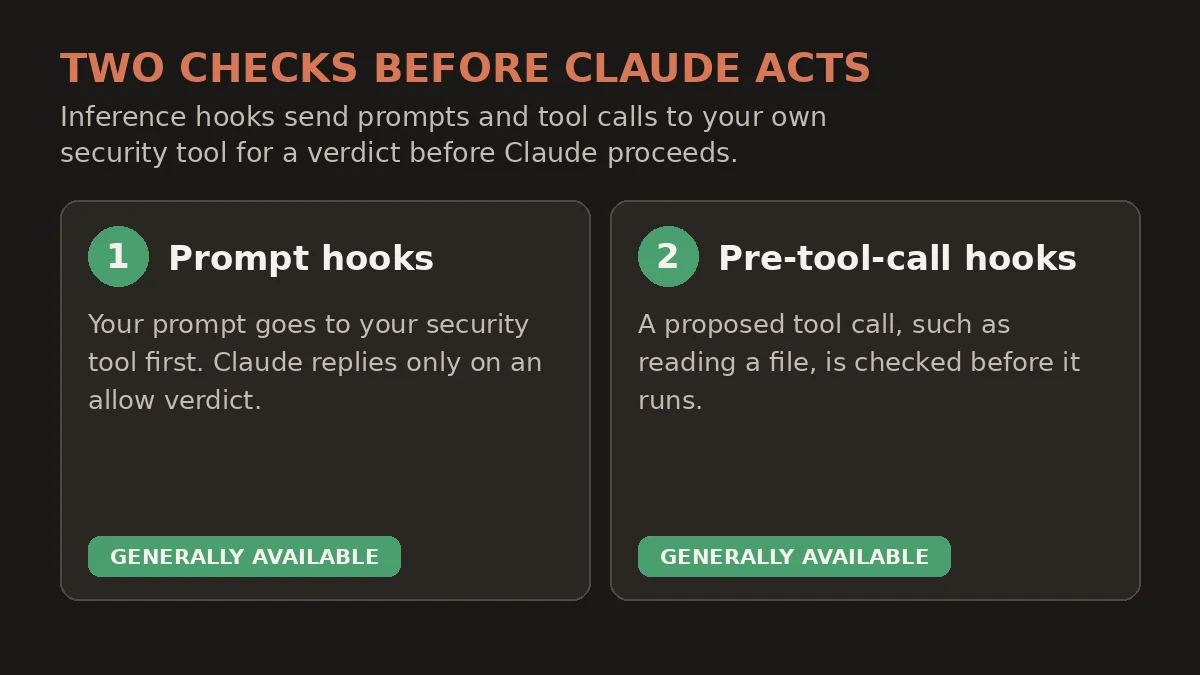
Inference hooks connect Claude to the data security tools an organization already uses, so its data loss prevention and security policies apply to prompts and tool calls as people work. There are two kinds of hooks, both now generally available.
Prompt hooks send a user’s prompt from a supported Claude product to the organization’s security tool for a check before Claude generates a reply. Pre-tool-call hooks inspect a proposed tool call, such as reading a file or querying a database, before it executes. If the security tool says no, Claude does not answer or run the tool.
The hooks work through signed HTTPS requests to the customer’s chosen security endpoint. Anthropic’s earlier announcement named Netskope, Palo Alto Networks, Proofpoint, and Zscaler as supported data loss prevention vendors, and organizations can also point the hooks at their own internal server. The hooks apply across claude.ai on web, desktop, and mobile, plus Cowork, Claude Code, Claude for Microsoft 365, Claude in Slack, and Claude in Chrome.
The checks come with limits that security teams should know about. Verdicts are binary, allow or block, with no rewriting and no partial redaction. The default timeout is 5 seconds, adjustable by the customer. The payload covers conversation text, tool calls, their results, and attachment text, but it excludes file and image bytes and system instructions, so image-only content bypasses inspection. Hooks are also not available for organizations that use Claude through Amazon Bedrock or Google Cloud, or for Claude Platform API organizations.
Centralized Management and Access Controls
Centralized management, also in beta, gives a parent organization, which represents a company across its Claude Enterprise and Claude Platform organizations, its own admin console at admin.claude.com. Admins manage company-wide settings there once, instead of from individual organization settings. Those settings include single sign-on, directory sync, domain verification, groups, and Compliance API keys.
The console shows every organization under the parent in one place and adds two roles. Parent owners can manage everything, including role assignments, while parent admins can manage everything except those assignments. Companies can also connect more than one identity provider, so an acquired company can keep its existing provider or move one domain at a time.
The access controls arriving in beta include the ability to sign a member out of Claude with a single Admin API call, ending their sign-in sessions on every browser and device without removing them from the organization. Enterprise admins can now also manage their IP allowlist themselves, set the most-used Claude Desktop settings without a device management push, and block personal and other outside Claude accounts in Claude Desktop on managed computers to help prevent shadow IT.
Finally, Anthropic added an endpoint detection and response integration for Cowork. When Cowork and the unified Claude app work locally, they run shell commands and code in an isolated virtual machine on the user’s computer. Admins can now run their organization’s EDR sensor inside that virtual machine, reporting activity to the security team’s existing console. The sensor runs in detection mode, reporting activity rather than blocking it, with Claude verifying the sensor package’s signature at each start. The integration is in beta on macOS and Windows, and it covers only the virtual machine on the user’s computer, not Cowork sessions in the cloud.
Why It Matters
Enterprise adoption of AI assistants has been held back by a simple worry: what data leaves the company when employees paste it into a chatbot, and what can an agent do with the tools it can reach? Anthropic’s answer is to push enforcement into the moment before Claude acts, rather than auditing it afterward. A prompt hook that can block a reply containing sensitive data, and a pre-tool-call hook that can stop a database query, give security teams a control point that fits the tools they already run.
The limits matter too. Image-only content escapes the hooks, cloud Cowork sessions escape the EDR sensor, and organizations on Bedrock or Google Cloud cannot use the hooks at all. For companies running Claude directly through Anthropic, though, the generally available hooks are the most production-ready piece of the package, while the beta features show where Anthropic is heading next.
Sources
- Anthropic, “More visibility and control over Claude Enterprise for security teams,” November 5, 2026
- DataStudios, “Claude Enterprise security center, EDR in Cowork and admin.claude.com parent console”
- AI Weekly, “Anthropic Ships Claude Security Center, Inference Hooks GA”
- Inxen, “Anthropic lets enterprises veto Claude responses before they are generated”