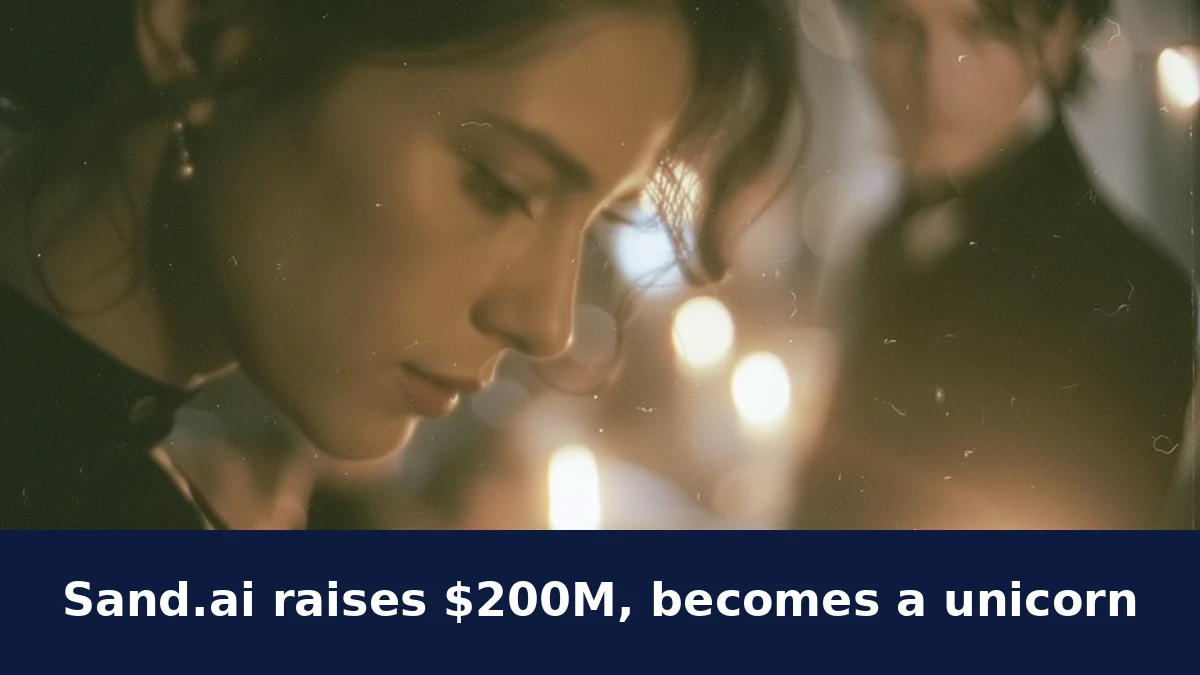
Beijing video AI startup Sand.ai has raised $200 million in a Series A+ round, becoming China’s newest AI unicorn less than three years after it was founded. The company announced the round on November 5, 2026, saying it takes its fundraising over the past 10 months to roughly $300 million across three rounds.
The Sand.ai Series A+ round was co-led by Cornerstone Capital and Wangsu Science and Technology, with Times Capital, Panlin Capital, Orient Securities Capital, Pudong Venture Capital and Shanghai Guofang among the new backers. Existing investors including Matrix Partners China and CAS Star added to their stakes. Sand.ai says the deal lifts its valuation above $1 billion, a figure the company supplied and that has not been independently verified.
Part of the round was visible before it closed. Wangsu, a Shenzhen-listed content delivery and edge computing company, disclosed in a September 29 stock exchange filing that it planned to invest RMB300 million, about $44.5 million, through a convertible note and warrants for roughly 4.4 percent of Sand.ai. The parties signed the agreements on October 16, according to an October 19 progress filing.
Sand.ai plans to use the money for video foundation model research, training and inference infrastructure, product development and international expansion, ahead of the full release of its next model, MAGI-2.
A contrarian bet on autoregressive video
Sand.ai was founded in January 2024 by Cao Yue, a former principal researcher at Microsoft Research Asia and a co-author of the Swin Transformer computer vision architecture. From the start, the company took a different technical road from most of its rivals.
Most well-known video models, from OpenAI’s Sora to many Chinese contenders, are built on diffusion, which starts from noise and refines a whole clip at once. Sand.ai’s first model, MAGI-1, released in April 2025, is autoregressive: it generates video chunk by chunk, each piece conditioned on what came before, much like a language model predicts the next word. According to 36Kr, MAGI-1 held the top spot on Google DeepMind’s Physics-IQ benchmark for a long stretch.

A frame from a video generated by Sand.ai’s MAGI model. Image: Sand.ai
The new money arrives just ahead of the full release of MAGI-2. A preview shipped on August 5, 2026: a 114-billion-parameter mixture-of-experts model that activates only around 6 billion parameters per token. Text, video and audio tokens share a single sequence, so picture and sound are generated together in one pass. The preview outputs 10-second clips with synchronized audio, upscaled to 1088 by 1920, and its weights, inference code and technical report are public.
The design is a business decision as much as a technical one. Cao told 36Kr that a dense model would cost three to five times more to run for the same result. Even so, the preview needs eight Nvidia Hopper GPUs for inference and a checkpoint set of about 307 GB, so it is not something hobbyists will run on a laptop.
Models paired with products
Sand.ai pairs its models with products. In January 2026 it launched VidMuse, a music-video agent, and 36Kr reported it reached annual recurring revenue in the tens of millions of dollars within three months. AI News Daily Asia reported VidMuse passed $10 million in annual recurring revenue two months after launch, with a Pro tier at $39 per month.
That revenue matters because the company is still burning cash. Wangsu’s investment disclosure put Sand.ai’s revenue at 17.4 million yuan in the first half of 2026, against a net loss of about 152 million yuan, unaudited, according to AI News Daily Asia’s reading of the filing.
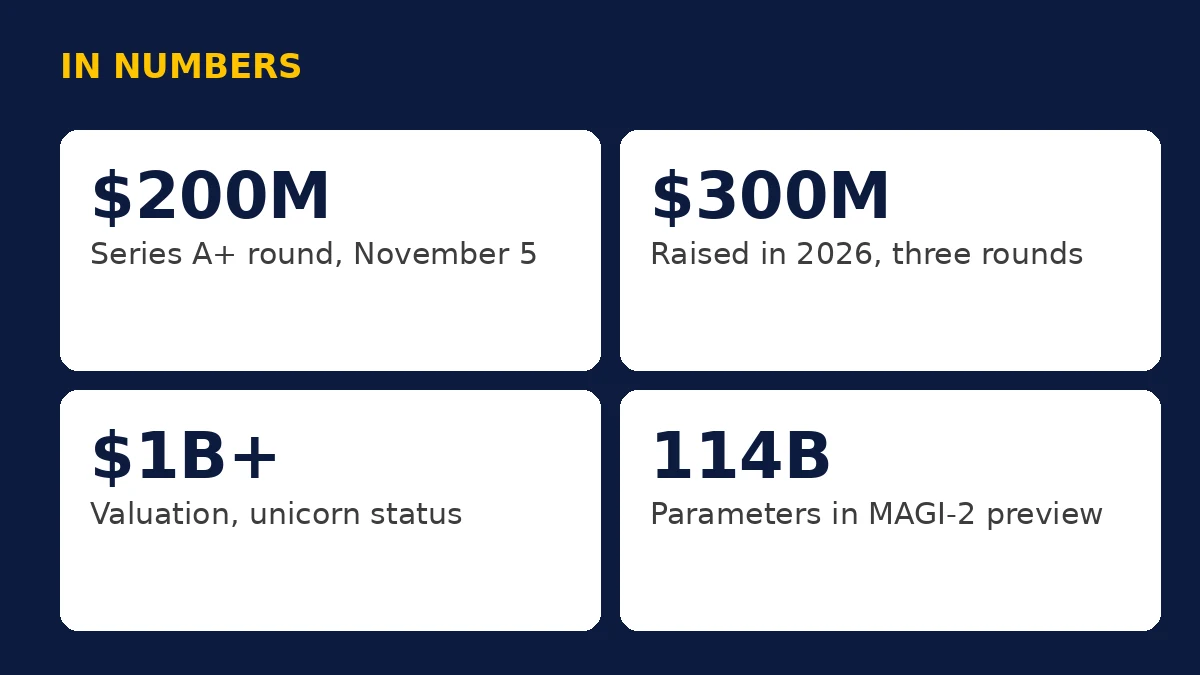
Sand.ai in numbers. Graphic: GPTOnline
Why it matters
Sand.ai’s round shows how crowded China’s video generation race has become. Google’s Veo, OpenAI’s Sora, ByteDance’s Seedance and Kuaishou’s Kling all have far bigger budgets and built-in distribution. Kuaishou’s Kling unit completed a financing of about RMB19.8 billion in October, according to AlphaMaven.
Against that scale, Sand.ai is betting that a different architecture plus open weights can win developer mindshare. Releasing MAGI-1 and the MAGI-2 preview openly follows the playbook that made Chinese labs such as DeepSeek and Qwen influential: publish strong open weights and let adoption build the brand.
Whether autoregressive video can match diffusion on pure visual polish at scale is still open. MAGI-1 won on physical plausibility, but consumers and advertisers usually pick tools on how good the output looks and how fast it renders. The full MAGI-2 release will be the real test, and this $200 million gives Sand.ai the runway to run it.