Anthropic has published a detailed account of how it gives Claude a memory that lasts between sessions, and the centerpiece is a process the company calls “dreaming.” In a research post published on November 6, “The components of agent memory,” the company describes offline passes in which Claude rereads its own logs, corrects notes that turned out to be wrong, and builds linked wiki pages.
This is research, not a product launch: no new model, API or pricing change. What Anthropic offers is a working theory of agent memory, tested on Claude Managed Agents and Claude Code. The numbers come from Anthropic’s own evaluations, not independent benchmarks.
Four layers of memory
Anthropic defines agent memory narrowly: knowledge Claude gains from experience that it retains between sessions, saved as context it can read later. That excludes weight changes, in-session learning and compaction.
The design splits memory into four layers: transcripts, the searchable event log of everything Claude did; memory notes, short lessons, rules and plans Claude writes for itself; memory representations, organized structures such as linked wikis; and injected context, a small layer preloaded into every new session, retrieved when needed.
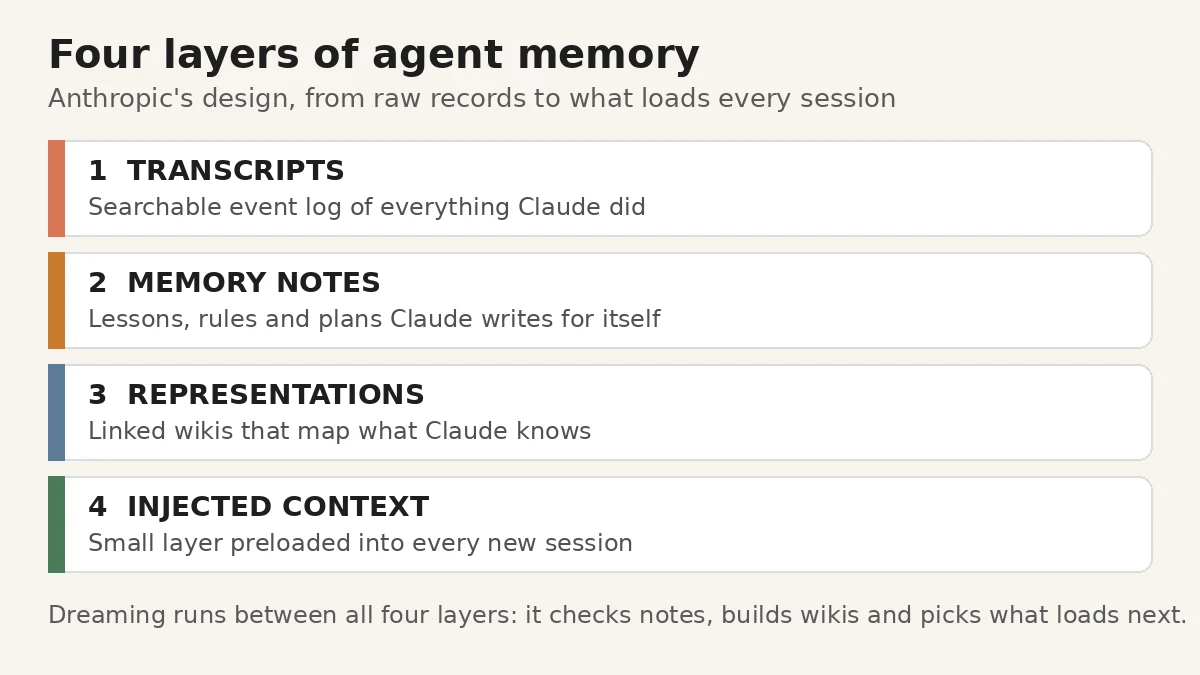
Dreaming runs between all four layers. The idea borrows from sleep-time compute, proposed by researchers at Letta and UC Berkeley as a way for models to use idle time between interactions to reorganize their existing context. The parallel is human sleep, where the hippocampus replays experiences into long-term knowledge. Dreaming is the agent version of that replay.
What dreaming does
First, dreaming can correct memory. Anthropic shows the failure with a run of Pokémon Red. Claude wrote down, incorrectly, that the PokéCenter was on the east side of Mt. Moon. Walking out of the building, it announced, “Mt Moon is behind me,” and updated its notes: “Mt Moon DONE.” Claude then dropped off a one-way ledge three times and gave up, writing, “I’m going to stop rather than keep looping,” before wandering back to Pewter City. A dreaming pass checked the note against the session transcript, caught the error and rewrote it. With the corrected note, Claude went straight back into Mt. Moon and reached Cerulean City.
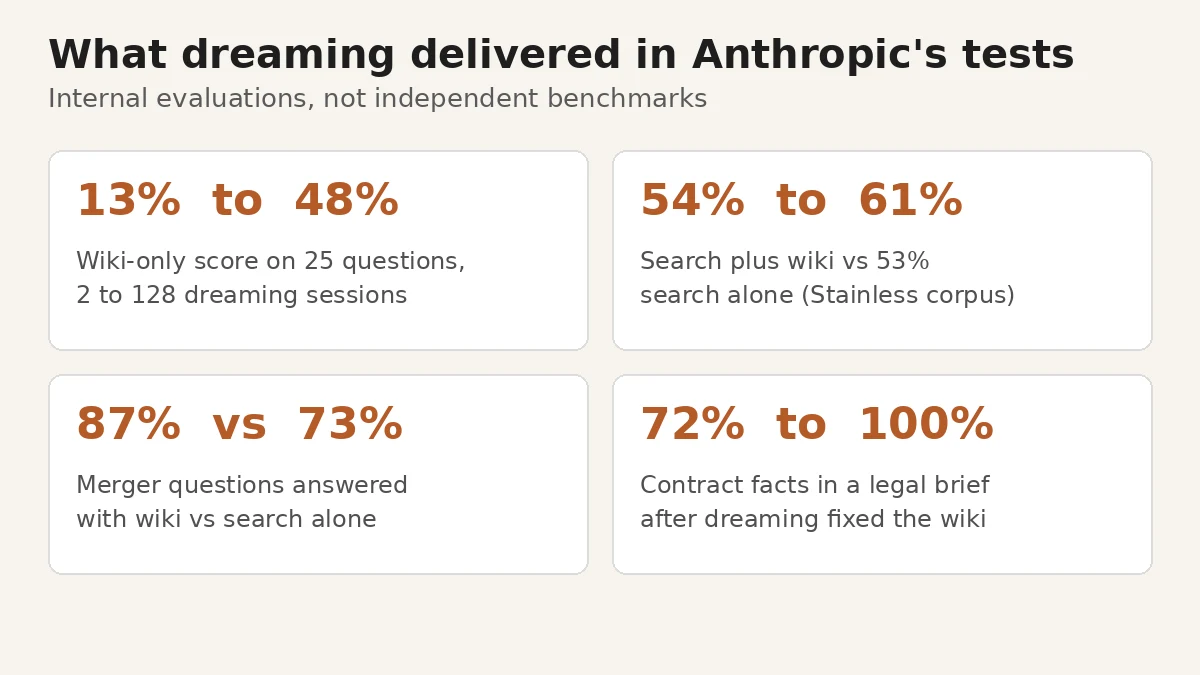
Second, dreaming builds new representations. Over 128 sessions, Opus 5 agents explored a corpus of about 350,000 internal files, roughly 420 million tokens, from Stainless, writing and correcting linked wiki pages, merging duplicates and checking claims against sources. Dreaming also promotes notes up the hierarchy and fills gaps in the wiki. In a legal benchmark, it focused memory on a specific goal: after Claude reflected on its failures and rebuilt a wiki, giving each contract its own page quoting the terms word for word, a brief that had covered only 41 of 57 facts (72 percent) met 100 percent of the criteria.
The results in numbers
On a task from Continual Learning Bench (CL-Bench) 1.0, Claude answered database questions in fresh sessions, with only a persistent memory directory carried over. Claude Opus 5 was the first model to close the loop, turning wrong answers into tested rules about how to answer in future, and Opus 5.5 and Sonnet 5.5 did the same. Older models struggled to close the loop.
The Pokémon test showed why selective memory beats indiscriminate storage. Sonnet 3.7 wrote 413 memory files across 225 folders and earned one badge, while Fable 5 wrote nine files in two folders plus a single global.md dashboard and earned four badges. Fable 5 stored only what the game did not already show on screen: strategy, plans and tested rules. After seven Poké Balls in a row failed to catch a Magikarp, it wrote, “If 3+ balls fail in a row, VARY the timing (insert extra ‘wait’ presses between menu steps), the catch landed right after doing this.” Opus 5.5 took a similar approach and beat the game.
Anthropic also reports a counterintuitive finding about steering: “We’ve found that it helps to tell Claude what memory is for, but not how to use it.” A rule to “record only failures” weakened Opus 5 and Opus 4.7. Prompting Sonnet 4.6 to read its memory and test its theories nearly doubled its score. Sonnet 5 does this on its own, reading its memory before answering 9 out of 10 times, versus less than half for Sonnet 4.6.
On the wiki tests, performance on 25 questions about the Stainless corpus grew from 13 percent to 48 percent of graded criteria as dreaming scaled from two sessions to 128. With both search and the wiki, the score rose from 54 percent to 61 percent, compared with 53 percent for search alone, while saving about 20,000 tokens per question. On merger questions, the wiki scored 87 percent against 73 percent for search alone. Limits remain: on one legal task the wiki showed no clear gain.
What this is not
The post describes research setups on Managed Agents and Claude Code’s auto memory, and it does not announce dreaming as a general product feature. Claude Code already loads only the first 200 lines or 25 KB of a MEMORY.md file. Open questions remain: when to create memory and how to keep it current, since dreaming costs compute. A wrong note promoted to the top layer can be carried into every session.
Why it matters
Memory is becoming the difference between a chatbot and an agent that can work a job over days. Agents face the bind Anthropic frames with Kierkegaard: life can only be understood backward, but it must be lived forward. An agent has to decide what is worth remembering before it knows what comes next, and a wrong guess can compound across sessions. Anthropic’s answer is to treat memory as a prediction and to let an offline pass check the prediction against the record. The lesson: give the model a small, well-chosen memory, tell it what memory is for, and let it judge salience itself. Whether dreaming becomes standard will depend on cost and cadence.