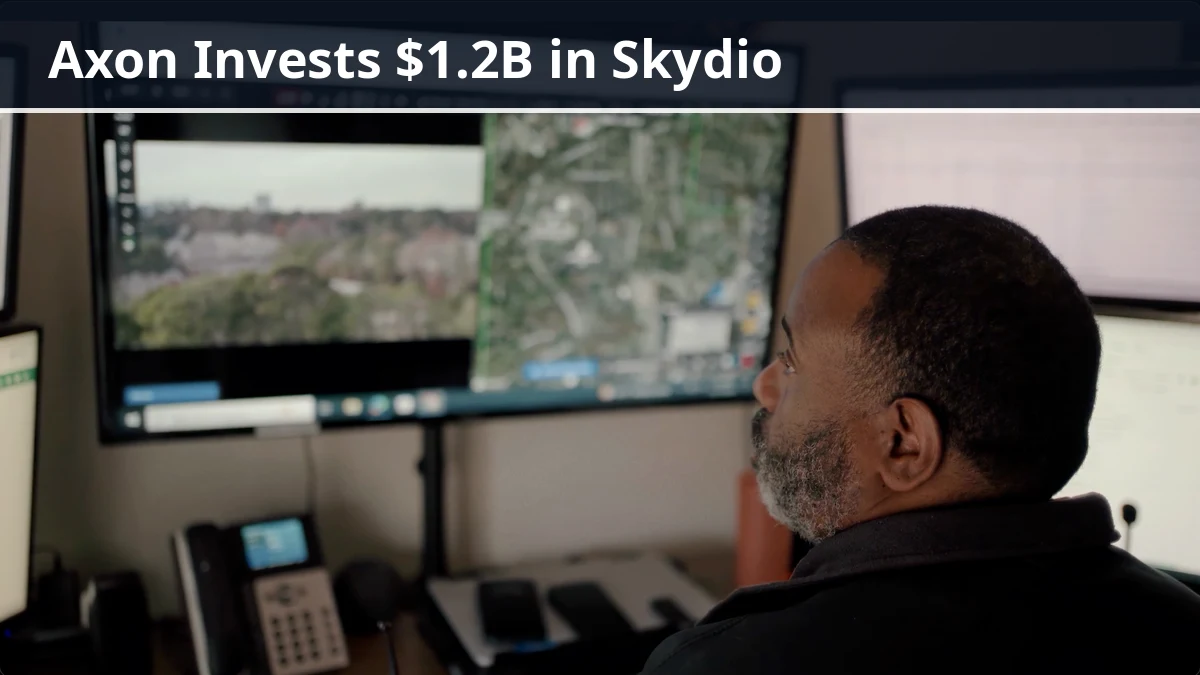
Axon is making the largest bet in its history on police drones. The public safety technology company announced on November 5 an additional $1.2 billion investment in Skydio, the largest US-based drone manufacturer, lifting its fully diluted stake from about 15% to about 37% at a $5.2 billion pre-money valuation. The deal also makes Axon the exclusive distributor of Skydio drones to public safety agencies in the United States and Canada.
Skydio’s autonomous drones anchor Axon’s Drone as First Responder (DFR) program, in which aircraft launch to 911 calls and often arrive before officers on the ground. Axon estimates the total addressable market for DFR at approximately $13 billion in the US and Canada alone, and Skydio expects about $1 billion in total bookings in its current fiscal year.
“Within a decade, millions of drones will be working across America. Skydio is positioned to lead in every sector they touch,” said Rick Smith, founder and CEO of Axon, in the announcement. “Axon is taking a major stake in one of the most valuable categories in tech, and Skydio stays free to move fast. With exclusive channel rights, Axon will widen its lead in public safety drones as Skydio builds the future of American aerial robotics.”
What Was Announced?
Axon’s investment consists of approximately $1.2 billion in a mix of cash and Axon stock, subject to final transaction terms. It combines new primary capital for Skydio with purchases of shares from existing Skydio shareholders. According to Axon’s filing with the Securities and Exchange Commission, about 60% of the package, roughly $720 million, is cash. The one tranche that closed on announcement day was a $254.9 million purchase of 25 million new non-voting Series G preferred shares at $10.19617 each. The remaining transactions are expected to close in the fourth quarter of 2026 and the first quarter of 2027, subject to customary closing conditions.
Axon pre-funded the purchase by pricing $1.15 billion of zero-coupon convertible notes due 2031 in September. The deal follows Skydio’s $110 million Series F six months earlier, which valued the company at $4.4 billion post-money, so the new $5.2 billion pre-money valuation is about 18% higher.
“Axon has been an incredible partner in bringing our drones to public safety customers across the U.S.,” said Adam Bry, CEO of Skydio. “We’re excited to deepen that partnership with Axon becoming our exclusive channel for U.S. and Canadian public safety. This investment strengthens our ability to accelerate our technology roadmap, scale our impact in public safety and continue advancing autonomous flight across every critical industry we serve.”
What Drone as First Responder Means
In a DFR deployment, a docked drone launches automatically when a call comes in, flies to the scene and streams live video to responders before officers arrive. Skydio serves more than 1,500 public safety customers, and more than 28 million Americans now live within two miles of a Skydio DFR dock. At agencies deploying the system, priority response times have been reduced by as much as 65%, with drones arriving before officers on roughly 80% of the calls where they are deployed.
Axon says that earlier visibility can support safer responses, help de-escalate potentially deadly situations, locate missing children and other vulnerable people, and improve outcomes when every second matters. The exclusivity is a central part of the deal for Axon: all Skydio public safety sales in the US and Canada now run through Axon alone, and Axon books the drone revenue on a net basis in its Software and Services line. Axon president Josh Isner called the exclusivity one of the deal’s most valuable pieces.
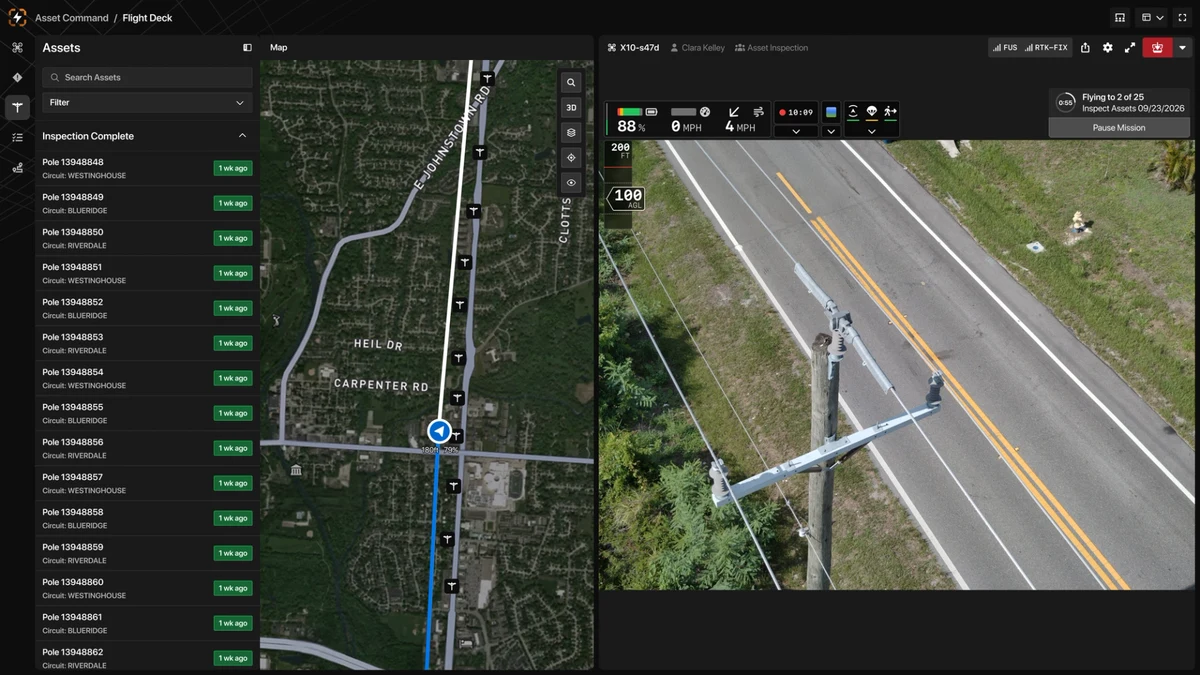
Skydio’s Flight Deck software, used to manage drone inspections. Image: Skydio
A Partnership Years in the Making
The two companies have worked together since 2021, when Axon began selling Skydio drones through its Axon Air program, and added the docked DFR package in June 2024. Skydio, founded in 2014 and based in San Mateo, California, builds AI-backed autonomous drones used by more than 4,000 agencies and organizations across the US in public safety and critical infrastructure, every branch of the US military and the armed forces of 32 allied nations. Axon bought counter-drone company Dedrone in 2024 and now sells the two drone businesses as a pair, Dedrone for airspace security and Skydio to respond.
The announcement came alongside Axon’s third-quarter results, which showed record revenue of $909 million, up 28% year over year. The same shareholder letter, however, cut roughly $130 million of 2026 revenue from three federal Dedrone deployments, $30 million that slipped out of the third quarter and $100 million out of the fourth, a reminder that the drone business still carries execution risk even as the Skydio bet grows.
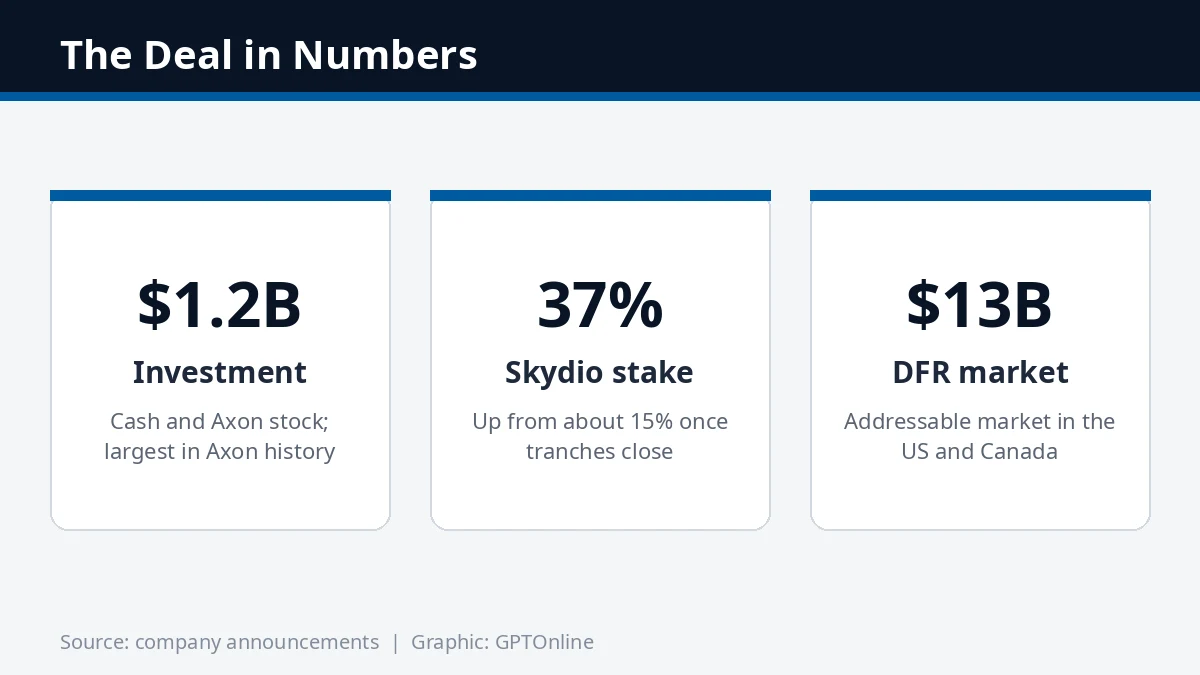
Source: company announcements | Graphic: GPTOnline
Why It Matters
The deal is a bet that drones become standard first-response equipment, not a niche tool. A $1.2 billion commitment from the company that already supplies body cameras and Tasers to most American police departments signals that Axon expects DFR to follow the same path: from pilot programs to default infrastructure, with the vendor that controls the channel capturing the margin.
It also consolidates the US drone market at a moment of policy pressure. Chinese-made drones face growing restrictions in the United States, and Skydio, as the largest domestic manufacturer, is positioned to benefit. By locking up exclusive distribution, Axon ties its own growth to Skydio’s, while Skydio gets a sales channel that reaches nearly every police department in the country. Whether the bet pays off will turn on how fast agencies adopt DFR, and on whether the technology keeps its promise of faster, safer responses in daily use.