Democrats are preparing a flood of legislation targeting artificial intelligence systems and data-center development when they take control of Congress in January 2027, lawmakers, congressional aides and advocates told Reuters. The plans would mark a sharp break from the Republican-led Congress, which focused on promoting AI development and declined to pass restrictions, even as voters turned against the rapid buildout of data centers and their power demands.
The agenda covers three fronts: shielding consumers from rising electricity costs tied to data centers, requiring independent testing of advanced AI systems, and clarifying when AI companies can be held liable for harm caused by their products.
Three Fronts of the Planned Bills
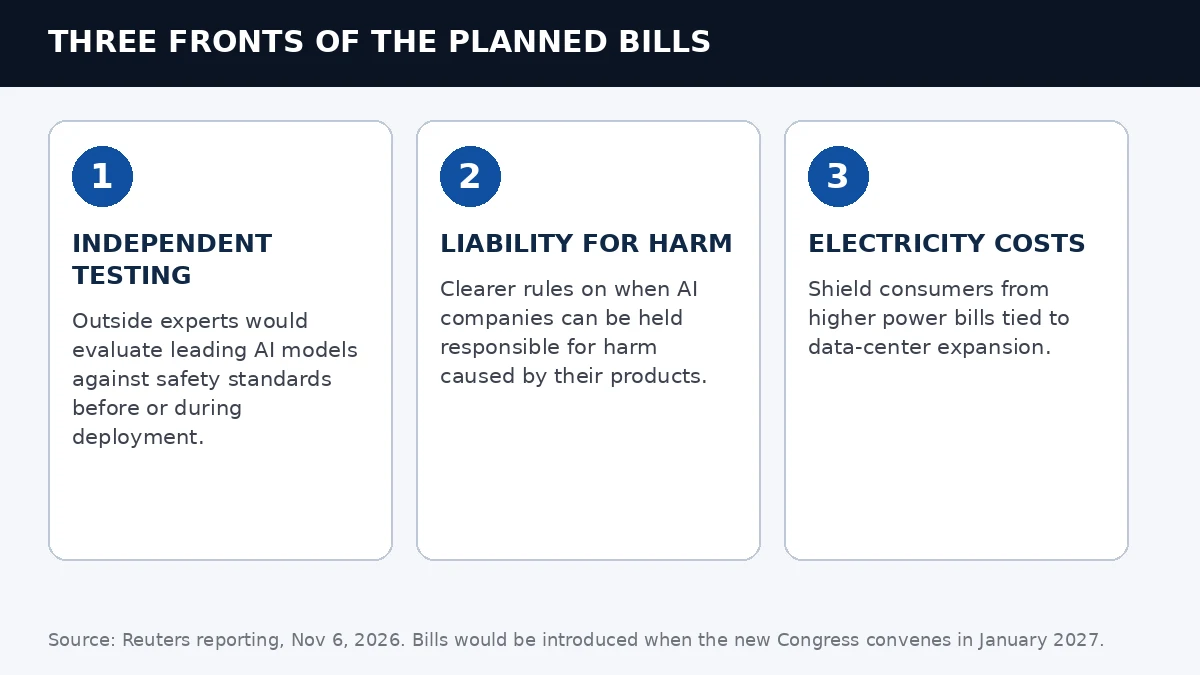
Independent testing. Representative Lori Trahan of Massachusetts, one of the Democratic Party’s leading voices on AI policy, plans to push legislation requiring independent experts to evaluate leading AI models against safety standards, her deputy chief of staff Francis Grubar told Reuters. Trahan also plans a liability bill clarifying when companies can be held responsible for harmful actions by their AI systems.
Liability for harm. According to a November 5 legal analysis by Foley and Lardner, Trahan’s CLAIM Act discussion draft would create a federal right to sue developers over AI conduct that would be unlawful if a person committed it. Senator Maria Cantwell’s six-principle framework, meanwhile, calls for enforceable standards developed by the National Institute of Standards and Technology, independent audits before release, and mandatory incident reporting.
Electricity costs. Senator Chuck Schumer, expected to become majority leader, said at a Washington event on November 5 that protecting consumers from higher energy costs linked to the rapid expansion of data centers would be among his priorities next year.
The Lawmakers Driving the Push
Representative Zoe Lofgren, a Democrat from California who is seeking to chair the House Science Committee, said Democrats would focus on developing “responsible regulations for AI while also fostering innovation.” Representative Greg Casar, a Texas Democrat and chair of the Congressional Progressive Caucus, said this week that AI executives should be called to testify under oath.
Abdul El-Sayed, a newly elected Democratic senator from Michigan, has advocated creating an independent federal agency with authority to oversee AI developers and enforce regulations.
The Obstacles
Any legislation would face steep odds while Republican President Donald Trump remains in the White House, as he has repeatedly dismissed calls to write mandatory rules for AI technology. Overriding a presidential veto requires two-thirds support in both chambers.
The politics, though, may be moving in the bills’ favor. A Reuters-Ipsos poll published in October found that most US voters believe the Trump administration and Congress are not taking AI risks seriously enough and support stronger government oversight. Data-center projects have also drawn protests in communities facing higher power bills and strained grids, as GPTOnline reported from Amsterdam.
Why It Matters
The coming Congress will test whether voter frustration with AI’s costs can be turned into law. For two years, Washington’s AI debate has been dominated by a race to build faster, with safety rules treated as a brake on American competitiveness. The Democratic agenda flips that logic: independent testing before deployment, liability when systems cause harm, and protection for households paying for the data centers’ electricity.
None of the bills has been introduced yet, and the details will decide how far they go. But the direction is clear. When the new Congress convenes in January, AI regulation will be on the agenda in a way it has not been since the current administration took office.
Sources
- Reuters, via Dunya News: Democrats planning flood of AI bills when they take control of Congress (November 6, 2026)
- NDTV Profit: US Democrats Plan Wave Of AI Bills As They Prepare To Take Control Of Congress (November 6, 2026)
- Superpower Daily: Democrats outline AI safety and liability bills for their coming congressional majority
- Pivot News: Democrats line up AI and data-center bills for January (November 7, 2026)