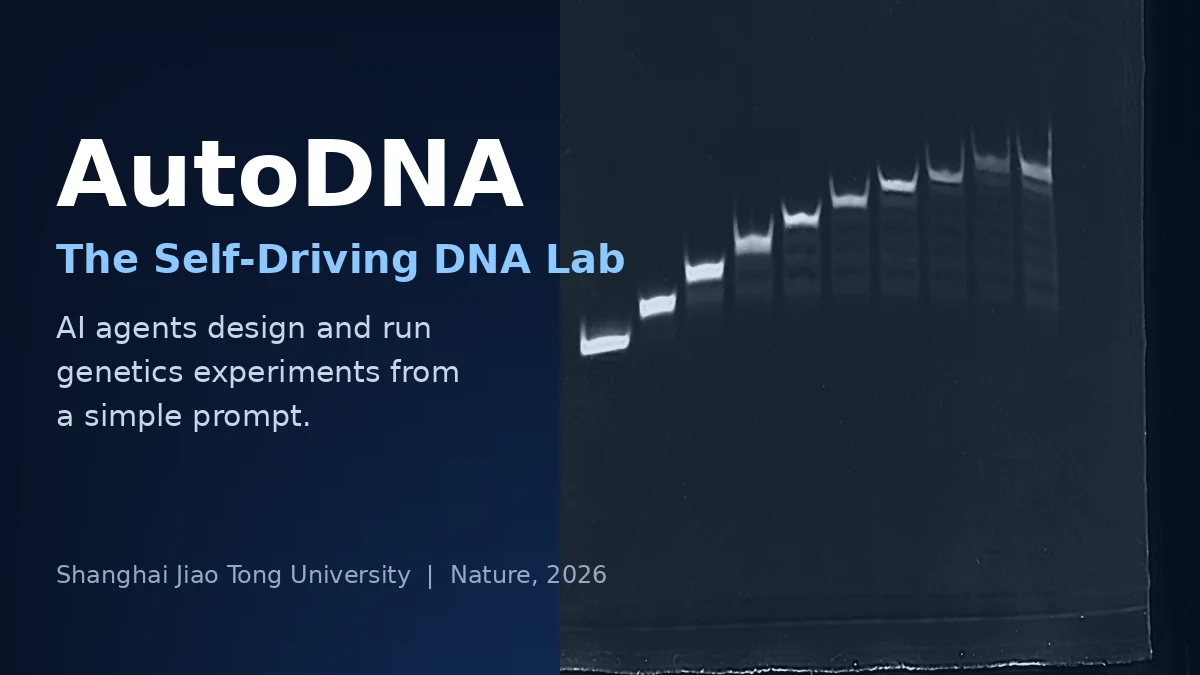
A genetics laboratory at Shanghai Jiao Tong University now designs and runs its own experiments. The system, called AutoDNA, takes a plain-language request from a human operator, plans the experiment, drives robotic arms across more than 20 types of instrument, troubleshoots failures, and reads out the results, all with minimal human input. The work is described in a paper published in Nature this week, with an accompanying news report from the journal.
AutoDNA is one of the most ambitious entries yet in the race toward “self-driving” laboratories, where AI does not just analyze data but physically does science. Human hands are now needed only to refresh reagents and service hardware.
What Was Announced
Researchers led by computer scientist Haibo Chen built AutoDNA as an AI-native lab from the ground up, rather than bolting AI onto existing automation. A team of specialized AI agents, including planner, literature, protocol, reagent, code, hardware and hypothesis agents, receives a natural-language goal, breaks it into executable steps, writes instrument code, monitors execution, and revises procedures when results drift off target.
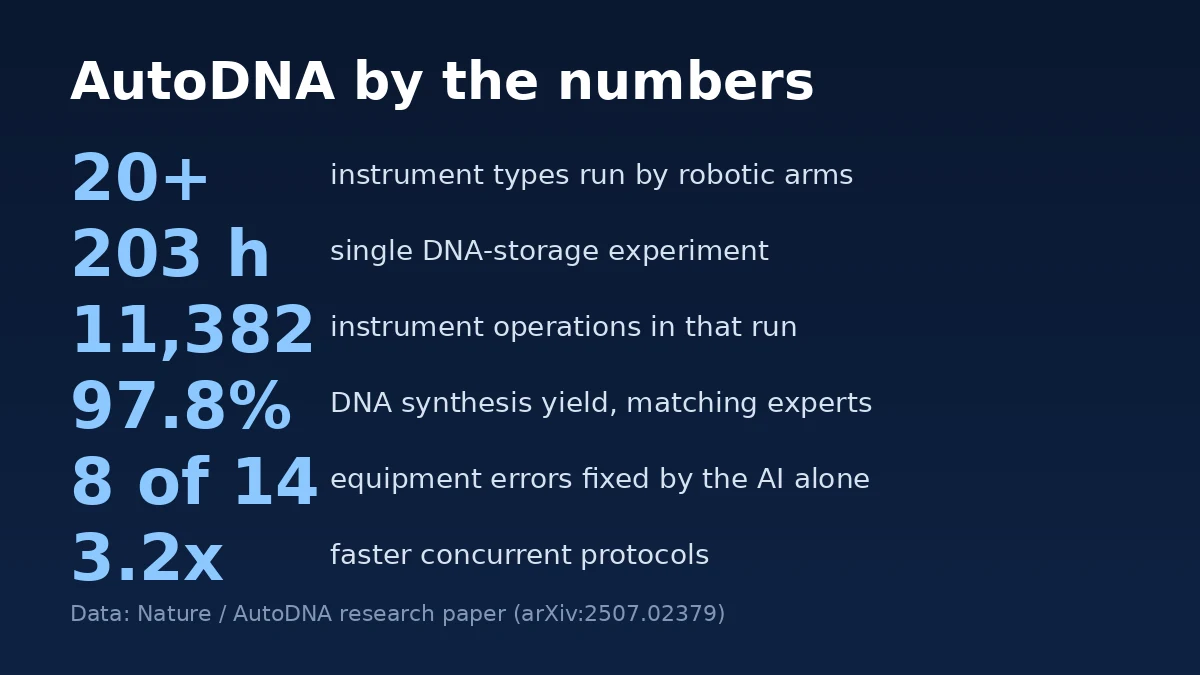
The facility moves samples by robotic arm and can complete thousands of operations in a single project, spanning DNA synthesis, transcription, amplification, sequencing and mutation detection. In multi-user tests it also handled concurrent requests, speeding up parallel protocols 3.2-fold and improving instrument utilization.
The Tests: DNA Storage, Cancer Mutation, Synthesis
To prove the system, the team ran four representative applications. In a DNA data-storage demonstration, AutoDNA took a plain-English request, designed an encoding scheme, synthesized 78 DNA oligonucleotides encoding the sentence “Intelligence is the ability to adapt to change” (Nature notes the line is often misattributed to Stephen Hawking), managed physical storage, amplified and nanopore-sequenced the molecules, then decoded the reads to recover the message exactly. The run involved 11,382 instrument operations over roughly 203 hours.
In a diagnostic-style workflow, the system started from a pre-processed colorectal-cancer sample, designed and synthesized its own primers, and correctly detected and validated the clinically observed KRAS G13D point mutation. In enzymatic de-novo DNA synthesis, the agents iteratively adjusted reaction times, reagent concentrations and wash steps until stepwise yields reached 97.8%, matching previously published expert-optimized results, with no human intervention.
The system also showed it can handle real-world messiness. In one run, 14 equipment errors occurred; the AI resolved 8 of them on its own, with humans stepping in for the remaining 6.
Why It Matters
Designing autonomous labs for molecular biology is hard because workflows are complex and demand high precision, Chen told Nature. “In many existing systems, human experts are still required to configure the instruments,” he said. “AI is mostly added to handle just one part of the process.” AutoDNA’s answer is co-design: the models, the experiments and the instruments were built to evolve together, which the authors say establishes a blueprint for “science-as-a-service” that could lower the expert and resource barriers to advanced biomaterials research.
Outside experts are impressed by the degree of autonomy and the ease with which the system absorbs diverse equipment. “The future of science is going to involve a lot of autonomous labs,” said Milad Abolhasani, a chemical engineer at North Carolina State University.
What It Does Not Show
The results come with clear limits. People must still replenish reagents and swap labware, so the lab cannot run indefinitely unattended. The DNA-storage run was a controlled demonstration, not evidence that DNA is ready for large-scale archival use. And detecting a previously characterized KRAS mutation validates the system; it is not a new clinical assay. The authors position AutoDNA as a platform for complex, multi-objective experiments, not a replacement for scientists.
Sources
- AI agents run this automated biology lab that sequences DNA and more, Nature News, November 4, 2026
- An AI-native experimental laboratory for autonomous biomolecular operations, Nature, 2026 (Wu M, Wang Z, Wang J, et al.)
- An AI-native experimental laboratory for autonomous biomolecular engineering, arXiv:2507.02379 (preprint)