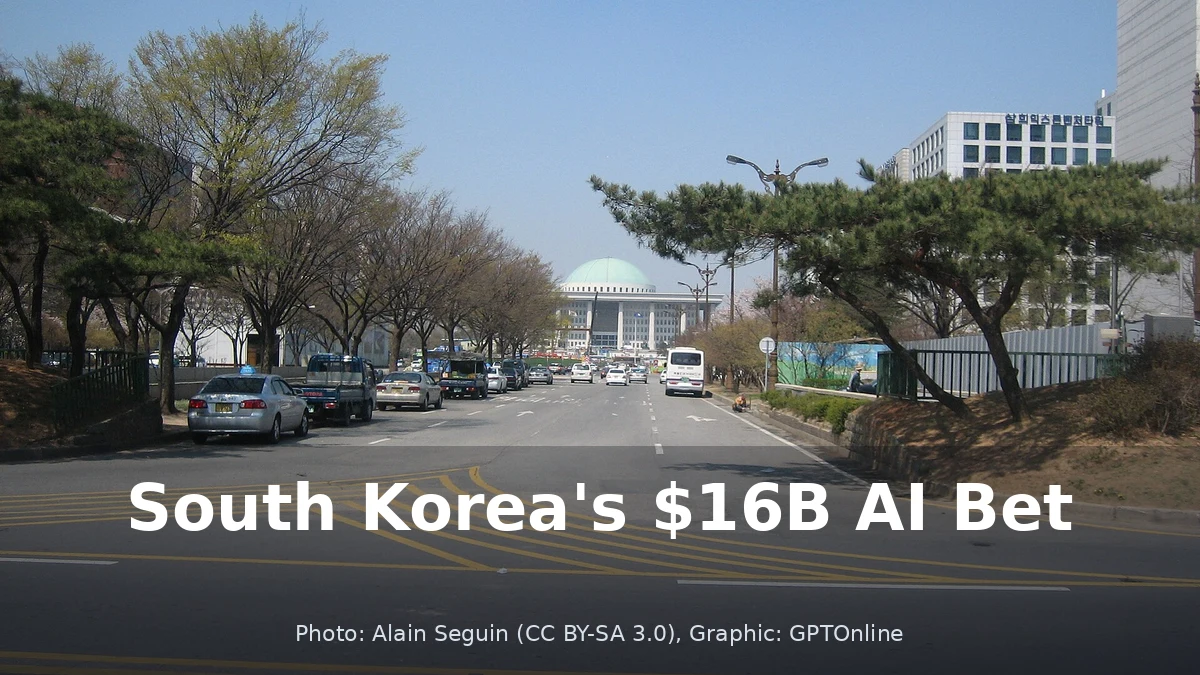
South Korean President Lee Jae Myung pledged on Monday to nearly double the country’s artificial intelligence spending, proposing a record national budget that puts AI at the center of Seoul’s economic growth strategy.
Addressing the National Assembly to seek approval for the 2027 budget, Lee said the government “will invest 21.3 trillion won (US$15.97 billion), nearly twice this year’s amount, in AI and the three megaprojects of semiconductors, physical AI and AI data centres,” according to Reuters.
What Was Announced?
The headline figure sits inside the proposed South Korea AI budget for 2027: a total national budget of 820.9 trillion won (about $615.62 billion), a record 12.8 percent increase over this year that Lee’s administration first proposed in September, Reuters reported.
The AI allocation of 21.3 trillion won covers three national megaprojects: semiconductors, physical AI, and AI data centers. It is nearly double this year’s AI outlay of 10.8 trillion won, a jump of roughly 97 percent.
The full text of the speech, published by Sisa Journal and cited by AIStockWire, details where the money goes:
- 4.7 trillion won ($3.5 billion) for frontier AI model development, with the stated goal of building Korean models that match the world’s best;
- 2 trillion won ($1.5 billion) for chip production, including early fab start-ups in the Seoul area and a chip cluster in the southwest, plus a new dedicated special account to give the chip industry steady funding;
- 2.1 trillion won for power, water and industrial park infrastructure supporting the buildout;
- 500 billion won ($373 million) for physical AI field trials across eight sectors, including manufacturing, smart factories and defense.
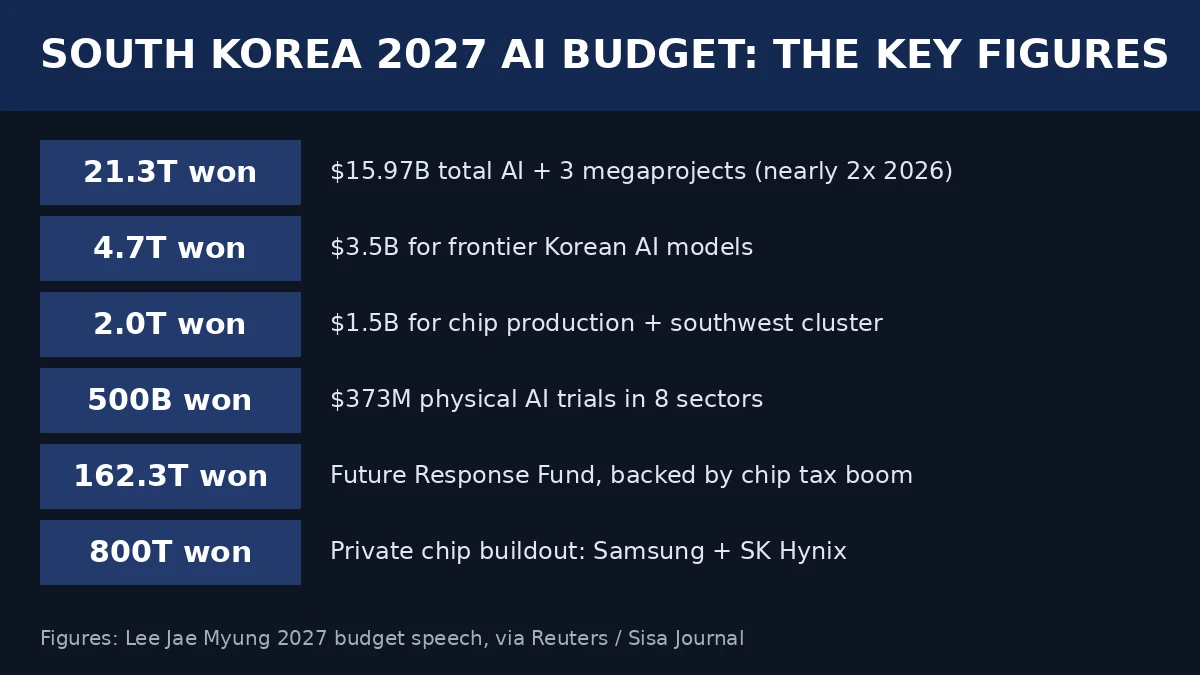
The key figures in South Korea’s 2027 AI budget proposal. Figures: Lee Jae Myung 2027 budget speech, via Reuters / Sisa Journal
The science ministry’s narrower research plan puts AI R&D at 4.1 trillion won, up 69.1 percent, Dong-A Science reported. That figure measures research spending only, so it is a subset of the 21.3 trillion won Lee cited.
Semiconductors Fund the Ambition
Korea’s AI push is being financed, at least in part, by the AI boom itself. The budget includes a 162.3 trillion won Future Response Fund, financed largely by additional tax revenue from the semiconductor boom, to support growth industries, young people, regional development and education while buffering future revenue shortfalls.
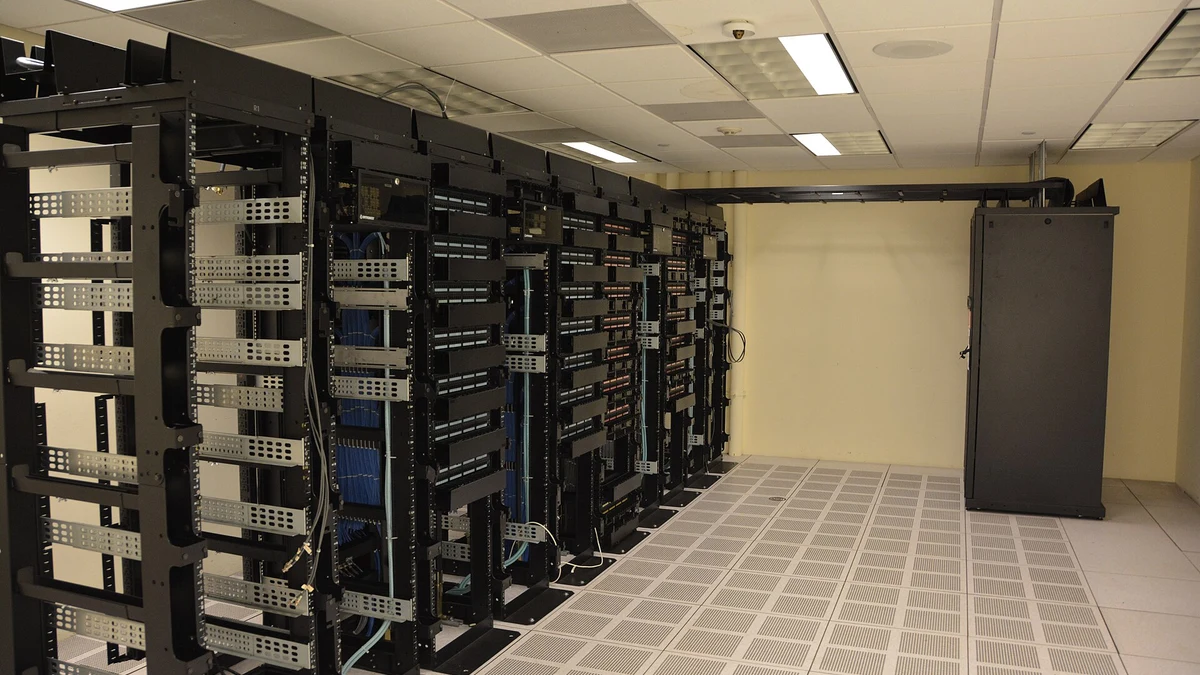
AI data centers are one of the three national megaprojects backed by the 21.3 trillion won budget. Photo: Carl Lender (CC BY 2.0)
Citi economist Kim Jin-wook said in a report Monday that the cumulative funding source for the fund could reach KRW 215 trillion for 2026 to 2027, and that the strategy may support the case for an upgraded credit rating.
The public money runs alongside a private-sector buildout: Lee is pursuing an 800 trillion won semiconductor manufacturing program in the country’s southwest, led by Samsung Electronics and SK Hynix. Both memory giants have seen earnings surge on demand for the advanced chips that power AI data centers.
On fiscal discipline, Lee said next year’s deficit would narrow to 0.1 percent of GDP, the lowest in two decades, from 3.9 percent this year, with the debt-to-GDP ratio falling to 48.3 percent from 51.6 percent.
Why It Matters
South Korea is one of the world’s leading producers of the memory chips that sit inside nearly every AI data center, so a budget that channels semiconductor tax windfalls back into AI infrastructure is a deliberate flywheel. The emphasis on “physical AI”, that is, AI operating in the real world through robots and machines rather than software on a screen, signals where Seoul expects the next wave of economic value to come from.
The announcement also lands in a year of escalating national AI spending races, from Saudi Arabia’s HUMAIN buildout to major sovereign AI funds in the UK and elsewhere. For GPTOnline readers tracking where state capital is flowing, Korea’s near-doubling of its AI line item in a single budget cycle is one of the clearest signals yet that governments are treating AI capacity as core economic infrastructure.
One caveat: the budget still needs National Assembly approval before any of the 21.3 trillion won can be spent.
Sources
- Reuters, via Channel NewsAsia: South Korea’s president vows to make bold AI investment in record budget push
- Reuters, via The Business Times: South Korea’s Lee vows to make bold AI investment in record budget push
- AIStockWire: Korea’s 2027 AI budget: 21.3 trillion won, nearly double (breakdown citing the full speech text published by Sisa Journal)
- Crypto Briefing: Lee Jae Myung proposes record 2027 budget with $15.97 billion for AI