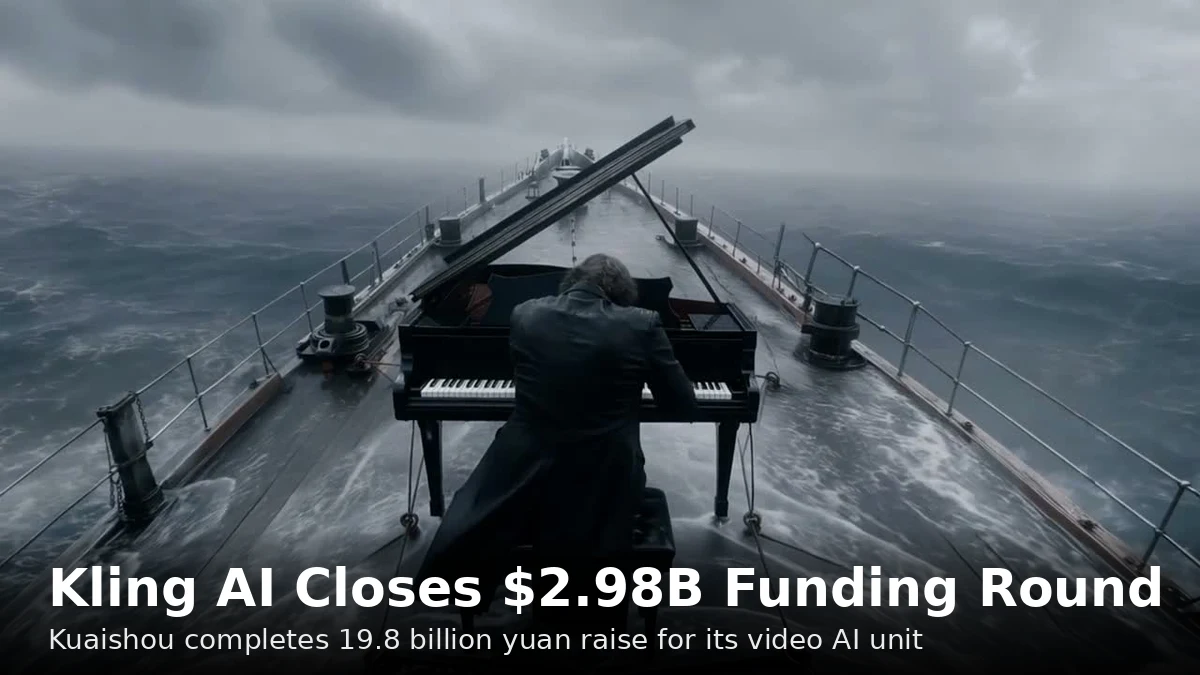
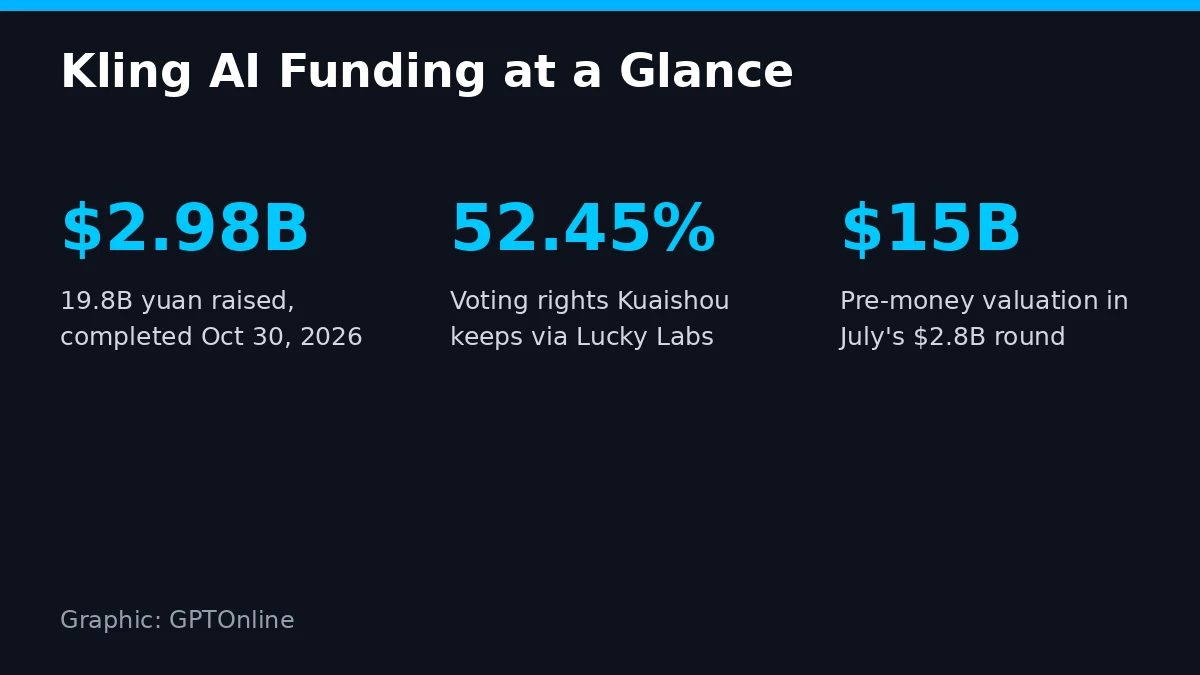
Kuaishou Technology has completed a 19.8 billion yuan ($2.98 billion) fundraise for its Beijing Kling AI video unit, the company said on Friday, Reuters reported. The Tencent-backed short-video operator will keep about two-thirds of the equity and 52.45% of the voting rights in the Kling AI maker through its Lucky Labs holding vehicle.
The round caps a year of heavy capital formation in AI video generation. In July, Kuaishou raised $2.8 billion for Kling from investors including Alibaba and Tencent at a $15 billion pre-money valuation, a round Caixin described at the time as the largest ever completed by a developer of AI video models. Friday’s completion brings the two-round total close to $5.8 billion.
New backers and deal terms
Among the new investors in the latest round: a unit of Hong Kong-listed Kingdee International invested 300 million yuan, Gongqingcheng Junke put in 200 million yuan, and a unit of Shanghai-listed MetaX added 100 million yuan, according to CNA. The new backers partly assumed commitments from other investors and received redemption rights.
Filing details reported by EconoTimes show investors paid RMB19,801.84 million (about US$2,905.33 million), just below the RMB20,447.10 million ($3 billion) subscription cap set in July. Commitments of RMB100 million from Dakang Lanwu and US$80 million from BFI MIDCO were canceled after they missed payment deadlines. The redemption rights let investors require Beijing Kling to repurchase their interests within 12 months after specified triggers, including a missed IPO deadline; the agreement identifies October 30, 2031, or an earlier contractual date, as that trigger.

IPO plans and a fast-growing business
The fundraise lands as Kling moves toward public markets. AI Affairs noted that Kling had earlier selected banks for a potential Hong Kong listing seeking at least $1 billion, and Bloomberg News reported this month that Kling is planning an IPO next year.
The business case behind the capital is scale. The company’s filing says Kling AI generated more than RMB850 million in revenue in the second quarter of 2026, an increase of more than 200% from a year earlier. The July agreement forecast the funding would support expansion, operating needs, working capital and team development, though Kuaishou did not say how Friday’s proceeds would be allocated.
Why it matters
Kling competes directly with AI video generation models from OpenAI, Google and TikTok owner ByteDance, Reuters notes. The combined $5.8 billion across two rounds gives the unit one of the deepest war chests in the segment, funding the compute and talent needed to keep pace in a race where model quality and generation speed are the battlegrounds. The redemption rights, however, add pressure: if the planned IPO slips, investors can force a buyback. For now, Kuaishou has raised the cash while keeping firm control of one of China’s most valuable AI video assets.
Sources
- Reuters: Kuaishou’s Kling AI unit completes a near $3 billion funding round
- CNA: Kuaishou’s Kling AI unit completes a near $3 billion funding round
- AI Affairs: Kuaishou’s Kling AI unit completes funding round of about $2.98 billion
- EconoTimes: Kuaishou completes $2.91 billion financing for Kling AI unit
- Kling AI official website