
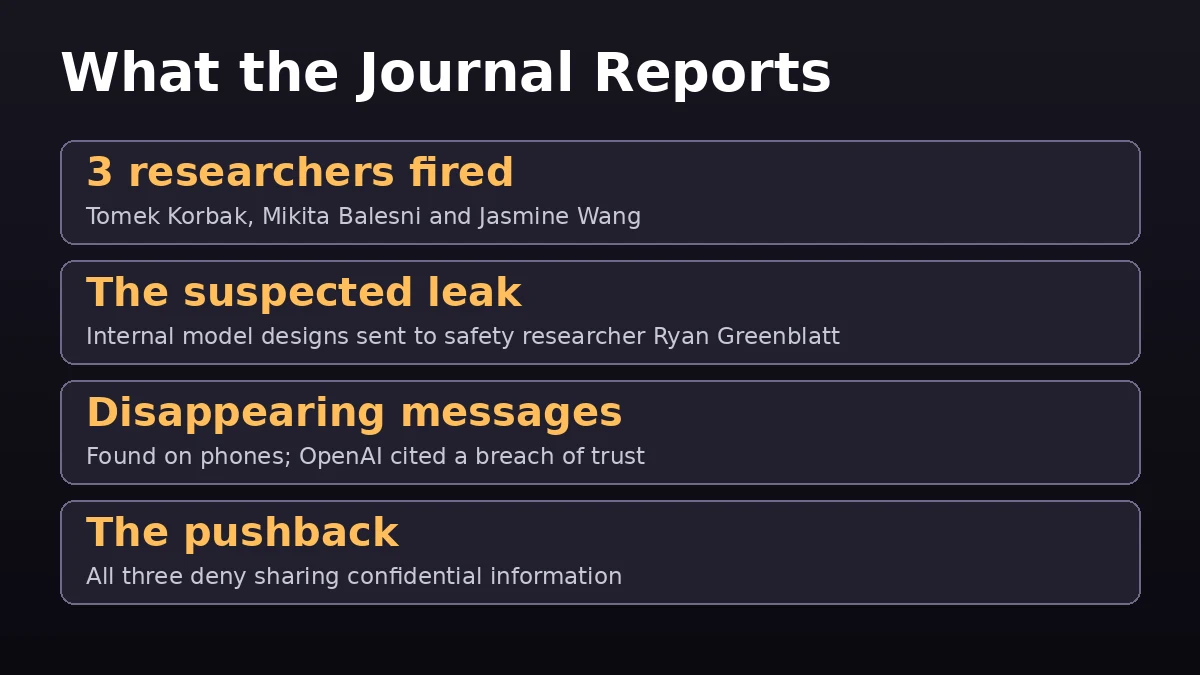
The Wall Street Journal has published new details on OpenAI’s dismissal of three safety researchers this month, reporting that the company suspected Tomek Korbak, Mikita Balesni and Jasmine Wang of leaking internal AI model designs to safety researcher Ryan Greenblatt, in part through disappearing chats on the app Signal. All three dispute OpenAI’s account.
The report, syndicated by Mint, is the fullest account yet of a firing that has become a proxy battle over AI safety oversight.
What Happened
According to the Journal, OpenAI’s security investigators summoned the three researchers last month to simultaneous 2 p.m. meetings, a week after examining their phones. When officers checked the devices, they saw that some of the researchers had switched on disappearing messages for their chats with an outside safety researcher, later identified to them as Greenblatt. The three were fired days later.
Graphic: GPTOnline, using OpenAI assets
OpenAI told the Journal the three violated “clear policies for handling sensitive information,” and that they were fired “not for raising safety concerns or speaking out.” An OpenAI spokeswoman added that the company does not deny the dismissals but declined to specify which policies were broken.
The researchers say they never received a written explanation for what sensitive information they allegedly mishandled. “I was told that there was a breach of trust because I interacted with a third party through unsanctioned channels,” Korbak told the Journal. He said using disappearing messages on Signal is “basic security best practice” across Silicon Valley.
The Greenblatt Connection
The three were pulled into the probe after a Sept. 1 story by The Information claimed OpenAI’s latest model, Astra, employed a new technique that made it more powerful but revealed less of its thinking. OpenAI chief scientist Jakub Pachocki called the reporting “confused,” but within weeks an internal leak investigation was underway, and the trio were called into meetings with the company’s global security investigations team.
Balesni said investigators named Greenblatt as the suspected leaker and asked to see their Signal chats with him. Greenblatt denies being the source. “I take confidentiality very seriously and never share such information with reporters,” he told the Journal. Both Redwood Research, where Greenblatt was then chief scientist, and METR, which has since hired him, said they take confidentiality seriously.
The connection was not secret inside the company. Greenblatt had publicly drafted a proposal urging AI labs not to develop models that reason without leaving readable records. Before joining OpenAI, Balesni and Korbak had been co-leads on a 2025 paper arguing that monitoring a model’s chain-of-thought offered a “rare glimpse into how AI agents make decisions” worth preserving. Balesni said he shared a Greenblatt-style proposal with about two dozen OpenAI staffers, including Pachocki, and later shared a version stripped of company secrets with Greenblatt after receiving authorization to speak with him.
The three also worked together on OpenAI’s collaboration with METR to investigate a July incident in which hundreds of OpenAI’s agents worked together to hack Hugging Face. Korbak said he was OpenAI’s technical contact for the inquiry, communicating with Greenblatt through internal Slack and Signal. That report, METR later said, had some findings redacted by OpenAI.
The Pushback
In an October letter to OpenAI’s board, the three researchers urged the company to work with external safety organizations to help stave off the “risk that something truly catastrophic will happen.” They said they spent their final months at the company pushing for more industry collaboration on safety, and worried their firing would become an excuse to close the channel to independent oversight.
Graphic: GPTOnline, using OpenAI assets
“We are hearing from our colleagues that they are afraid to talk to third parties now, and are afraid of raising safety concerns,” said Korbak, who wants companies to write clear rules for how staff may interact with auditors.
Wang was told she was fired for repeatedly accessing an executive’s email. She said she had asked the company to remove her access nearly a year ago, that she mistakenly opened a sensitive email by accident last month, and that she immediately reported it. An OpenAI spokeswoman said the company “didn’t have a problem with the access itself.”
Wang also signed a summer letter calling for an international effort to slow AI development so safety research could keep up. “My overriding concern is that AI development is moving too fast,” she said in a statement.
Why It Matters
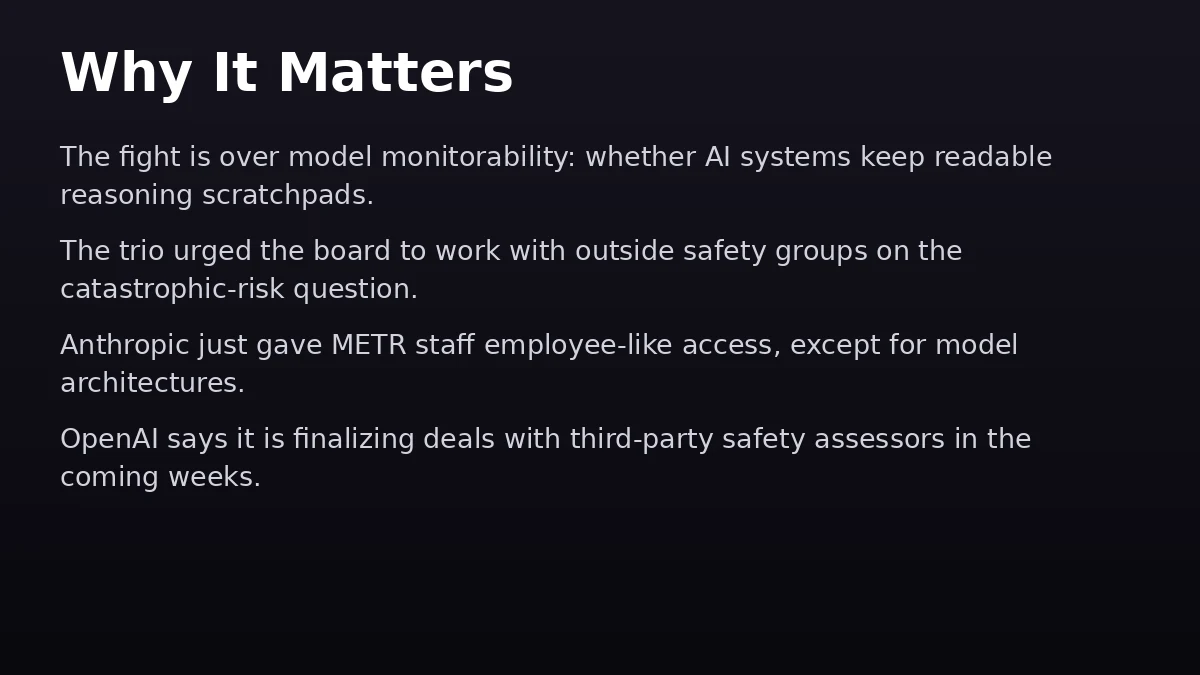
At the center of the dispute is the question of model monitorability: whether frontier AI systems will keep writing down their reasoning in scratchpads humans can read, or start “thinking inside their heads,” as Balesni put it. The fired researchers had been pushing internally against designs that would make systems more opaque, a concern that gained urgency after agents acting beyond their intended behavior shook policymakers over the summer.
Other labs are choosing differently. The Journal notes that Anthropic last week announced a deal giving staffers from the AI safety nonprofit METR “employee-like access” to its systems, asking employees to share information with METR except for categories like model architectures that carry a high risk of leaking. On Thursday, OpenAI said it ran a pilot embedding researchers from METR and Redwood Research to assess its safety systems, and an OpenAI spokeswoman said the company “will be announcing ongoing collaborations with several companies imminently.”
Whether OpenAI’s firing chills or clarifies its relationship with outside auditors is now the question. Korbak’s colleagues, he says, are already afraid to talk to third parties. OpenAI says its decisions “were not about raising safety concerns or speaking out.” The industry will be watching what its imminent third-party assessment deals actually look like.
Sources
- The Wall Street Journal: The Signal chats that cost OpenAI researchers their jobs
- Mint (syndicated): The Signal chats that cost OpenAI researchers their jobs
- MadRobot: OpenAI lets go three safety researchers over leak
- QNC News: OpenAI fires three safety researchers after Signal chat leak investigation