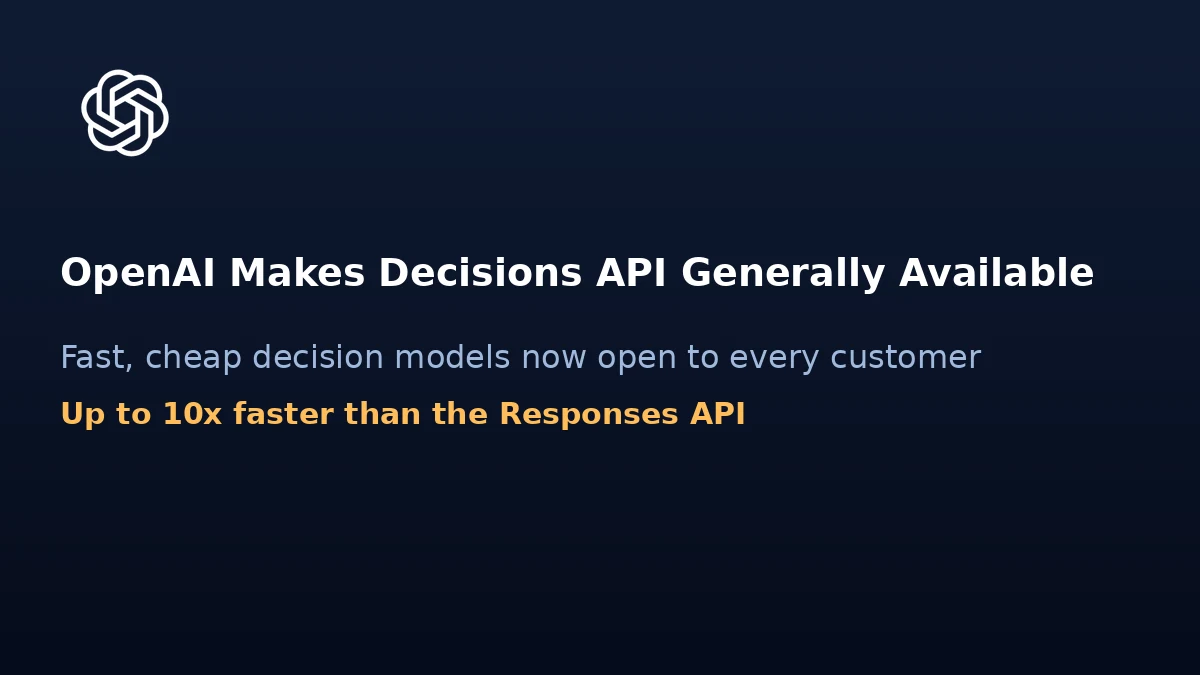
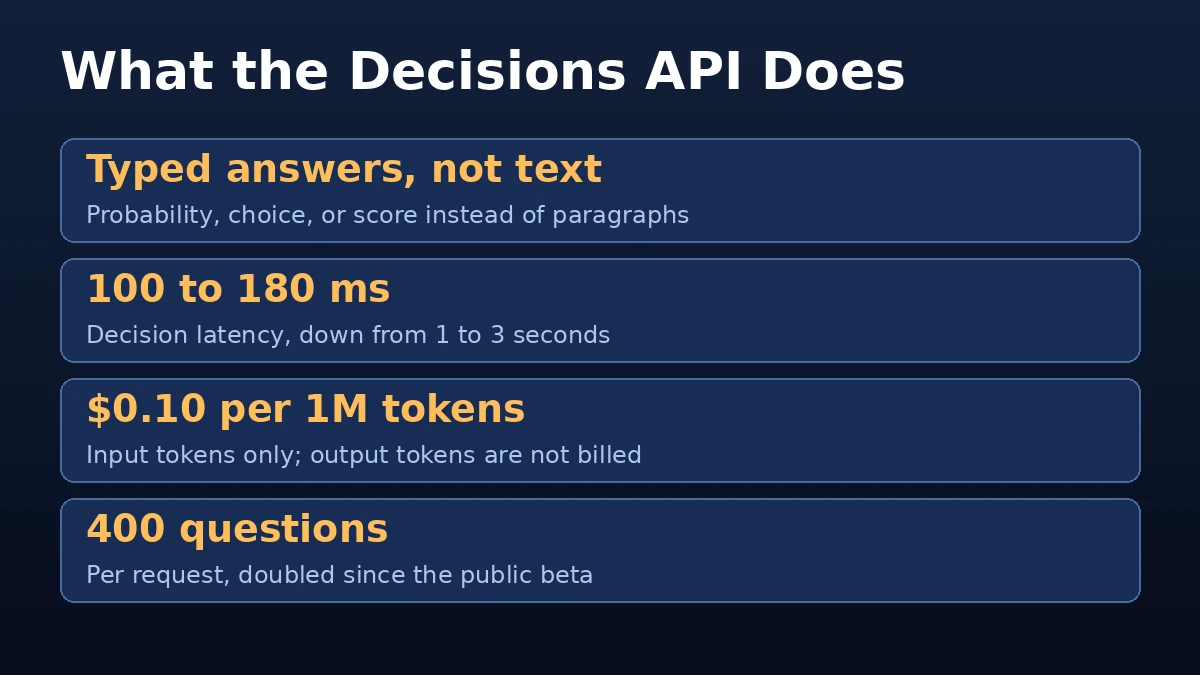
OpenAI on Thursday made its Decisions API generally available, opening to all customers a service that returns short, typed answers instead of long-form text. The company says it delivers decisions up to 10 times faster than running the same model through its Responses API, priced at $0.10 per million input tokens with no charge for output tokens.
What Was Announced?
Unveiled at OpenAI’s developer day on September 29, the Decisions API became available to every customer on October 22, TechCrunch reported. The public version adds new voice and visual modalities, and OpenAI says it worked to lower latency around the world by targeting inference resources geographically.
Rather than training a dedicated decision model from scratch, OpenAI took ChatGPT Luna and reconfigured it to speed up inference and lower cost. Nikunj Handa, the product lead for OpenAI’s APIs, told TechCrunch: “The big unlock with Decisions API has been the speed, shrinking things from one to three seconds to 100, 120, 180 milliseconds. In the future, we may sort of like have specific training to make our models like even better in these ways. But right now, it’s just plain old Luna that gets the job done.”
Graphic: GPTOnline, using OpenAI assets
Key Features and Details
The API handles questions with bounded answers across text, images and structured inputs. Developers define a question and its allowed answers, and the service returns one of three typed answer types:
- Predicate: the estimated probability, from 0 to 1, that a condition is true, such as whether a product photo shows visible damage.
- Choice: one option from a predefined set, such as whether an agent should continue, retry or ask for clarification, with probabilities and a confidence figure.
- Score: a rating against an ordered rubric of 2 to 10 levels, returned as a probability-weighted average of the level indices.
Requests go to a dedicated endpoint, POST /v1/decisions, and gpt-6-luna is the only model currently supported, per the developer guide. Since the public beta, OpenAI has raised the limit to 400 questions per request, up from 200, and added native GPT-Live integration, prompt caching for reused context, inference residency in the US and EU, native JSON inputs, images in question instructions, hosted image inputs, conversation history, organization usage reporting and Private Link. The company also added inference capacity in several regions in Asia.
OpenAI says its own teams are already using the API: the dots team uses it to cut response times and improve interactivity, the Personal Finance team categorizes transaction descriptions, and the Communications team classifies press coverage by theme and scores whether it reinforces or challenges key narratives.
Pricing and Availability
The Decisions API is generally available now through the dedicated Decisions endpoint. It costs $0.10 per million input tokens, with cached input at $0.01 per million tokens, and there are no output-token charges, according to OpenAI’s announcement. Cache writes are billed, and regional processing premiums and long-context multipliers still apply, with Zero Data Retention available to eligible customers.
Graphic: GPTOnline, using OpenAI assets
Why It Matters
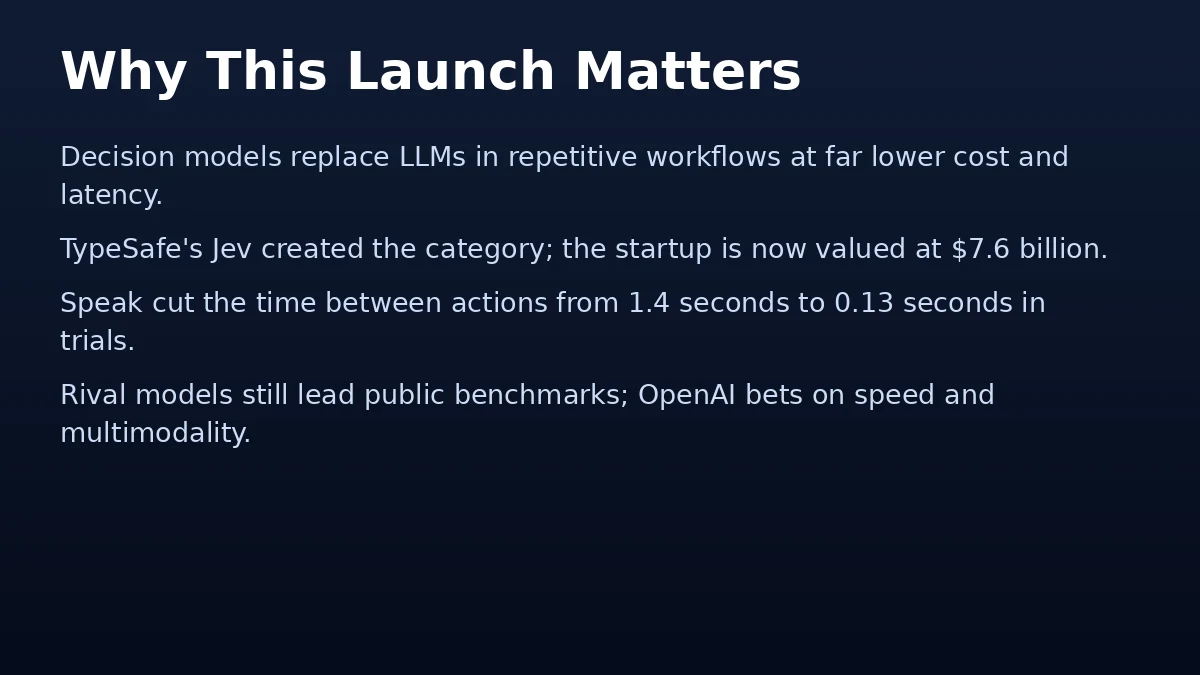
The launch plants OpenAI firmly in a category created by TypeSafe’s Jev model: deep learning models that act as super classifiers, quickly picking one option from a set and attaching a confidence rating. Developers have found that these “System One” models can replace full LLMs across repetitive workflows, running faster and far more cheaply. Jev’s traction recently helped make TypeSafe, a startup founded by a former OpenAI researcher, a $7.6 billion company, TechCrunch reported.
In early trials, customers including Box, Datadog, Ramp and Speak swapped the Decisions API in for OpenAI’s own LLMs to boost throughput. Andrew Hsu, the CTO of Speak, which builds AI language tutors, said the change cut the time between actions from 1.4 seconds to 0.13 seconds.
OpenAI is not the benchmark leader, though. Public benchmarks including the AIM System One Index and the Artificial Analysis Decision Index currently favor D1 Ultra, a decision model Liquid released last week, while Jev remains competitive and OpenAI’s model ranks eighth and fourteenth respectively. OpenAI’s counter is multimodality: for image classification, “Luna is extremely powerful and has been showing better calibrations,” Handa said. He also sees further speed gains unlocking new use cases: “Can we get this to something like 60 milliseconds, and then you could imagine an API call for every single frame in a video?”