
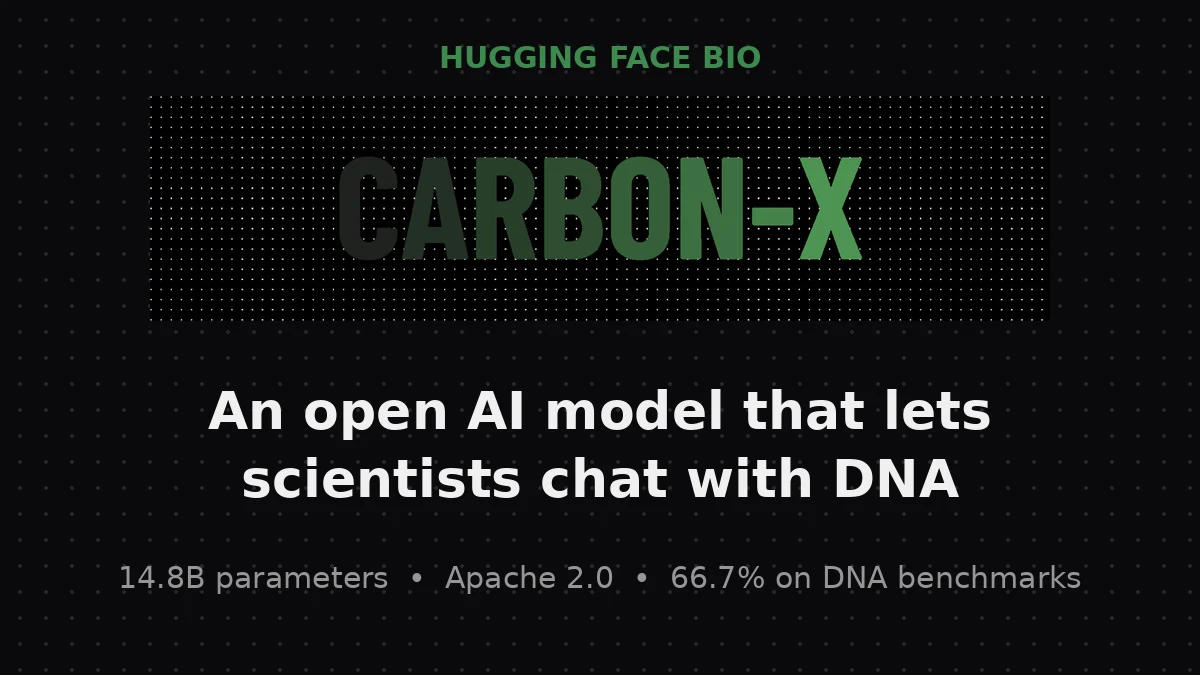
Hugging Face has released Carbon-X, a new open AI model that lets researchers ask questions about DNA the way they would ask a chatbot. Instead of returning only numbers or raw sequences, the model reads genetic code and answers in plain English, explaining its reasoning along the way.
The launch, announced Thursday, positions Carbon-X as a “first of its kind” model that combines DNA analysis and generation with natural language. Hugging Face developed it with researchers at the Zhongguancun Academy in Beijing and the Telethon Institute of Genetics and Medicine and the University of Naples Federico II in Italy, according to Wired‘s reporting on the release.
What Carbon-X Does
Give Carbon-X a raw DNA sequence inside an ordinary chat conversation and it answers in English. Per its official model card, the model can predict whether a mutation is benign or pathogenic, identify regions that control gene activity, classify a sequence by the type of organism it came from, predict the next bases of a sequence, and explain its reasoning. Its answers can mix English explanations with DNA.
A researcher might provide a DNA sequence and ask whether a particular mutation could increase a person’s risk of disease, and the model would offer a prediction and an explanation. It can also generate new DNA sequences, which could help researchers develop new gene therapies.
How It Learned to Read Genes
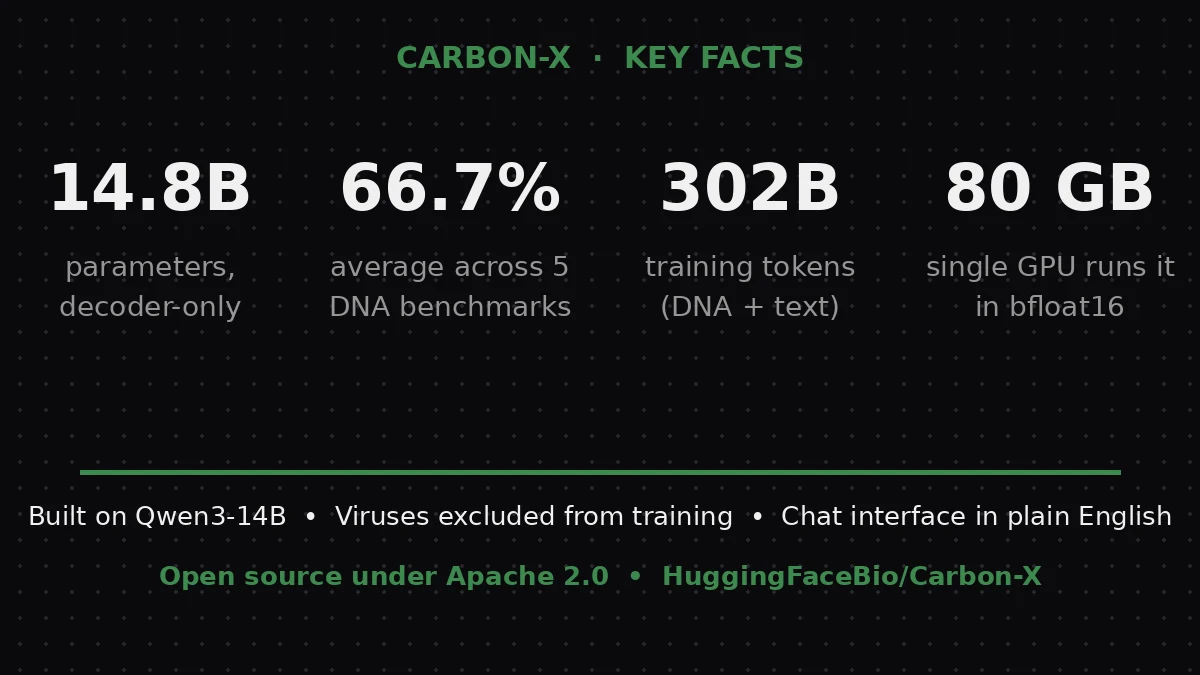
Carbon-X starts from Qwen3-14B, an open model from Alibaba, and extends its vocabulary with 5,515 DNA tokens. A hybrid tokenizer keeps the standard text vocabulary and encodes DNA as non-overlapping six-letter chunks, so one DNA token covers six base pairs. The team then mid-trained the model on 302 billion tokens, more than half of them raw DNA from mammals, other vertebrates, invertebrates, plants, fungi, protozoa and microbes, plus English and biology text. Supervised fine-tuning and reinforcement learning with verifiable rewards followed.
The result is a 14.8B-parameter decoder-only model with a 40,960-token context window, enough for about 49,000 DNA letters at a time. It cannot take in a whole human genome at once, only small sections.
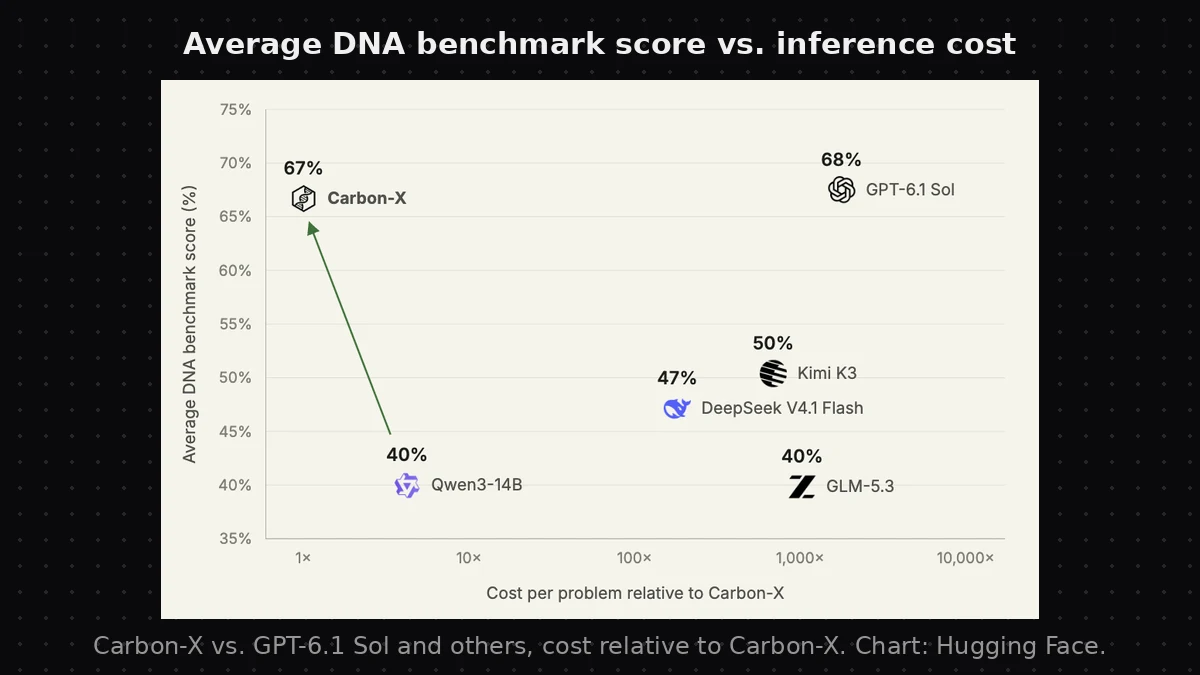
Across five DNA benchmarks covering variant-effect prediction, sequence understanding and next-base prediction, Carbon-X averages 66.7%, according to its model card. That is 27 points above the Qwen3-14B model it starts from and ahead of every other open model the team evaluated. It sits close to GPT-6.1 Sol’s 67.5% at about 1/1,800 of the inference cost per problem, and it leads every model tested on coding-variant effects and next-base prediction. Hugging Face estimates that analyzing the 2.4 million variants of uncertain significance in ClinVar would cost about $300 with Carbon-X, compared with $32,000 to $4 million using frontier models.
Open, Local, and Built to Avoid Lock-In
Carbon-X is released as open source under the Apache 2.0 license, and the weights fit on a single 80 GB GPU in bfloat16. Researchers can run it on their own hardware, avoiding the need to share sensitive patient data with external AI companies, a point Hugging Face senior research scientist Lewis Tunstall emphasized in interviews about the launch.
“We wanted to provide the open research community with tools that don’t make them fully dependent on some external single provider,” Tunstall said, noting how AI has concentrated the best research tools inside a handful of major labs. “If you want to really push the frontiers of mathematics, you likely have to be at one of these AI labs like OpenAI or Anthropic, because they’re the ones who have the best mathematics models,” he added, suggesting a similar dynamic is likely to play out in other fields of science.
On the model’s core novelty, Tunstall told Wired: “We’ve unlocked a new capability in language models, which is fundamentally about being able to chat with DNA.” Because the questions are in ordinary language, he added, even nontechnical users “can actually ask questions about DNA that wouldn’t be accessible through any other tool.”
Limits and Safeguards
The team deliberately excluded viruses from the training data to avoid potentially dangerous applications, Tunstall said. And Carbon-X comes with an important caveat: its developers say its predictions have not yet been validated in wet-lab experiments, so the accuracy of its predictions in real laboratory settings remains unestablished.
Earlier biology-focused models tended to give researchers numbers or raw sequences back. Google DeepMind’s AlphaGenome predicts the effects of sequences and mutations in numerical form, while Evo 2, developed by the Arc Institute and Nvidia with academic partners, can generate whole genomes. Carbon-X instead puts DNA and language into the same conversation.
Why It Matters
Carbon-X is a bet that the next wave of biology AI will be conversational and open rather than locked behind cloud APIs. For researchers working with sensitive or unpublished sequences, a capable model that runs locally and costs little to operate could meaningfully change what experiments are worth running. The context is also commercial: Hugging Face, the model-sharing platform, agreed to a nearly $13 billion acquisition by Nvidia in September, and Carbon-X is one of the first flagship releases from its biology research arm. The real test, as the team itself notes, will be whether the model’s predictions hold up in the lab.
Sources
- Hugging Face Bio, “HuggingFaceBio/Carbon-X” model card (official)
- Business Insider via DNYUZ, “Hugging Face is launching a new AI model that lets scientists ‘chat with DNA'”
- Superpower Daily, “Hugging Face releases an AI model for asking questions about DNA” (reporting Wired’s coverage)
- MadRobot, “Hugging Face’s Carbon-X is a free AI that lets you chat with DNA”