
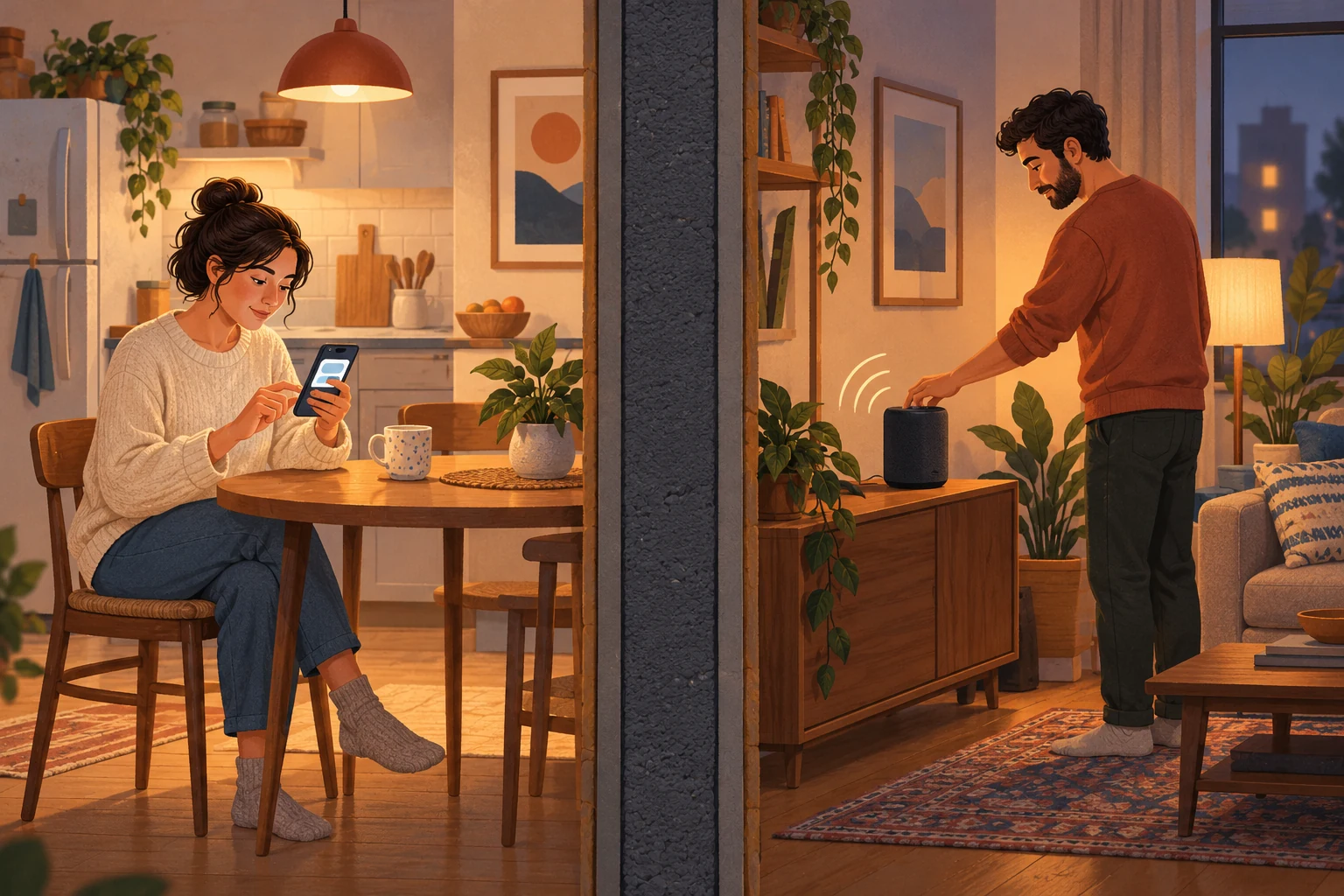
Original AI-generated editorial illustration for GPTOnline.ai; conceptual artwork.
A polite noise message works best when it says what you can hear, how it is affecting you, and what change you are asking for. These 48 original messages give you wording for a first text, a short note, a late-night request, or a firmer follow-up. Choose one that matches what actually happened, then replace the bracketed details before sending.
Choose the message that fits the situation
If you have not spoken before, introduce yourself briefly. Describe the sound rather than guessing at someone’s intentions. When you are unsure where it comes from, say so. A specific request such as lowering the bass or keeping a conversation indoors can be clearer than simply asking someone to “be considerate.”
- Friendly first requests
- Late-night and early-morning requests
- Music, television, and gatherings
- When you need a quiet window
- Specific requests about everyday sounds
- Clear, respectful follow-ups
Replace details such as [name], [unit], [time], and [duration]. Include a reason only if it is true. Use the Copy button beside a message, or select and copy the text manually if the button is unavailable.
Friendly first requests
- Hi [name], it’s [your name] from [unit]. The sound is carrying into my place. Could you keep it a little lower, please?
- Hello from next door. I can hear the TV quite clearly through our shared wall this evening. Would you mind turning it down?
- Hey [name], a quick favor: could you lower the music for a while? It’s reaching my living room. Thank you.
- Hi, I’m [your name], your neighbor in [unit]. I wanted to let you know that voices from the balcony are carrying into my room. Could you speak a little more quietly?
- I’m hearing loud music near [location], but I’m not sure which apartment it’s coming from. If it’s yours, could you please turn it down?
- Hi [name], could you help me with a little less noise this evening? I can hear it in [room], even with my windows closed.
- Just a friendly note from [unit]: the volume is quite noticeable on my side of the wall. Could you lower it a bit when you see this?
- Hey neighbor, I know sound can travel more than we expect here. Could you keep the noise down near our shared wall, please?
Late-night and early-morning requests
- Hi [name], I’m heading to bed and can still hear the music in my bedroom. Could you turn it down for the rest of tonight?
- It’s [time], and the TV is keeping me awake. Would you lower the volume now, please?
- I have an early start tomorrow. Could you keep the conversation on the balcony quieter tonight? It’s carrying through my bedroom window.
- Hi [name], would you mind moving the speaker away from our shared bedroom wall tonight? The sound is coming through quite strongly.
- Good morning. The music is waking me before my alarm. Could you keep the volume lower until [time], please?
- Hey [name], I’m still asleep at [time] on weekends. Could you avoid running the blender beside our shared wall before [time], if that works for your routine?
- I can hear furniture being moved overhead late at night. If that’s coming from your place, could you leave the heavier moving until tomorrow?
- Hi [name], the conversation in the hallway woke me up. Could you take it inside and keep the voices lower for the night?
Music, television, and gatherings
- Hi [name], the bass is coming through more strongly than the rest of the music. Could you lower the bass setting as well as the volume?
- I hope the gathering is going well. The music is quite loud in my apartment. Would you turn it down a few levels, please?
- Thanks for letting me know about your party. The sound is louder than I expected, so could you lower the music now?
- Hi [name], I can hear the commentary from your TV in my room. Could you reduce the volume for the rest of the match?
- The speaker near the open window is sending music straight into my place. Would you move it farther inside and lower the volume?
- Hey [name], the singing is carrying through the wall tonight. Could you lower the microphone and backing-track volume?
- I’m hearing the same bass beat in my apartment even after the volume change. Could you try a lower bass setting or move the speaker away from the wall?
- Hi [name], could you ask your guests to keep their voices lower in the shared hallway when they leave? The sound reaches my bedroom. Thank you.
When you need a quiet window
- Hi [name], I have a work call from [time] to [time] today. Could you keep the music lower during that window? I’d appreciate it.
- I’m studying for an exam this afternoon. Would you be able to lower the TV between [time] and [time] so I can concentrate?
- I’m recording a short presentation at [time], and the music is audible on my microphone. Could you turn it down for [duration]?
- Hi [name], I work from home in the room next to our shared wall. Could we agree on a lower speaker volume during [time window]?
- I’m trying to rest from [time] to [time] today. If you’re planning anything noisy, could you avoid that window if possible?
- Would you be able to pause the drilling for my call from [time] to [time]? If that doesn’t fit your plans, please let me know so I can arrange another place to take it.
- Hi [name], I have an online interview at [time]. Could you keep the music and TV quieter for about [duration]?
- I know it’s daytime, but the bass is making it hard to focus here. Could you reduce it for the next [duration], please?
Specific requests about everyday sounds
- Hi [name], the door has been closing very loudly this evening. Could you guide it shut rather than letting it swing closed, please?
- I can hear chairs scraping across the floor above my room. Would you be willing to try felt pads under the legs?
- Hey [name], the washing machine is vibrating against our shared wall. If you can, would you check whether it needs a little space or leveling?
- Hi [name], I can hear the weights being dropped through the ceiling. Could you set them down more gently, especially during [time window]?
- The speaker on the floor seems to be sending vibrations into my room below. Would you try raising it onto a stable stand and lowering the bass?
- Could you close the window while you’re playing music this evening, if that’s comfortable for you? The sound is traveling straight across to my place.
- Hi [name], the tapping from the furniture assembly is quite loud next door. Could you pause at [time] and finish tomorrow?
- I can hear repeated banging from [area] right now. If that’s coming from your place, could you reduce it or let me know when you expect to finish?
Clear, respectful follow-ups
- Hi [name], following up on my message from [day]. The music is still coming through loudly this evening. Please turn it down.
- Thanks for lowering the volume earlier. It has gone up again, and I can hear it in my bedroom. Could you bring it back down?
- We agreed to keep the music lower after [time]. It’s [time] now, and the bass is still carrying into my apartment. Please lower it.
- Hi [name], I mentioned the late-night TV on [day]. It has been audible in my bedroom again tonight. Could we agree on a quieter volume after [time]?
- I’m checking that my earlier note reached you. Could you reply about keeping the speaker farther from our shared wall?
- The music has been loud in my room on [dates], including tonight. I’d like us to find a workable solution. Could you keep it lower after [time]?
- Hi [name], moving the speaker helped, but I can still feel the bass through the wall. Could we try a lower bass setting next?
- I’ve asked about the noise a few times, and it’s still disrupting my sleep. Please keep the volume lower at night. Could you let me know what arrangement you can maintain?
Personalize the request without overexplaining
Name the sound you can actually hear. “The TV is audible in my bedroom” is more useful than “You are always noisy.” Mention a date or time when it helps identify the problem. Avoid “always” and “every night” unless those descriptions are accurate.
Ask for one practical change. Lowering a speaker, reducing bass, closing a door gently, or agreeing on a short quiet window gives your neighbor something concrete to consider. Suggestions such as felt pads are optional requests, not promises that a particular fix will work.
Keep daytime requests realistic. You can ask for a short quieter period without assuming everyone can stop normal activity. Give a clear start and end time. If you need reliable silence for an important call, have another location in mind if possible.
Be specific in a follow-up. Refer to the earlier request or agreement, say what is still happening, and ask for the next adjustment. Avoid insults, public callouts, or threats. Once the volume improves, a brief thank-you can close the exchange.
For a note instead of a text
Add a greeting and identify yourself using only the details you are comfortable sharing. Keep the note short, and check that it is going to the right home. Do not include your phone number unless you want that person to have it. Avoid putting personal contact details in a place where others can read them.
When a direct message is not the right next step
If approaching the neighbor feels unsafe, skip direct contact and use your building’s usual support or management channel, if one is available. If earlier messages have led to hostility, do not keep pressing for an in-person conversation. You can keep a factual record of dates, times, and what you heard without speculating about the cause.
These examples are writing suggestions for everyday neighbor communication. They do not establish local noise rules or guarantee a response. Check the applicable building guidance if you need to understand its process for recurring concerns.
Before you send
Read the message once for leftover placeholders, an accurate description, and a clear request. Send one message, then allow a reasonable chance to respond rather than repeating it rapidly. A note about an immediate noise problem can be brief; a recurring issue may need a calmer conversation later.
For other everyday conversations, you can also adapt our polite messages to ask for borrowed items back or our messages to decline casual plans with friends.