Updated October 16, 2026.
Hypertxt AI is a browser-based writing platform that brings brand information, search opportunities and article drafting into one workspace. It targets SEO and generative engine optimization (GEO), with tools for preparing content that search engines and AI answer services can understand. Official overview.
This is a documentation-based overview. We reviewed Hypertxt’s public product pages and policies; we did not test a paid account, generated articles or publishing integrations.
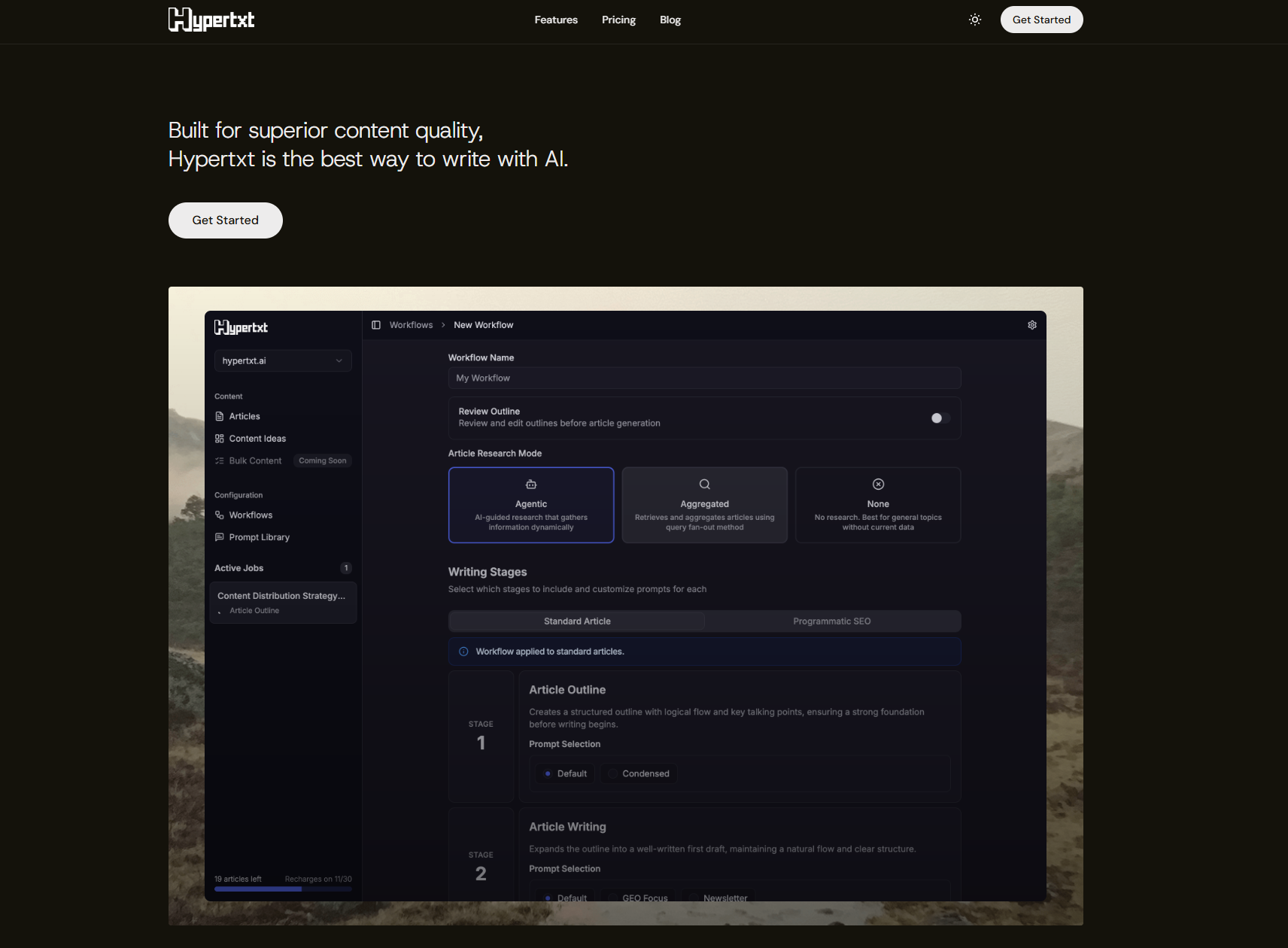
Featured image: historical Hypertxt homepage artwork with a dark workflow editor. The quality claims shown are vendor marketing, not our assessment; this image does not establish the current interface.
Who it suits
The documented workflow is relevant to marketers, founders and agencies that need help choosing topics and producing drafts. Google Search Console is optional: connected projects can use query and page performance, while other projects can start with brand information, keywords and a manual brief. Workflow and FAQ.
Our assessment: consider it when research handoffs and first drafts slow your publishing. Budget for an editor who understands the subject. The useful test is how much revision a publishable article needs, rather than how quickly the first version appears.
Core features
- Brand context: import notes, a website URL or a sitemap to inform positioning and tone.
- Search research: combine Search Console signals with keyword expansion. Search metrics require configured data providers; missing metrics remain blank.
- Staged drafting: build a research brief, outline and article, then run review steps. Optional Exa enrichment supplies web-source context.
- Editing and export: revise drafts, retry generation and export Markdown, including generated metadata and slugs.
- CMS connections: the named destinations are WordPress, Ghost and custom webhooks, with integration validation and publication tracking.
These are vendor-documented capabilities, not independently measured results. Feature documentation.
Language is set per project. Hypertxt does not enumerate a complete supported-language list on the pages reviewed, and says output quality depends on the AI provider. Have a fluent editor check localized drafts. We did not verify a native mobile application. Language FAQ.
For technical teams, Hypertxt also documents an MCP workflow for AI agents. Its publishing guide distinguishes sending a destination draft from making a post public; recording a published state manually does not itself contact the CMS. Publishing guide.
Plans and pricing
The pricing page lists the following. Amounts use the displayed “$” symbol; the page does not explicitly identify the currency code or tax treatment.
- Starter: $19/month. Monthly allowances: 10 articles, 200 keyword credits and 50 content ideas; three projects.
- Growth: $99/month. Monthly allowances: 30 articles, 600 keyword credits and 150 content ideas; nine projects.
- Agency: $240/month. Monthly allowances: 90 articles, 1,800 keyword credits and 450 content ideas; 30 projects.
- BYOK: $89 one-time. Unlimited articles, content ideas and projects; 250 included keyword credits.
The three-day trial includes two articles and requires a payment card. It automatically becomes Starter at $19/month unless cancelled before the trial ends. Check the final currency, tax, charge date and total before confirming. No annual rate or credit-rollover policy is stated on this pricing page.
The homepage also displays a $1 single-article offer with no automatic conversion, alongside trial links. Because these offers differ, verify which one your checkout actually applies. Homepage offer.
BYOK costs
The one-time licence covers access to Hypertxt’s workspace; it does not cover usage charged by your AI and data providers. The BYOK guide requires at least one generation provider, OpenAI or Anthropic. Exa, DataForSEO and Keywords Everywhere are optional additions for research or keyword data.
BYOK projects have no fallback to Hypertxt’s hosted keys. Your provider account controls billing, rate limits and model access; premium Opus use needs suitable Anthropic access. Consequently, “unlimited” generation should not be read as unlimited free API usage. Estimate provider charges for your actual workflow before comparing BYOK with a hosted subscription.
Billing and refunds
Under the terms of service, subscriptions renew automatically until cancelled. Trial cancellation is available in Account → Billing. Cancelling prevents later renewals but does not automatically refund a period already billed; applicable statutory refund or withdrawal rights remain unaffected.
We did not find a blanket money-back guarantee or a specific BYOK refund window in these terms. Check the purchase terms before paying rather than assuming a one-time licence is refundable.
The terms require output review and disclaim guaranteed rankings, traffic or revenue. You retain content ownership, subject to rights granted to operate and improve the service.
Privacy and data
The privacy policy describes storage of account and project information, brand notes, briefs, drafts, connected-service settings and billing records. Provider keys and OAuth tokens are encrypted at rest. Information may be processed in the United States and elsewhere.
Retention is based on operational and legal need, without a fixed deletion deadline. Deletion can be requested where legally and technically permitted. The policy does not expressly promise that inputs or outputs are excluded from AI-model training.
The terms prohibit submitting sensitive personal information or confidential third-party data. Encryption of credentials alone does not make those inputs permitted.
Example workflow
Fictional example: Northbridge Desk, an imaginary coworking business, wants an article explaining meeting-room booking etiquette. This is an illustrative editorial plan, not a test result or customer case study.
- Prepare a short brief with the intended reader, house rules and an approved public information page. Omit member details and private booking records.
- Choose one reader question: “What should a team check before reserving a meeting room?” Keep the draft focused on that question.
- Ask an editor to verify every claim about cancellations, access and equipment against the business’s current rules. Replace generic advice with concrete examples.
- Preview the draft on the destination website. Check headings, links and mobile readability before the authorized publisher makes it public.
For a useful evaluation, record editorial time and factual corrections across several comparable drafts. Treat any later search-performance change as something to investigate, not proof that the writing tool caused it.
Important limits
Hypertxt’s own comparison page says it does not provide a SERP content score or monitor whether AI answers mention your brand. Teams needing those measurements should evaluate them separately. Vendor’s stated tradeoffs.
Start with one low-risk topic and a clear acceptance checklist: accurate claims, working sources, appropriate tone and acceptable revision time. Research assistance can organize evidence, but someone still needs to verify that the cited pages support what the final article says.
For a worked example of checking whether an AI draft preserves its source’s meaning, read How to Catch Meaning Changes in an AI Summary. The example is separate from Hypertxt and does not measure this product.