Updated October 18, 2026. LotusEye is a browser-based anomaly-detection service from pratya LLC. It learns a baseline from numerical data and assigns anomaly scores to later readings. Its main documented workflow is equipment monitoring: upload normal-operation data, evaluate other periods, and investigate readings that depart from the baseline.
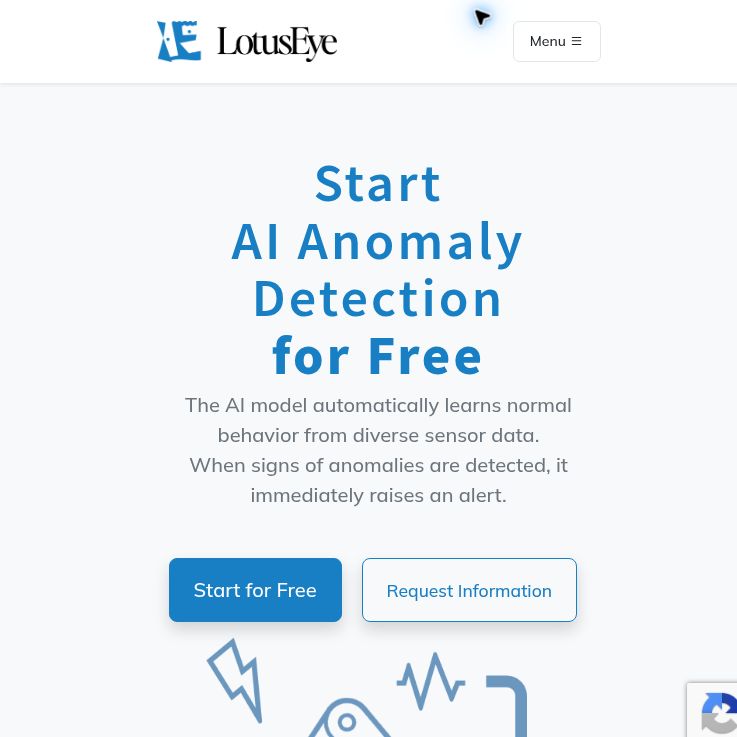
Screenshot of the official LotusEye homepage, captured October 18, 2026. The page contains provider claims; no sensor data was uploaded and no detection test was run.
The practical question is whether its scoring interval, data limits, and handling terms fit your equipment. In particular, LotusEye calculates scores in hourly units, and its terms prohibit uploading confidential information. Those details matter more than a broad promise of “real-time AI monitoring.”
How LotusEye works
The official product page supports two CSV layouts: wide data, with sensor readings in columns, and long data, with timestamp, sensor name, and sensor value columns. Train with representative normal operation, then compare test periods against the resulting model. The browser interface displays scores for investigation.
Readings more frequent than hourly are averaged into hourly values before scoring. That makes the service a candidate for reviewing slower operational changes. Evaluate separately whether averaging would hide short-lived spikes important to your application; an hourly anomaly score is not a substitute for a safety interlock or a millisecond-level alarm.
Features and plan boundaries
- Manual CSV workflow: create a model and inspect scores without building an integration.
- API uploads and email alerts: available from Light upward. Automated collection still requires a process that prepares and submits the data.
- Model review: the manual describes graph-based retraining and a rollback to the previous model on paid plans.
- False-positive reduction mode: a paid-plan option that may take longer to process. The manual warns it can increase false positives when training data is limited.
- Sensor-contribution reports: the manual’s detailed report section assigns these to Business. They help investigate which readings contributed to a high score; contribution does not by itself establish a physical cause.
The user manual also documents a Japanese or English interface and model-level member permissions.
LotusEye pricing in Japanese yen
The English site displays approximate dollar conversions, but its pricing component states that payments are made in Japanese yen through Stripe. Use the native JPY amounts below when budgeting. Plans attach to individual models; annual figures are the annual charges, not monthly prices.
Free
- Monthly payment: ¥0
- Annual payment: ¥0
- Sensor and upload limits: 10 sensors; 10 uploads/day; 1 MB/upload
Light
- Monthly payment: ¥1,980 per model
- Annual payment: ¥19,680 per model
- Sensor and upload limits: 10 sensors; 10 uploads/day; 1 MB/upload
Standard
- Monthly payment: ¥4,980 per model
- Annual payment: ¥49,560 per model
- Sensor and upload limits: 50 sensors; 20 MB/upload; fair-use upload policy
Business
- Monthly payment: ¥7,980 per model
- Annual payment: ¥79,440 per model
- Sensor and upload limits: 100 sensors; 100 MB/upload; fair-use upload policy
Free allows one model per account and no added management members. Its listed score-log retention is six months, with an additional warning that new uploads remove older data. Paid retention is six months on Light, twelve on Standard, and thirty-six on Business. Standard and Business do not impose a normal daily upload-count limit, but unusually heavy use can trigger temporary restrictions.
Check the official Japanese pricing section and checkout for current charges, taxes, and the number of model subscriptions you need. Currency conversion and card-provider fees may change the amount paid outside Japan.
A useful first evaluation
Hypothetical example: a facilities team wants to review a training rig’s temperature, pressure, and electrical-current readings. Use non-confidential data that the team is authorized to upload. Keep maintenance logs locally so a reviewer can compare high scores with known events. This example illustrates an evaluation plan; GPTOnline has not run it in LotusEye.
- Choose a clearly defined question, such as whether a sustained change in the rig’s operating pattern is distinguishable from normal startup and shutdown.
- Prepare timestamped CSV data with consistent sensor names and units. Check missing readings and time-zone handling before upload.
- Train on a representative normal period. Keep a separate test period that includes ordinary variation and any known abnormal event.
- Compare scores with the local event log. Record both missed events and alerts during acceptable operation.
- Change one setting or training choice at a time. Keep an evaluation record so a quieter chart is not mistaken for better detection.
If relevant failures occur only in brief bursts, inspect the raw readings alongside the hourly analysis. Decide in advance how much delay and how many false alerts are acceptable for this non-safety-critical evaluation.
Data handling and important restrictions
Read the LotusEye terms before uploading operational data. Section 11.5 says users must not upload confidential information. Section 6.2 allows the provider to use generated customer data in anonymized form for service improvement, new products, and analysis. The terms also restrict providing the service to third parties. A consultant should confirm the permitted arrangement before using it with client data.
The separate privacy policy describes personal-information handling. Neither a privacy policy nor a private login should be read as permission to submit trade secrets. Ask the data owner to classify the proposed input first.
Cancellation also needs care: the manual documents canceling a model subscription by deleting the model, and a paid model cannot simply be switched to Free. Export anything you need and understand the deletion consequences before changing plans. The terms generally describe fees as non-refundable.
Who should consider LotusEye?
It is most relevant to teams with structured numerical readings, a meaningful normal baseline, and staff who can investigate alerts. A small pilot can establish whether the data format and hourly scoring are useful before an integration or paid rollout. It is a poor fit when confidential input is unavoidable, sub-hour detection is essential, or nobody can validate the alerts against real operating conditions.
Explore other data analysis tools in the GPTOnline directory.