Updated October 18, 2026. Competely AI is a web-based competitive-intelligence service that combines a sourced comparison of your business and its competitors with recurring email briefs about changes. It is designed for founders, marketers, product managers and agencies that need to revisit the same market over time.
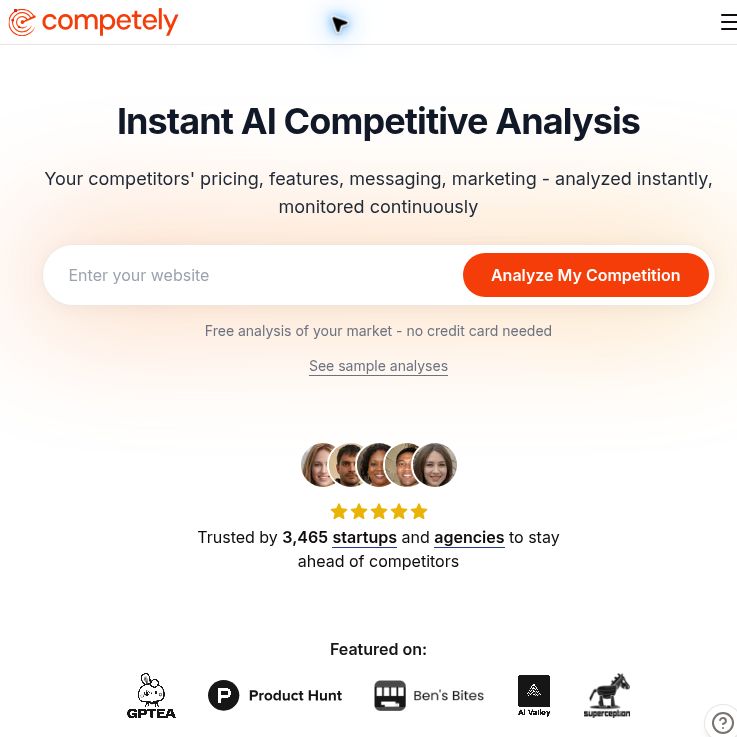
Screenshot of the official Competely homepage, captured October 18, 2026. The page contains provider marketing claims; no website was submitted and no analysis or monitoring test was run.
The important distinction is between the analysis, a detailed snapshot you can rerun, and monitoring, which sends updates on a schedule. A new brief does not automatically mean the entire comparison table has been refreshed. This overview is based on official product, pricing and help pages checked on October 18, 2026; we did not run a paid analysis.
How Competely works
You start with your website URL, review suggested competitors and add or replace companies using their URLs. Paid projects can also start from a product description. Competely then researches the selected websites and other public sources to build a side-by-side table.
The official workflow guide describes more than 100 data points per competitor, with source links attached to individual cells. Topics include features, pricing, positioning, customers and SWOT. You can expand a cell’s sources to check the evidence behind a claim.
Competely estimates that full analyses usually take 15–45 minutes. That is a vendor estimate, not a turnaround guarantee or a result measured for this article.
Useful features
- Competitor discovery: suggested rivals provide a starting list, while manual selection keeps the comparison relevant to your segment.
- Structured research: the comparison brings different kinds of public evidence into a consistent format, making gaps easier to spot.
- Competitive Briefs: scheduled emails summarize public changes such as pricing revisions, feature releases and messaging shifts.
- Exports and sharing: paid plans include CSV and PDF exports and optional read-only links. Recipients do not need an account to open a shared analysis.
- Separate refresh controls: rerun the detailed analysis when you need a new snapshot; adjust or pause monitoring separately.
Although product pages advertise client sharing, the published terms restrict AI output to internal use and require prior written consent before sharing it with third parties. Agencies should clarify their permitted client-sharing arrangement before distributing reports.
See the product overview and analysis-versus-monitoring explanation for the distinction.
Free access and paid pricing
The homepage offers a free account without a credit card and a limited analysis against two competitors, covering positioning, value proposition, key features and differentiation. Full comparisons, exports, sharing and ongoing briefs require a paid plan.
Prices checked October 18, 2026 are shown below using the vendor’s dollar symbol ($). The public pages reviewed did not explicitly identify the currency code or tax treatment; confirm the billing currency and final total before purchasing.
- Starter: $39 billed monthly, or $348 billed annually. Includes 3 active projects, up to 10 competitors per project, 3 analysis runs per project per rolling 30 days, briefs every two weeks, up to 10 brief recipients and 1 user. New-project creation is capped at 5 per rolling year.
- Pro: $59 billed monthly, or $528 billed annually. Includes 6 active projects, up to 15 competitors per project, 4 analysis runs per project per rolling 30 days, weekly briefs, up to 15 recipients and 1 user. New-project creation is capped at 15 per rolling year.
- Scale: $99 billed monthly, or $888 billed annually. Includes 10 active projects, up to 15 competitors per project, 5 analysis runs per project per rolling 30 days, weekly briefs, up to 30 recipients and 3 users. New-project creation is capped at 30 per rolling year. The monthly pricing view lists extra users at $20 per month each.
Sources: current pricing and project limits. Annual prices are yearly commitments, not monthly charges. The pricing page says cancellation preserves access through the current billing period; the terms generally make fees non-refundable unless otherwise stated or required by law.
Limits that are easy to overlook
Analysis allowances belong to each project and use a rolling 30-day window. The initial completed analysis and successful reruns count; failed runs and automatic retries do not. Scheduled monitoring is separate. A slot becomes available again 30 days after the counted run, rather than everything resetting on the first day of a calendar month.
Deleting a project frees an active-project slot, but does not erase its creation from the yearly new-project allowance. This matters for agencies that frequently rotate clients. Check both limits before choosing a plan. See the analysis quota guide.
A practical example: checking product positioning
Suppose a small software team is deciding how to position a new scheduling product. A useful evaluation would be:
- Choose three direct competitors serving the same buyer, rather than accepting every suggested company.
- Inspect evidence for pricing, integrations, target customers and the primary promise on each homepage.
- Record the source date and distinguish an advertised feature from one independently confirmed through documentation or a trial.
- Export the comparison and write a short hypothesis, such as a potential gap in onboarding support. Validate that hypothesis with customers before changing strategy.
- Use briefs to watch for changes, then rerun the full comparison before a major launch or pricing decision.
This is a suggested workflow, not a report generated during our review. Competely can help organize research, but the quality of a strategic decision still depends on evidence and judgment.
Privacy and accuracy considerations
Competely’s privacy help page says projects are private by default, identifies OpenAI and Anthropic as AI providers, and says it does not currently train or fine-tune models on your data. However, its privacy policy includes broader permission for training and improving AI using inputs and outputs. Ask for clarification before submitting confidential strategy, client material or personal information; do not treat the help statement as an unconditional no-training guarantee.
Public websites can be incomplete or outdated, and AI can misread them. Verify consequential claims, particularly financial estimates, customer counts, compliance statements and prices. A citation makes a claim easier to inspect; it does not establish that the source is accurate or current.
Who is it best suited to?
Competely is worth considering when you repeatedly research a defined set of competitors and need shareable comparisons plus periodic updates. A one-off question or a simple alert for one webpage may not justify a subscription. Start with the limited free analysis and judge source relevance before paying.
Compare other options in the GPTOnline AI tools directory.