Updated October 24, 2026.
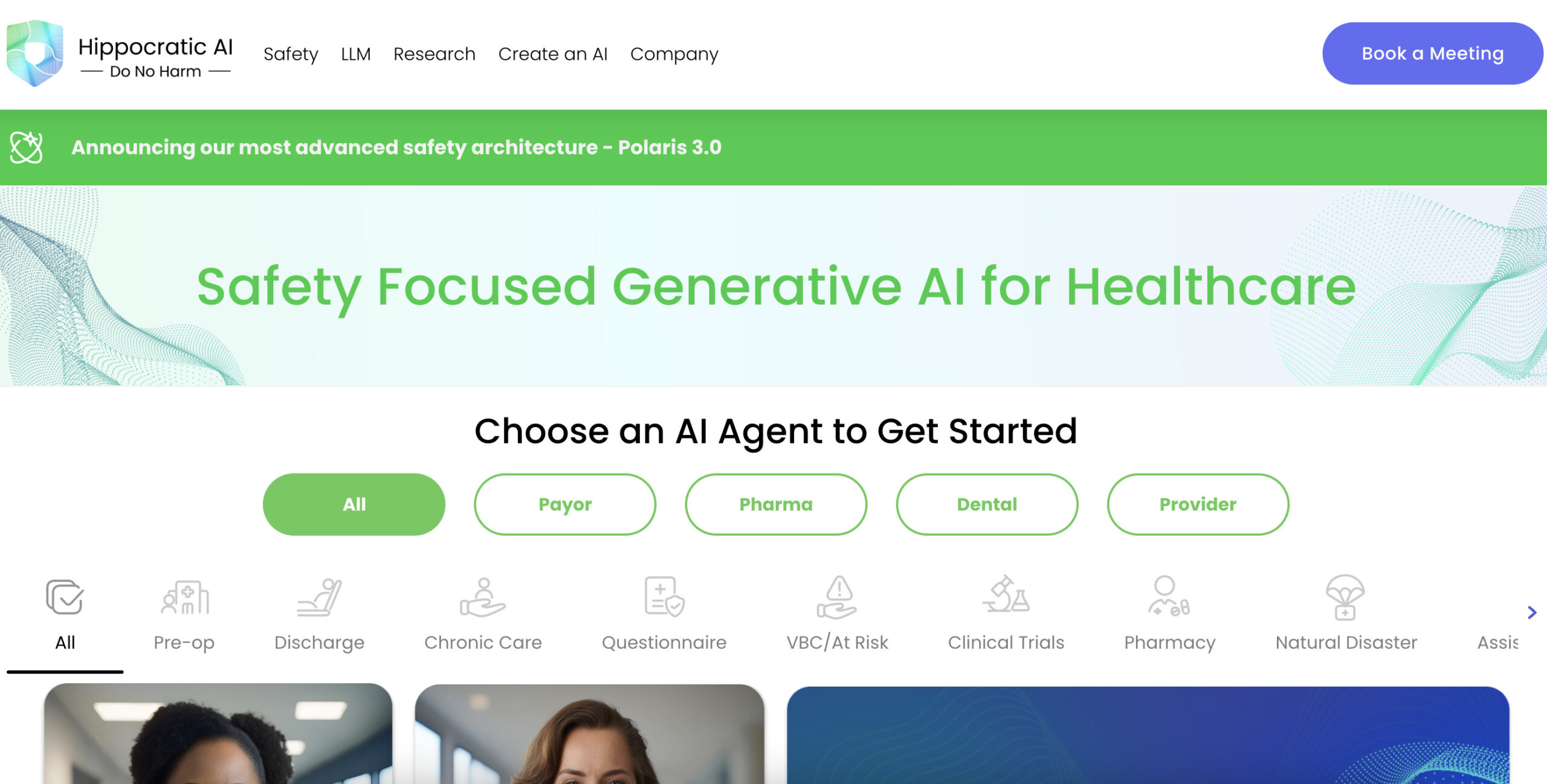
The retained image shows an earlier Hippocratic AI homepage promoting Polaris 3.0. Its capture date is unrecorded; it is historical provider marketing, not the current Polaris 5.0 interface or independent evidence of clinical safety. Source: Hippocratic AI.
| Name |
Hippocratic AI |
| Overview |
Hippocratic AI is a pioneering healthcare technology company founded in February 2023, dedicated to addressing the global shortage of healthcare workers by developing safety-focused generative AI agents for non-diagnostic, patient-facing tasks. These AI agents are designed to handle various responsibilities such as chronic care management, post-discharge follow-up, medication adherence support, appointment scheduling, patient education, and social determinants of health screening. The agents interact with patients through voice-based conversations, aiming to enhance healthcare access and outcomes, particularly in underserved communities. |
| Key Features & Benefits |
- Safety-Focused Design: The provider describes clinical testing, supervision, cross-validation and escalation to human nurses. These safeguards are not a guarantee that every response is safe or equivalent to a human clinician.
- Polaris Architecture: Polaris 3.0 is an earlier version. The current product page presents Polaris 5.0, while the safety page also links research on 3.0 and 4.0. Provider benchmark claims should not be read as independent proof of outcomes in every clinical setting.
- Clinician-Created AI Agents: Clinician-led agent creation and certification tools support tailored patient-facing workflows. Confirm current builder access, eligibility, review requirements and commercial terms directly with the provider.
- Voice-Based Interactions: AI agents communicate with patients using voice, facilitating more natural and engaging conversations.
- Empathetic Communication: Voice agents are designed for supportive conversations; empathy and patient engagement are design goals, not guaranteed clinical outcomes.
|
| Use Cases and Applications |
- Chronic care management
- Post-discharge follow-up
- Medication adherence support
- Appointment scheduling
- Patient education
- Social determinants of health screening
- Protocol-based collection of health-risk information for clinician review
- Nutrition-related education within an approved care workflow
- Wellness coaching
- Symptom information collection and escalation to human clinicians, not autonomous diagnosis or prescribing
|
| Who Uses? |
- Healthcare providers and systems
- Nurses and medical assistants
- Social workers and nutritionists
- Patients, especially in underserved communities
- Licensed clinicians creating AI agents
|
| Pricing |
- Healthcare deployment: The earlier listing quoted approximately $9 per agent-hour. A current universally applicable rate was not reconfirmed on the reviewed product pages; request a quote for the model, call volume, integrations and support required. This is not a like-for-like replacement-cost comparison with a nurse.
- Creator payments: The earlier App Store description quoted 5% of a base rate plus 70% of a creator-set premium, capped at $5,000 per agent. Treat those as previously advertised terms, not a current earnings promise; confirm the applicable agreement and eligibility.
|
| Tags |
#HealthcareAI, #GenerativeAI, #PatientCare, #VoiceAI, #EmpatheticAI, #ChronicCare, #AIinMedicine, #HealthTech, #AIForGood |
| App Available? |
Healthcare organisations can arrange access through the provider and its agent-building or safety tools. Patient-facing services include voice calls. A standalone general-consumer mobile app was not verified. |
Check clinical scope before deployment
The provider states that its agents do not diagnose or prescribe. Confirm the permitted workflow, human escalation, clinician oversight, patient consent and data-handling arrangements before deployment. Evaluate representative cases with qualified clinical staff; this directory profile is not medical advice or an independent clinical validation.
Sources reviewed October 24, 2026: source 1, source 2, source 3, source 4.