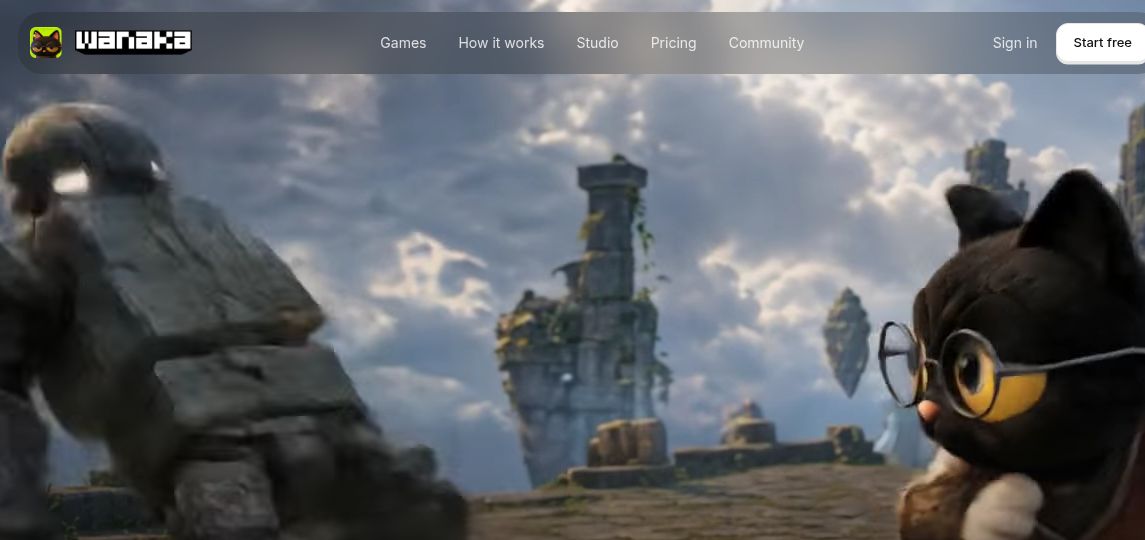
Image source: Wanaka official homepage. Screenshot captured November 7, 2026 (Vietnam time), for editorial identification.
Wanaka Studio is an AI-assisted 3D game creation tool for people who want to turn an idea into something playable in a browser. It combines natural-language instructions with a visual editor, giving creators a way to refine a scene after the AI has produced a starting point. Its Product Hunt launch was November 4, 2026.
On the launch page, founder and CEO Yang Zhang introduces the product and explains its approach. This overview draws on those maker statements and the official website. We have not built or benchmarked a game with it.
What can you create with Wanaka Studio?
The official website describes a workflow in which you explain a game, work with AI to build it, and share a playable link. It presents tools for characters, environments, animation, interfaces and audio. Examples include racing, exploration, puzzle and simulation games.
The maker’s launch description adds a synchronized visual editor, character rigging and built-in multiplayer. The intended benefit is that creators can mix prompts with direct scene adjustments instead of describing every small change through chat. These are published product capabilities, not independently verified performance results.
Wanaka is most relevant to a hobbyist, an educator exploring a simple interactive activity, or a designer testing a game mechanic. Before choosing it for a larger project, establish whether its publishing and integration options fit the eventual destination.
A hypothetical first project
Consider a designer who wants to test a short obstacle course: the player jumps between platforms, collects three objects and reaches a finish point. A useful first attempt would focus on that small loop rather than a large world with many systems.
- Describe the controls, goal and failure condition clearly. Specify what should happen when the player falls or misses an object.
- Build a simple scene before requesting detailed characters or elaborate scenery. Check whether the movement and camera make the course understandable.
- Use direct editing for a small adjustment, such as platform spacing, then ask the AI for another change. Check that the earlier adjustment is preserved.
- Give another person the playable link without explaining the rules. Observe where they get confused, stuck or uncertain about the next action.
- Revise one problem at a time. Keep a short list of what changed so you can distinguish an improvement from a new fault.
This is a suggested evaluation, not a demonstration we performed. A convincing first result should show that the intended mechanic works repeatedly, including after a restart. Attractive screenshots alone cannot establish whether a game is enjoyable or reliable.
Pricing and access
Wanaka advertises a free starting option. Its pricing page presents monthly and yearly billing choices, but the paid amounts and detailed allowances were not available in the text retrieved for this overview. We therefore do not quote a subscription price or promise a particular free usage limit.
Before spending time on a substantial project, check how generation is charged, what happens when an allowance runs out and which publishing features your plan includes. Confirm whether a displayed yearly price is an equivalent monthly amount or the amount charged at checkout.
Current limits to check
In launch-page replies, Yang Zhang says an API is not yet available and that published games currently stay on Wanaka’s domain. Treat custom-domain support as a future possibility, not an available feature. Export compatibility also needs direct verification before making it part of a production plan.
Wanaka’s claims about visual quality and efficiency should be treated as vendor claims. This article does not establish that it can replace a professional engine or meet a particular frame-rate target.
Privacy and publishing
Start with original, non-confidential material. Avoid uploading private client assets or recognizable third-party characters unless you have the necessary rights. Before sharing a game, check its visibility, the content it exposes and whether the sharing settings meet your needs. Publicly playable projects should receive a separate content and usability review.
Wanaka Studio is worth exploring when a small playable prototype would help you evaluate an idea. Test the core mechanic and publishing route first, then decide whether to expand the project. Find other creative tools in GPTOnline’s AI tools directory.