three.dev is a tool that finds the failures hiding in your AI agent’s live traffic and helps you fix the ones that matter first. It scores every conversation your agent has in production, groups the failures by their root cause and hands the fix to your coding agent. three.dev launched on Product Hunt on 12 November 2026 after early access. You can see the official site at https://three.dev/.
What is three.dev?
Most teams learn about agent failures from users. three.dev watches the traffic instead. Requests pass through the three.dev proxy to your AI provider, and each response is scored as it happens, so problems surface with evidence before a customer reports them. Issues are grouped into failure modes by root cause, ranked by severity and frequency, so you know what to fix first.
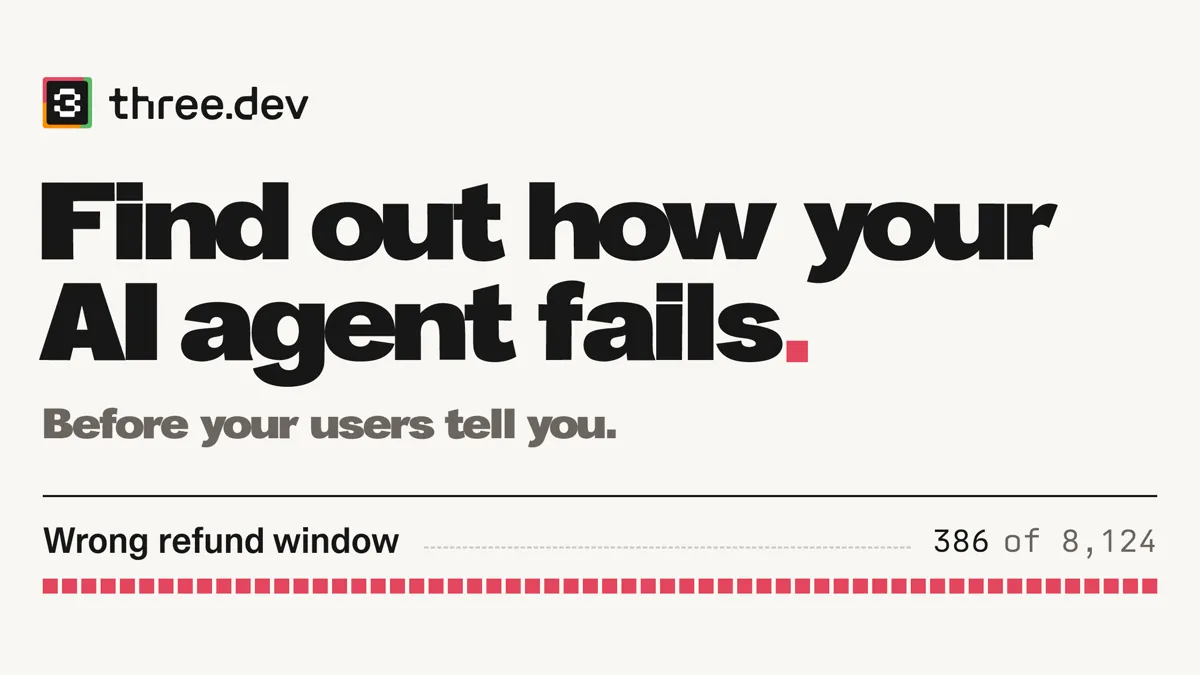
In the product’s own demo, one reply promised a refund within 14 days while the policy says 30. That became the failure mode “Wrong refund window”, found in 386 of 8,124 scored requests, and after the fix it fell to 16.
Key features
- Scores your live traffic as it happens, with every issue backed by evidence down to one line of your system prompt or one message in a long conversation.
- Groups issues into failure modes by root cause, ranks them by importance and frequency, and lets you merge or dismiss modes.
- Connects to your coding agent over MCP, so it can read a failure mode, find the code behind it and ship the fix.
- Compares any two slices of traffic, such as before and after a fix or two prompt versions, with each failure mode shown side by side.
- Answers questions about your traffic in plain words through Chat, with answers linked to the requests behind them.
- Tests changes safely with Experiments (early access): replay past traffic, then try a new version on some live sessions.
- Offers specialised language models trained on your own traffic (early access), for better quality, latency and cost than frontier models.
How it works
Setup starts with one prompt pasted into Claude Code, Codex or Cursor. Your agent installs the three.dev skills and routes your LLM calls through the three.dev proxy to your AI provider, including OpenAI, Anthropic, Gemini and Azure OpenAI. Scoring adds no latency, because each response goes to your app and to the evaluator at the same time.
Once traffic flows, you read your failure modes, pick the top one and ask your coding agent to fix it. The agent reads everything three.dev recorded about the mode and ships the fix, and compares the week before with the week after to see the failure count move.
Who is it for?
three.dev fits teams shipping AI agents to real users, where a wrong answer costs money or trust. It suits developers who already work with a coding agent, since the fix loop is built around one. LanguaTalk is a customer, and its CTO Don Pottinger calls three.dev a huge leap for quality at fast response times. Every plan includes unlimited seats, so the product also fits small teams.
Pricing
three.dev starts free at $0 a month, with about 50,000 requests a month, 5,000 scored, 1 GB of data and 30 days of history. The Starter plan costs $79 a month, with about 250,000 requests, 10,000 scored, 5 GB of data and 90 days of history, and teams who sign up by 22 November get six months of Starter free under a launch offer. The Pro plan costs $249 a month, with about 1,000,000 requests, 25,000 scored, 20 GB of data and 180 days of history. Enterprise pricing is custom. Every plan includes scoring, unlimited seats, failure modes, MCP access and Chat. See current pricing on the official three.dev pricing page.
Pricing may change; see the official website for current pricing. Details reflect the official site as checked on 13 November 2026.
Image: three.dev (official visual)