Updated: October 17, 2026
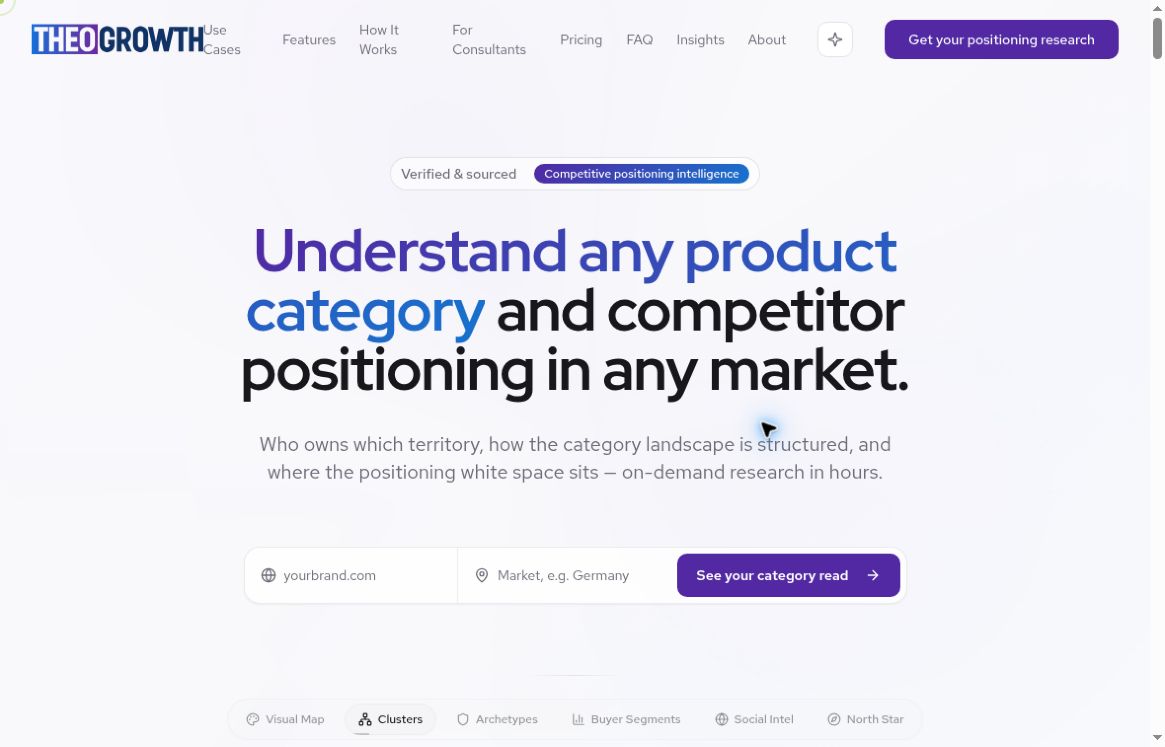
Image: screenshot of the official THEO Growth homepage, captured October 17, 2026. Provider marketing copy; no research report or connector was tested.
THEO AI, from THEO Growth, is a competitive positioning research platform for brand strategists, agencies and consultants. Its current offer focuses on understanding a product category and comparing how competitors present themselves. This article covers the product at theogrowth.com.
Earlier descriptions emphasized organizing business context for AI assistants. THEO’s company overview describes that background and its move toward positioning briefs. The useful connection remains structured research that people can reuse, but the current service should not be described simply as an unlimited document-upload tool.
What THEO Does
The official website describes a workflow that starts with a brand website and target region. THEO researches competitors and produces positioning profiles, comparisons and maps using its CLEAR methodology. These can help a team organize questions for a pitch, a market-entry discussion or a positioning brief.
THEO also advertises connections to ChatGPT and Claude so users can work with research in those assistants. Confirm the required connector and account before buying. This is not evidence of compatibility with every AI service, nor a guarantee that generated follow-up answers remain accurate.
A Practical Way to Evaluate a Report
Suppose an agency is helping a fictional reusable-bottle brand assess the UK market. Before requesting research, define the relevant customer, sales channel and geography. Decide whether to supply a known competitor list or pay for discovery.
- Write down the decision the research should inform, such as which product promise needs clearer evidence.
- Check whether the proposed competitors actually serve the same customers. A luxury gift brand may not be a useful direct comparison for a low-cost sports bottle.
- Open the cited sources behind a few important findings. Record their dates and distinguish a competitor’s advertising claim from demonstrated product performance.
- Separate an apparent gap in competitor messaging from proven customer demand. Use interviews or other appropriate research to test the latter.
- If you reshape the report through an AI connector, recheck important claims and keep the original references alongside the new draft.
This is an illustrative evaluation exercise, not a report we commissioned or a measured result. A useful report should make your next questions clearer; it does not establish that a proposed strategy will succeed.
Pricing: Reports, Custom Work and the Connector
The pricing page, checked October 17, 2026, labels these offers as launch pricing:
- You Provide Competitors: €149 per report using competitor URLs you supply.
- We Find Them: €249 per report with competitor discovery.
- Custom Research: from €2,500 per engagement.
- Custom Research Programmes: individually quoted.
- MCP add-on: from €49 per month to work with research through ChatGPT and Claude.
The terms specify EUR and exclude applicable taxes unless stated otherwise. Before ordering, confirm competitor limits, markets covered, delivery scope, connector charges and renewal or cancellation conditions. We did not complete checkout or verify a free tier. The previous free Mini Knowledge, $50 project and unlimited Agency Kit descriptions are not supported by the current pricing page.
Accuracy, Rights and Refund Limits
The site advertises a free rerun for a false claim, but that is not an unconditional refund or proof of error-free research. The terms disclaim complete or correct outputs and require professional judgment. They allow lawful business use of project outputs while retaining THEO’s rights in its platform. Refund requests are assessed individually and should be raised within 14 days of delivery.
Ask for the precise deliverables before purchasing: the homepage describes 15 report sections while the company overview mentions 10. Neither page establishes a guaranteed competitor count for your particular project. Treat advertised turnaround as a provider claim, not a service level we have tested.
Privacy: What “No Source Storage” Does and Does Not Mean
The privacy policy, updated March 9, 2026, says THEO does not keep copies of the source websites it analyzes or train AI models on customer data. It nevertheless stores generated intelligence until deletion, account data through the contract plus 30 days, and technical logs for 90 days. “Zero storage” would therefore be misleading.
The policy describes EU-based core infrastructure but lists limited US processing through Anthropic and Stripe with contractual safeguards. Do not translate that into a promise that all data stays in the EU. These are provider disclosures, not an independent security assessment. Check the current processor list, deletion process and client permissions before supplying confidential context or connecting another assistant.
Who It May Suit
THEO may suit a team that wants a structured starting point for competitive positioning and has someone available to challenge the findings. It is less suitable if you need guaranteed market coverage, verified customer demand or a substitute for strategic judgment. Compare the scope and review effort with your existing process and with other tools in our AI tools directory.
Review basis: public product, pricing and policy pages. No paid report, account workflow or connector was tested.