When a coding assistant reads a file, its next request can contain more than the question you typed. shim-cli is an open-source project that helps developers inspect that traffic and apply limited, client-specific privacy controls. Its most important qualification is also its clearest: it is a best-effort guard, not a guarantee that sensitive information cannot leave your computer.
This overview is based on the project’s documentation and release notes, not a hands-on security assessment. For more developer-focused products, browse our AI tools directory.
What shim-cli does
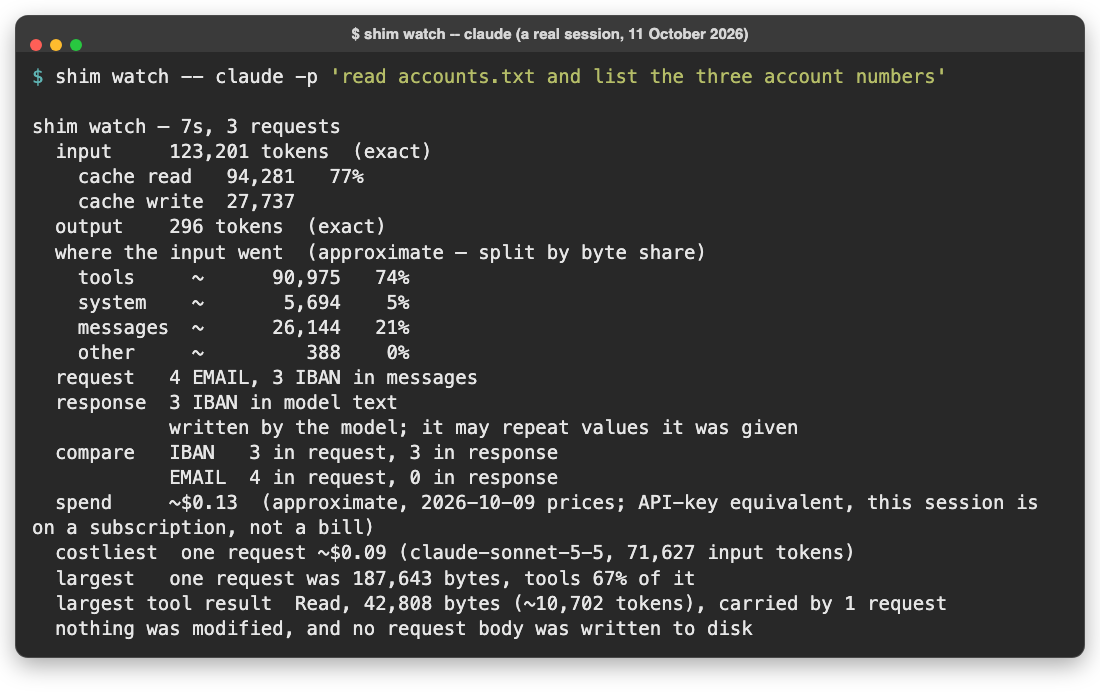
The project separates two jobs. Its monitoring workflow shows what a coding-agent session sent and estimates where tokens and spending went. Its installed hooks can inspect eligible interactions and, where the client permits it, mask detected values or stop an action.
These are different capabilities. Seeing a potential leak in a report does not mean the value was removed before transmission. Likewise, a token-cost estimate is not an invoice: subscription access, caching and provider pricing can change what a user actually pays.
The official version 1.2.3 release, dated October 20, 2026, addresses several practical edge cases. Among them is preventing an agent from writing a masking placeholder back into a real file as though it were the original value. The release also expands inspection of JSON tool arguments and records remaining gaps. That makes the release notes worth reading before an upgrade, rather than treating an update as an automatic security assurance.
Which coding clients are covered?
The privacy and trust-boundary documentation explains why coverage differs across Claude Code, Codex, GitHub Copilot CLI and VS Code:
- Claude Code: eligible successful tool results can be masked. Typed prompts cannot be rewritten by the hook; they can be reported or blocked instead. Shell commands, file writes and failed-command output have different limitations.
- Codex: typed prompts cannot be masked, and the documented integration does not inspect its tool traffic.
- GitHub Copilot CLI: prompt rewriting is supported, but its tool traffic is not inspected.
- VS Code: the integration reports findings and can stop certain actions under enforcement settings; it does not mask content.
The supported operating systems are macOS and Linux. Windows is not supported, and WSL is not verified. The packaged application requires CPython 3.10 or newer; installation choices and the bundled plugin hook have separate requirements described in the documentation.
A practical evaluation with dummy data
1. Start with a disposable project
Imagine a developer maintaining a small invoice-processing script. Before using an assistant with customer records, they create a separate test folder containing obviously fictional contact details and synthetic secret-shaped strings. They keep production files and credentials outside that test. This is an evaluation plan, not a result we obtained with shim-cli.
2. Separate observation from prevention
The developer first asks which supported client they use and which interaction they want to check: a typed prompt, a file read or a shell command. They consult the coverage table before expecting masking. They can then compare the tool’s report with their intended test input, without placing real secrets into a prompt to see what happens.
3. Check the returned file as well as the report
Suppose the agent proposes changing a configuration file after reading a redacted value. The developer reviews the diff to ensure that a placeholder has not replaced a working setting. Version 1.2.3 includes a protection for shim-issued placeholders, but ordinary code review and backups still matter. A failed or blocked action should be investigated, not routinely bypassed to finish the task.
Limits to understand before installation
Detection relies on recognizable patterns and can miss sensitive values. The project’s privacy documentation explains the boundaries, including interactions that cannot be rewritten. Traffic from a separate program or an unsupported path should not be assumed to pass through the same controls.
Installation changes how a coding client runs hooks. Review those changes and your organization’s policies first. Keep existing access controls, secret management and provider data policies in place; shim-cli is an additional inspection aid, not a substitute for them.
Price, licensing and who it suits
shim-cli is distributed under the Apache License 2.0. That does not include a paid model subscription or API allowance. Check the chosen assistant provider separately, and treat reported spending as an estimate with its stated assumptions.
It is most relevant to developers comfortable reading hook configuration and investigating outbound context. If you need uniform protection across every client, verified Windows support or a formal data-loss prevention boundary, its documented limits are reasons to look elsewhere rather than assume broader coverage.
Image: official shim-cli repository example, unchanged under the Apache License 2.0. The pictured October 11 session and approximate cost are historical provider examples, not a GPTOnline test or a current bill.