Updated October 15, 2026. This review is based on Replit’s public documentation. We did not build, run or deploy an application for this revision.
Replit combines a browser-based development workspace, AI-assisted app building and hosting. Its current Agent workflow is more relevant to evaluating the service than this listing’s older Ghostwriter description. It can help turn an idea into a project, but generated code, deployment choices and ongoing costs still need human review.
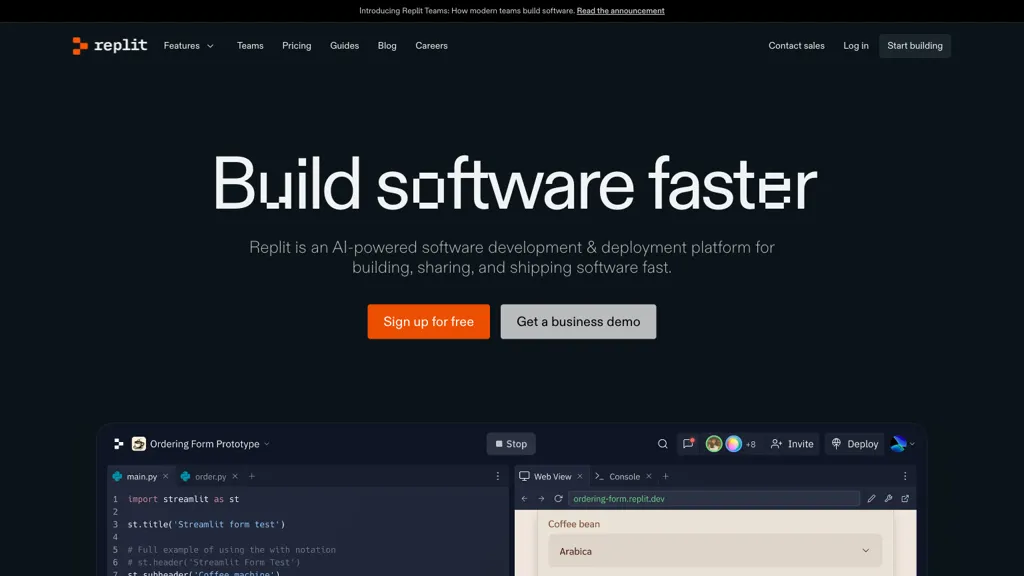
Historical Replit homepage image retained from this listing’s existing media. The interface and offers shown may differ from the current service; this is not a hands-on test result.
What Replit can help you do
Replit is worth considering when you want to develop a small application and manage its code and publication in one environment. Current Core documentation describes Agent, a visual editor, Design Canvas, planning tools and connectors. Collaboration allowances and the number of simultaneous tasks depend on the plan.
That convenience does not establish that an app is secure, correct or ready to serve customers. Review authentication, access permissions, dependencies and handling of user data before using a generated project beyond a prototype.
Separate membership, AI work and hosting costs
A subscription and a running application’s bill are different things. Included credits can be shared by paid Agent work, publishing, network transfer, database storage and AI integrations. A plan that allows more published apps does not promise unlimited free hosting.
Replit’s billing documentation distinguishes Free Mode within an allowance from paid Power and Max work. Paid tasks use effort-based pricing, so a complex request can cost more than a small change. Planning can also involve paid reasoning even when it does not modify the code. Check the mode and confirmation shown before starting paid work.
Hosting choices include Autoscale, continuously running Reserved VMs, Scheduled and Static publishing. Choose based on what the application needs, rather than treating a VM rate as the price of a Replit membership. Consult the current publishing cost documentation; storage and transfer can affect the total.
Current plans and prices
Replit’s public web pricing checked October 15, 2026 lists the following base subscription choices in US dollars. Taxes and additional usage charges may apply.
- Starter: a free option with daily Agent credits subject to a monthly cap, limited building features and one published app that expires after 30 days.
- Core: US$20 billed monthly, or US$216 billed annually, shown as US$18 per month on annual billing. Its US$20 monthly credit allocation expires after one month.
- Pro: the base tier costs US$100 billed monthly, or US$1,080 billed annually, shown as US$90 per month on annual billing. The base allocation is US$100 in monthly credits; Pro credits have a two-month expiration window. Higher tiers are available.
Compare the current official pricing and allowances before subscribing. An annual monthly-equivalent figure does not mean the annual subscription is charged one month at a time. Subscriptions renew unless cancelled; review the applicable cancellation and refund terms before paying. Legacy plans and mobile-store offers can differ from these default web prices.
A practical first project: a fictional equipment checkout tracker
For an initial evaluation, use invented equipment and borrower names. Ask for a small tracker with an item list, a checkout date, a return action and a visible availability status. Set requirements before requesting a polished design:
- An unavailable item cannot be checked out a second time.
- Returning an item changes its status consistently.
- Empty borrower names produce a clear validation message.
- Refreshing the page behaves as expected for the chosen storage design.
- Any administrative actions have an explicit access-control requirement.
Start with one small requirement, inspect the change and then add the next. Test normal and invalid inputs, including double submissions and missing values. This is a hypothetical test plan, not a report of results obtained in Replit. Do not load real borrower records or confidential files into an unreviewed prototype.
Budget and deployment checks
Review resource-level usage as well as the subscription price. Replit notes that usage reporting can lag, and spending limits can block usage-based services. A cap can therefore affect the availability of a published app, not just stop new AI work. Decide what downtime would mean before depending on that control.
Before public deployment, check the application’s environment variables, permissions, storage needs and expected traffic. Keep a way to recover working code and data. A successful build or preview is not evidence that those operational checks have passed.
Mobile access and native-app limits
Replit offers mobile apps as well as its web workspace, but those access options do not make every native-app workflow identical. Its native mobile documentation describes React Native and Expo, with native iOS work directed to the web editor. App Store submission still requires Apple’s developer membership and review. Android building and previewing are supported, while Replit currently says Google Play publishing is not yet supported.
Check data controls before using private work
Do not treat a private project as a blanket promise that the provider never processes its contents. Replit’s privacy policy covers submitted code, project files, prompts and generated outputs, among other information.
The current Pro Agreement permits content use for model development and improvement. Its linked model-improvement guide describes a Pro opt-out in Settings → Personalization: it applies to new content after opting out and does not delete earlier content. Do not assume that this Pro control or an Enterprise commitment applies identically to every plan. Review your applicable agreement and connected integrations before sharing confidential material.
Who should consider it?
Replit may suit people who value a connected coding, AI and hosting workflow and can review its output and usage. Teams with strict data-handling requirements, fixed-cost hosting expectations or specialized infrastructure needs should assess those requirements separately. Compare the current plan documentation with a small representative project before making a larger commitment.
For more development products, browse the Developer Tools directory. Check Replit’s official pricing page for current allowances and billing choices.