ProtoMap by HoundDog.ai maps relationships between gRPC services and Protobuf messages so developers can investigate the impact of a code change across repositories. It also exposes that context to compatible AI coding agents through Model Context Protocol (MCP). Its main use is answering questions such as which services call an endpoint or where a message field travels before you change it.
This makes ProtoMap relevant to teams working on distributed systems, where the repository currently open in an editor may show only part of a dependency chain.
Why ProtoMap is worth a look now
HoundDog.ai issued its ProtoMap launch announcement on November 9, 2026. An earlier official demonstration was dated October 29. The November announcement describes the product’s role in tracing the reach of gRPC and Protobuf changes across monorepos and microservices.
The announcement is company-provided information, not independent proof of coding performance. This profile focuses on the documented workflow rather than the vendor’s benchmark multipliers.
What ProtoMap analyzes
The product page describes a graph of service connections and message relationships across codebases. Developers can inspect this context directly or let an MCP-compatible agent query it. The supported protocol scope is gRPC and Protobuf; REST and GraphQL are presented as forthcoming, so they should not be assumed available for a current deployment.
The documentation distinguishes its deterministic source scanner from optional AI features. The scanner reads source code without requiring a build. AI can support the assistant and the review of uncertain flows. Uncertain relationships remain labeled rather than becoming a guarantee of complete understanding.
That distinction helps set expectations: a dependency graph can give an agent better evidence to investigate, but developers still need to review proposed edits and run the appropriate tests.
Is ProtoMap free?
The official pricing page lists a free ProtoMap Local Scanner for locally available code, local API graphs, and use with MCP-compatible agents. Enterprise is custom-priced and adds centralized, continuous repository coverage with cloud or on-premises deployment options.
HoundDog.ai also sells a separate Privacy Scanner. Its pricing should not be used as a ProtoMap price. If you enable the optional assistant, you need your own connected model API key and should account for any charges from that provider. A free scanner does not make every component of an AI-assisted workflow free.
How to assess it on a real project
The quickstart and official repository provide the setup route. The published prerequisites include Git, Docker Compose 2.23.1 or later, 4 GB of RAM, and 20 GB of disk space. Review the deployment choice and configuration before scanning private code.
Hypothetical example: a team plans to change a Protobuf field used in an order service. Before editing it, the team wants to identify callers and downstream services that may rely on the current field.
- Start with the relevant repositories, including known consumers rather than only the service being edited.
- Build the graph and inspect the field’s reported relationships.
- Ask the connected agent which callers and message paths need review, then follow its references back to source.
- Compare the results with at least one dependency the team already knows about and inspect uncertain relationships.
- Use the findings to plan code review and compatibility tests before merging.
This is a suggested evaluation scenario, not a tested result. Missing repositories or unsupported patterns can limit what any source-derived map tells you.
Where does the code context go?
Do not equate local scanning with a workflow that never sends data anywhere. Scans send graph descriptions and short code snippets to the configured ProtoMap Server. The AI-provider documentation says optional graph reviews send evidence about the reviewed flows to the connected provider. Chat sends relevant graph context, which can include code snippets.
Before using it with employer or client code, establish where your server runs, which provider handles assistant requests, and whether that data flow is permitted. Self-hosting and an optional assistant give deployment choices, but the configuration you select determines the actual boundary.
Who is ProtoMap best suited to?
ProtoMap is worth evaluating for teams making cross-service changes in gRPC/Protobuf systems, especially when developers or coding agents repeatedly search across repositories to understand impact. A small application with no relevant protocol usage has less reason to add it. Compare other development workflows in our AI tools directory.
Source note: This profile uses official product, documentation, and pricing information checked on November 9, 2026. It is not a hands-on review or an independent benchmark.
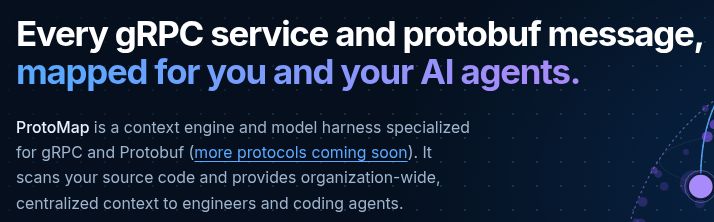
Product image: screenshot of the introduction on HoundDog.ai’s official ProtoMap product page, captured November 10, 2026.
Featured image: Screenshot of the public HoundDog.ai mark asset linked by ProtoMap’s official documentation, captured November 10, 2026. Source: official ProtoMap documentation.