OpenAI says its models improved AMD’s flagship GPU designs by up to 14% across power, performance and area, measured against baselines AMD engineers had already heavily optimized. OpenAI reports the work took less than five months, which it calls “roughly a year of progress achieved in less than 5 months,” and AMD has already folded some of the model-written changes into a design it sent for manufacturing.
The models did the work by rewriting the SystemVerilog code that describes the chip’s circuits, known as RTL. OpenAI says its models reasoned about that code “at the level of an expert microarchitect,” rewriting circuits that perform calculations, control operations or move data, then used Synopsys tools to verify each rewrite preserved the block’s behavior and to measure the tradeoffs in power, performance and area. The result is the clearest sign yet that AI models are starting to improve the very hardware the next models will be trained on.
https://x.com/OpenAI/status/2123100386638877054
What AMD got from the work
“We have partnered with AMD on PPA improvements and seen up to 14% improvement relative to heavily optimized baselines on the flagship GPU IP,” OpenAI wrote. PPA stands for power, performance and area, the three-way tradeoff chip designers balance in every block. AMD added the remaining changes to its production design files for use in future versions, and it separately verified single-digit percentage PPA gains across key blocks of its upcoming next-generation flagship CPU using designs written by OpenAI’s models.
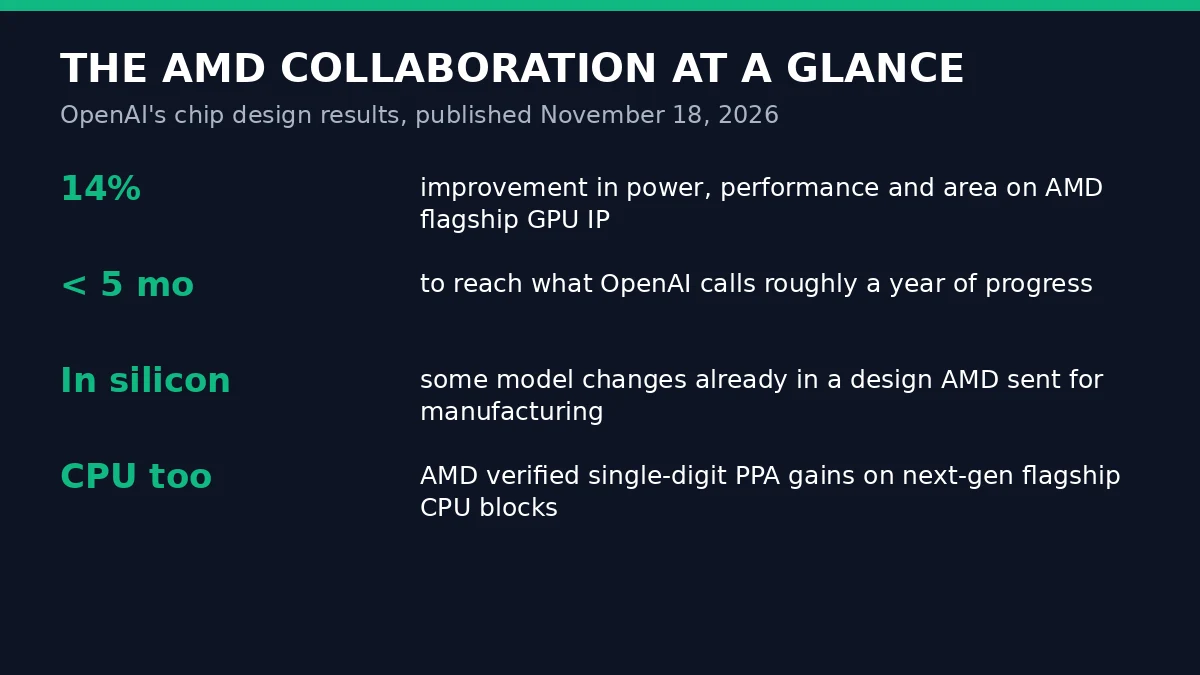
The AMD collaboration at a glance. Graphic: GPTOnline
The same approach already paid off on OpenAI’s own silicon. The company started using GPT-4o to help design Jalapeño, its first custom inference chip, in early 2025. Across the broader Jalapeño effort, model-proposed changes cut standard-cell area by about 13% in the vector unit and 10% in the matrix unit, and those optimizations were proven on real silicon during the chip’s bring-up. One multiplier redesign used about 15% less cell area while cutting latency from two clock cycles to one. OpenAI said in August that AI assistance helped move Jalapeño from initial design to tapeout in nine months.
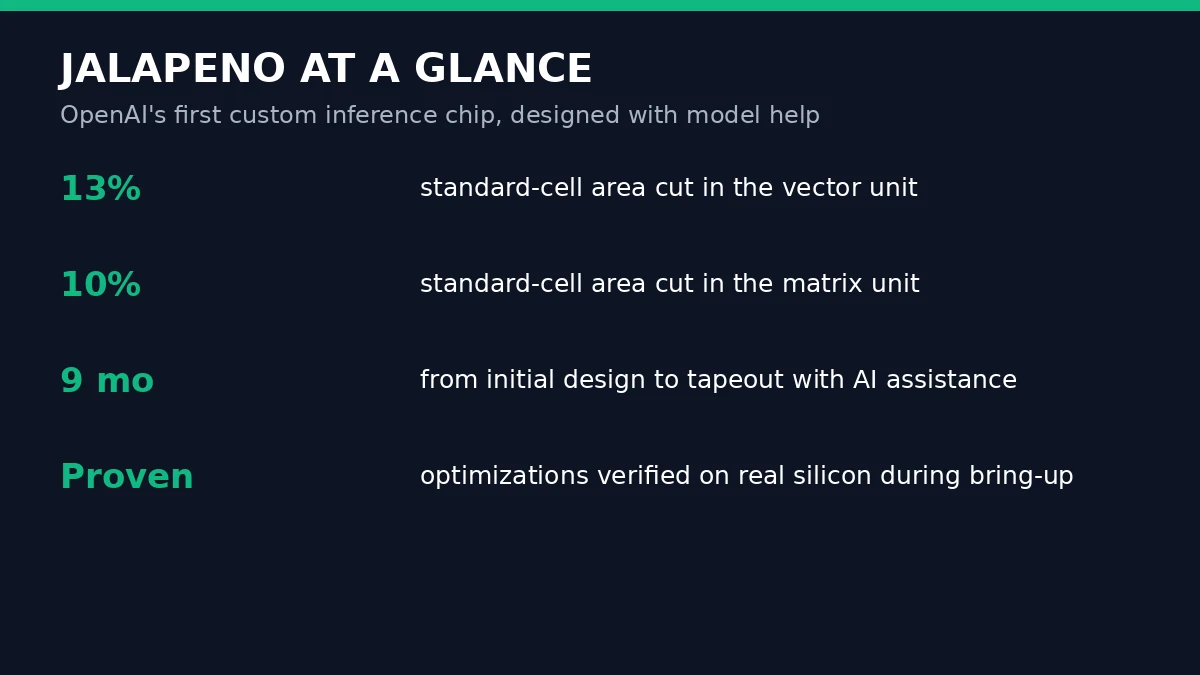
Jalapeno at a glance. Graphic: GPTOnline
How the models measure up
To track how chip design skill improves from one model generation to the next, OpenAI tested five models on two open-source 32-bit RISC-V cores, PicoRV32 and the Ibex core used in OpenTitan’s security chip. Each model was asked to increase throughput, first by optimizing the existing hardware description and then by designing a core from written requirements. The full evaluation ran 9,881 scored runs across both tasks, both cores and all token budgets.
At a comparable budget of about 112,000 tokens per run, GPT-6.2 Astra had the highest average score on both cores in the optimization task, and GPT-6.1 Sol also outscored GPT-5.6 Sol on both. In the design-from-specification task, GPT-6.2 Astra passed a mean score of 0.7 on PicoRV32 near 112,000 tokens and averaged about 0.75 on Ibex. All five models scored higher when designing from written requirements than when improving existing code, a gap OpenAI flags as a caveat, since models starting from a specification can leave out features present in the original cores, such as performance counters and extra instructions.
What is next: GPT-Synopsys
OpenAI is now partnering with Synopsys to train GPT-Synopsys, a model built to use Synopsys electronic design automation tools the way expert chip designers do, under a multi-year agreement covering joint development, go-to-market work and revenue sharing. The goal is to ground model-driven chip design in the trusted verification tools engineers already use, so model-proposed changes can move from experiment to production designs with proper checks. “We have demonstrated that our models can explore new processor architectures in RISC-V evals and contributed net new improvements on top of sophisticated production designs such as Jalapeño and AMD’s next generation flagship GPU and CPU,” OpenAI wrote.
The limits matter as much as the headline number. The 14% figure is a maximum on selected circuits, not a gain across a whole GPU, and OpenAI does not break it down by power, speed or area. The post carries no statement from AMD itself, and human engineers still verify every model-proposed change before it reaches silicon. Even with those limits, the fact that AMD put model-written edits into a design headed for manufacturing moves AI-assisted chip design from a lab demo to a production reality.