Updated on October 20, 2026.
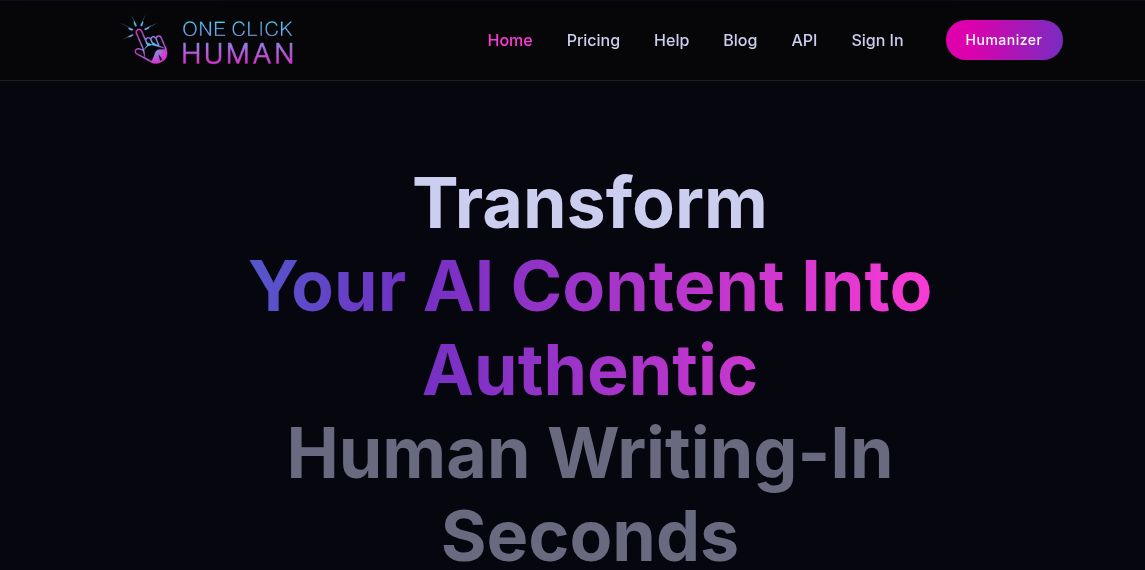
Featured image: screenshot of OneClickHuman AI’s official website, captured October 20, 2026. Vendor presentation, not a hands-on test.
OneClickHuman AI is a web-based writing tool for revising AI-generated drafts. Its advertised purpose is to make wording sound more natural while improving readability and retaining formatting. Potential uses include blog drafts, emails, social posts, and marketing copy that still need an editor’s judgment.
The official homepage promotes detector avoidance, grammar improvements, and search-performance benefits. Those are vendor claims, not verified guarantees. Rewriting a passage does not establish that it is accurate, original, appropriately sourced, or acceptable under a school’s or employer’s disclosure rules.
Current features and workflow
The service advertises support for more than ten languages and formatting preservation. Current paid cards mention Lightning mode, a content generator on Advanced, and API access on Enterprise. The earlier article’s fixed Lite/Premium two-mode description was not verified in the current plan display.
Bulk conversion is labelled coming soon on the homepage. Do not assume that a large word allowance means a ready-to-use batch upload feature. The public product and pricing pages were reviewed, but no text was submitted and no output quality or detector performance was tested.
Monthly plans and the limited free trial
The pricing page displays these US-dollar subscriptions:
| Plan | Price | Word allowance and important limits |
|---|---|---|
| Basic trial | Free for seven days | 10,500 words during the trial; 1,500 daily; 325 per article |
| Business | US$10 monthly | 50,000 words monthly; up to 1,500 per article; Lightning mode |
| Advanced | US$34 monthly | 200,000 words monthly; Business features plus the advertised content generator |
| Enterprise | From US$75 monthly | Starts at 500,000 words monthly; API and dedicated support listed |
The free option is a seven-day trial, not a verified perpetual 1,500-word daily plan. The comparison table labels paid plans as having no daily limit, but their monthly allowances still apply. Confirm any promotional discount, taxes, renewal terms, and the final charge before subscribing.
Lifetime-labelled word packages
A separate Lifetime tab lists 50,000 words for US$20, 100,000 for US$40, 200,000 for US$68, and 500,000 for US$150. Each card lists access to all modes, faster processing, premium support, and a 1,500-word article limit.
These are finite word packages, not unlimited words for life. The public cards do not explain every expiry, replenishment, or refund condition. Ask the provider to clarify those terms and whether a package covers your intended API or generator workflow; do not infer equivalence with an Enterprise subscription.
How to evaluate a rewrite
- Start with a short draft whose facts and intended meaning you can verify.
- Keep the original and compare wording, numbers, names, links, and citations after revision.
- Check whether the result sounds appropriate for the audience rather than simply more elaborate.
- Restore any important nuance or evidence the rewrite removes.
- Follow the relevant publication, workplace, or academic rules for AI assistance.
For example, an editor could compare two versions of a product introduction for clarity and concision, then fact-check the final copy independently. A detector score would not replace that review or prove authorship. Avoid submitting confidential documents until the provider’s current data-handling terms satisfy your requirements.
The verified access route is the website; native mobile or desktop apps were not established from the reviewed pages. Sources checked: October 20, 2026. This is a public-information overview, not a hands-on performance review.