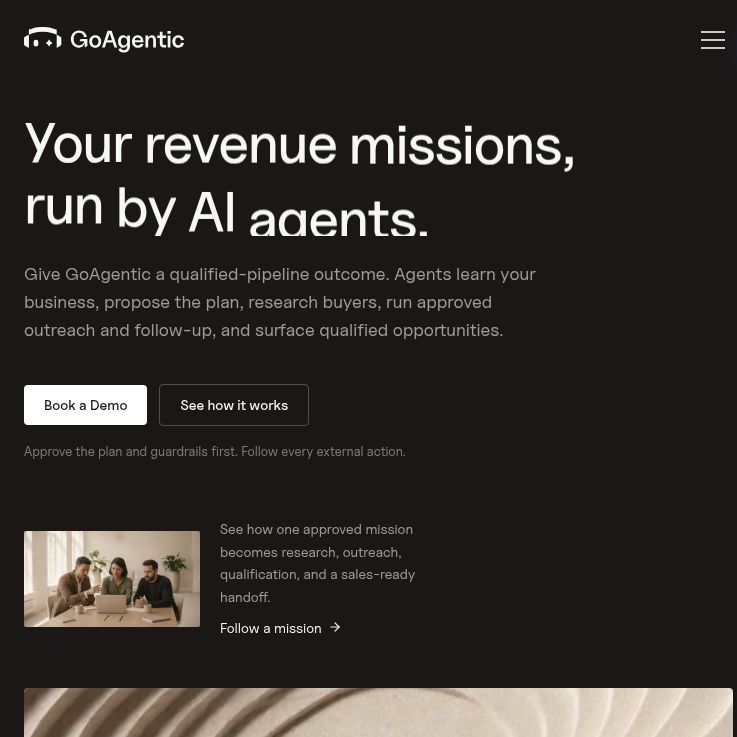
Updated October 18, 2026. GoAgentic AI is a B2B sales platform built around what it calls Revenue Missions: an approved plan for researching buyers, contacting them, handling replies and identifying qualified opportunities. A team sets the audience, business goal and limits, then supervises the agent’s work through approvals and activity records.
Screenshot of the official GoAgentic homepage, captured October 18, 2026. The headline and workflow preview are provider marketing; no demo, outreach campaign or revenue result was tested.
The current GoAgentic website offers a demo and founding access to its managed service. It describes calendar booking and sales-owner handoffs alongside outreach. These are vendor-described capabilities, not results from our own campaign test. The figures shown in its example dashboards should not be treated as guaranteed customer outcomes.
What does a GoAgentic Revenue Mission include?
The official product page describes a connected workflow:
- Buyer research: find relevant accounts and people, with evidence behind the recommendations.
- Message preparation: use the approved offer, supporting proof, brand voice and account context to personalize outreach.
- Follow-up execution: schedule work within the agreed plan and stop pending outreach when replies or risk signals require it.
- Reply qualification: separate potential opportunities, objections and opt-outs using criteria set by the team.
- Supervision: review significant changes, inspect external actions and pause a mission or all external activity.
A positive reply is not automatically a qualified opportunity. Define what must be true about the organization, buyer, problem and next step before a conversation counts. Ask the provider to demonstrate how uncertain classifications, conflicting CRM records and requests to stop are handled.
GoAgentic pricing and access
Checked October 18, 2026: the official pricing page lists the following offer. The site’s structured product data identifies the founding price currency as USD.
Offer: GoAgentic Managed founding plan
- Published terms: US$750 per month, paid month-to-month
Offer: Prospect allowance
- Published terms: Up to 1,000 eligible prospects researched and engaged per month
Offer: Price protection
- Published terms: Founding price locked for twelve months; this is separate from the month-to-month billing commitment
Offer: Core scope
- Published terms: Email-first service, managed sending infrastructure, CRM integration, teammates, approvals and reporting; no separate per-seat or mailbox fee
Offer: Larger requirements
- Published terms: Higher-volume or enterprise work scoped separately
The vendor identifies $995/month as a planned standard price after the founding cohort, not the current founding charge. Founding customers are expected to provide structured product feedback. Activation includes confirming fit, permitted sending, integrations and the first mission.
Confirm taxes, cancellation/refund terms and the meaning of an eligible prospect in the commercial proposal. The allowance is not a promise of 1,000 replies or meetings. No free managed-platform tier or trial allowance was listed in the pricing reviewed.
A practical first mission
Hypothetical example: a small software company wants to revisit 40 previous demo inquiries whose contacts explicitly requested follow-up. The goal is to identify three current projects worth a sales conversation. These numbers are example boundaries, not GoAgentic plan limits or predicted results.
- Prepare the business facts: provide accurate product capabilities, supported customers and approved evidence. Mark claims the agent must never make, such as an unverified integration or promised return on investment.
- Check the audience: reconcile the list with current permissions, opt-outs, existing customers and open opportunities. Remove anyone who should not receive the proposed message.
- Define qualification: agree on a relevant problem, a suitable buyer and a clear request for a next conversation. An email open alone should not qualify someone.
- Review the proposed work: inspect the source evidence and sample messages. Set a short operating window, a small sending cap and human approval for replies involving pricing, commitments or uncertainty.
- Evaluate the handoff: review the context behind each opportunity, correction workload, opt-out handling and sender health. Stop or revise the mission if the evidence or execution does not meet your standard.
Compare qualified conversations with the amount of review required. GoAgentic explicitly declines to guarantee meetings or revenue; the offer, market and buyer response still matter.
Privacy, permissions and outreach rules
The privacy policy, dated August 28, 2024, covers account and usage information, retention and security limitations. Its no-AI-training statement is specifically about data obtained through the Gmail API. It should not be expanded into a blanket promise covering every uploaded document, CRM field or other data source.
The terms say users retain rights to their data while granting a license for providing and improving the service. Before connecting business systems, confirm the required permissions, AI processors, data retention and deletion procedures, and who can approve external actions.
There is also an important policy question: the acceptable-use policy prohibits unsolicited email and spam, despite the site’s outbound-sales positioning. It contains placeholder date and contact fields. Obtain clarification about your intended audience and campaign before activation; product marketing is not permission to send messages that the provider’s rules prohibit.
Is the free Apollo exporter the same product?
No. GoAgentic also offers a free Apollo lead-export Chrome extension for exporting available Apollo search data to CSV. Its product page says no GoAgentic account is required. This utility does not include the managed Revenue Missions service.
Its privacy documentation needs clarification: the product page promises local processing without sending exported lists to GoAgentic, while the linked extension privacy policy, dated January 13, 2025, says data may be transmitted to a designated GoAgentic account. Do not assume an unconditional local-only guarantee. Review the current extension permissions and Apollo’s rules before installing or exporting data.
Who should consider GoAgentic?
GoAgentic may suit a B2B team with a clear offer, a permitted audience and someone responsible for reviewing evidence and exceptions. It is a poor fit for buyers expecting guaranteed meetings, unrestricted bulk outreach or a low-cost email-writing tool alone.
The main service is web-based; supported CRM connectors and provisioning should be confirmed during the demo. The separate Chrome extension is verified, but an official native mobile app was not established in this review. Compare alternatives in the GPTOnline AI tools directory by scope, review controls, data handling and total operating cost.