Updated October 17, 2026
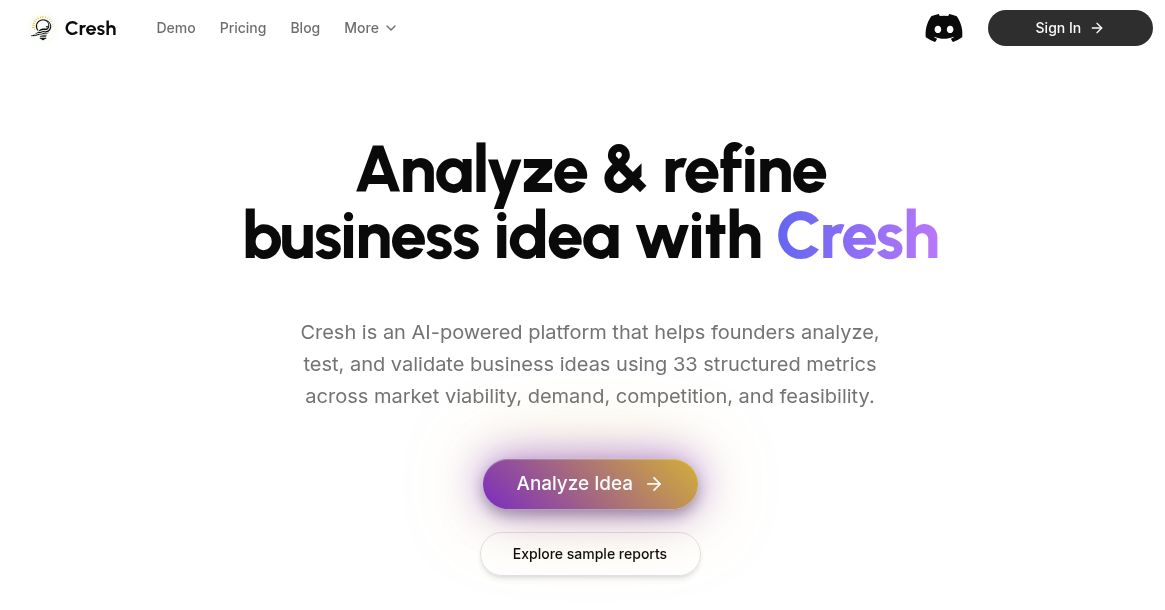
Screenshot of Cresh’s official homepage, captured October 18, 2026. Source: official website. Provider marketing shown for identification; no idea submitted or report tested.
Cresh AI is a browser-based tool for examining an early business idea through structured AI feedback. Its official website describes a full report covering 33 metrics, with scores and suggestions intended to help founders identify questions worth investigating.
An AI report can organize your thinking, but it does not establish that customers will buy, that a market estimate is correct or that a startup will succeed. Use Cresh as a starting point for research and testing, rather than a certificate of market validation. This overview is based on public documentation; we have not submitted an idea or tested a paid report.
What can Cresh help you examine?
The features page organizes its framework around market strategy, market viability, product viability, risk and financial viability, and technical viability. Other pages use different group labels, so these should be understood as the provider’s framework rather than a universal business standard.
The useful question is what lies behind each score. Does a proposed market look reachable? Is the problem specific enough? What competing alternatives already exist? What assumptions about costs, technology or customer behavior need evidence?
According to the workflow guide, a guided wizard helps describe the problem, audience, solution, competition and business model. The resulting analysis includes explanations and improvement suggestions. A full analysis includes a PDF report. We have not verified export formatting or the accuracy of its references.
Fast, Full and free analysis
- Fast Analysis: the current features comparison lists six metrics spanning all five groups, without a PDF report.
- Full Analysis: the comparison lists all 33 metrics and a PDF report.
- Free access: official pages disagree. The features page lists an overall score only, while the workflow guide describes five of 33 metrics. Check the account’s actual offer before relying on either limit.
A longer report supplies more AI-generated assessment, not more customer interviews. Neither the metric count nor a polished PDF demonstrates that the underlying assumptions have been independently verified.
Current pricing and Cresh Coins
The public homepage displays the following coin packages. Prices are reproduced with the site’s dollar symbol; the currency code, taxes and checkout terms were not independently confirmed. Check the current pricing page and purchase summary before paying.
- Fast Analysis: $6 for one Cresh Coin. This covers one Fast analysis.
- Base: $9 for two coins. Advertised for one Full or two Fast analyses.
- Popular Choice: $18 for six coins. Advertised for three Full or six Fast analyses.
- Premium: $25 for ten coins. Advertised for five Full or ten Fast analyses.
These allowances indicate one coin per Fast analysis and two per Full analysis. Do not interpret the package names as a verified monthly allowance. The terms also discuss automatically renewing subscriptions, possible coin expiry and generally non-refundable payments subject to exceptions or law. Confirm whether your specific purchase is one-time or recurring, when unused coins expire, and whether a rerun consumes more coins. The earlier promotional prices of $3, $8 and $12 are not the current public package prices.
A practical way to use an idea report
Fictional example: a founder is considering a scheduling service for independent music teachers. A useful idea description would specify the customer, the scheduling problem, existing workarounds, the proposed service and a tentative pricing model. It should distinguish observations from guesses.
- Write a bounded brief. For example: “Independent piano teachers who manage lessons by text message; a proposed tool for rescheduling and reminders.” Avoid unsupported claims that every teacher needs it.
- Review the report’s reasoning. If it suggests strong demand, identify what evidence would actually support that conclusion. Check cited sources and their dates rather than repeating the score in a pitch.
- Choose one uncertainty to test. Speak with potential users about their current process, frequency of the problem and alternatives. Do not treat agreement with a hypothetical idea as a purchase.
- Run a small, transparent test. A manually delivered scheduling pilot could reveal whether teachers use the service and what creates extra work. Record what happens without inventing demand.
- Revise the idea. Separate what the AI suggested from what people actually said or did. Compare later versions using the same assumptions where possible.
This is an editorial exercise, not a Cresh customer success story. It is also useful in a classroom or workshop where the aim is to critique assumptions rather than reward the highest AI score.
Privacy, ownership and sensitive ideas
Cresh’s terms say users retain their ideas and generated reports, with a limited service-related processing license. They also state that specific ideas are not used for model training beyond immediate analysis generation. These are provider commitments, not an independent privacy audit.
The privacy policy describes external processors, including AWS, MailerLite and Google, and possible processing outside the European Economic Area. Account deletion removes the user record and replaces identifiers in existing entries; this should not be described as verified deletion of every report. The stated 30-day server-log period is not a universal retention limit for all submitted content.
Before entering an unpublished invention, client information or confidential business plan, ask which AI providers receive the text, how report deletion works and what retention applies. The reviewed pages do not provide a sufficiently specific answer to every model-provider and report-retention question. Use a non-sensitive summary when detailed disclosure is unnecessary.
Who is Cresh best suited to?
Cresh may suit founders, product teams and students who want a repeatable set of prompts for examining an idea. It is less suitable as the sole basis for a launch decision or as evidence that investors or customers have endorsed a concept. No dedicated mobile-app listing was verified in this review.
Start by deciding what you want to learn, then choose the smallest analysis that addresses that question. For other research and planning options, browse our AI tools directory.