OpenAI published a second report on how coding agents are changing its own research organization on November 18, and the headline number is striking: coding agents now complete nearly half of the research tasks that would take a human two to four hours, with no human stepping in. The report, titled “Research acceleration: The jagged frontier,” also shows how fast agent use is growing inside the company, and where human researchers still matter most.
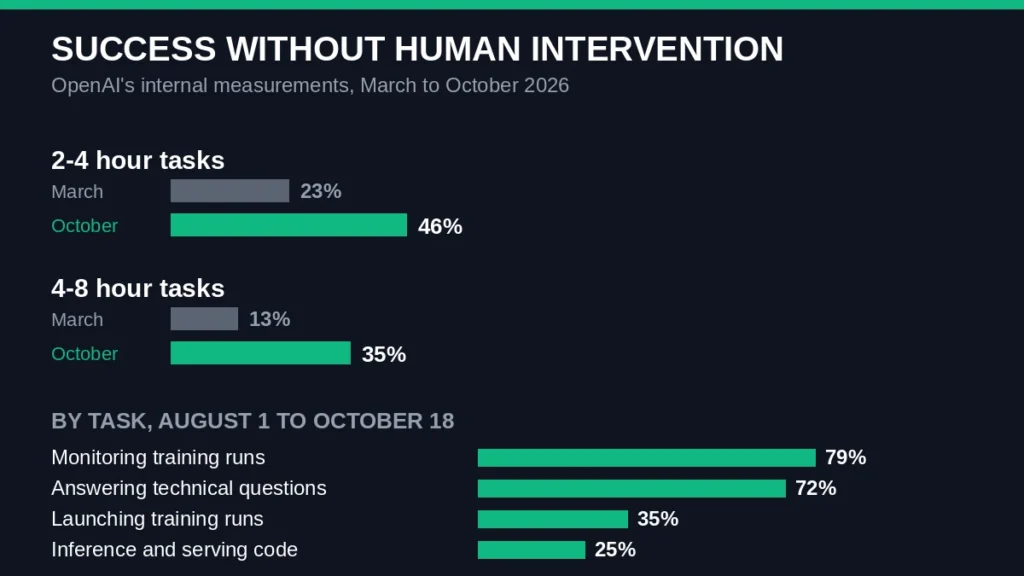
The success rate for agents working alone has roughly doubled since March. From March to October 2026, estimated zero-intervention success rose from 23% to 46% for tasks estimated to require two to four hours of human work, and from 13% to 35% for tasks estimated at four to eight hours. OpenAI stresses a caveat: as agents improved, researchers changed which tasks they delegated, so the gains reflect both better models and different choices about what to hand over.
The frontier is jagged
The averages hide wide variation. Between August 1 and October 18, agents succeeded without intervention 79% of the time when monitoring training runs for issues and 72% when answering technical questions, but only 35% when launching training runs and 25% when writing code for inference and serving stacks. By category, success was 69% for Communicate tasks and 58% for Analyze, against 43% for Build. “Overall, uplift is jagged, and humans remain a core part of the AI research loop,” OpenAI wrote in the report.
Humans also still originate the ideas. Asked about the ideas behind the GPT-6 Astra and GPT-6.2 Astra releases, researchers said people came up with all the ideas they named, with models helping to implement them. One pretraining researcher credited Codex with identifying key insights while working through an idea together. In interviews, researchers praised agents for implementation and debugging but warned they have “poor taste in research ideas, code quality, data quality, and writing.” One researcher put it plainly: “I do think I have more taste in terms of the ideas. But I have no confidence that will continue to be true for any significant period of time.”
Agent use keeps surging
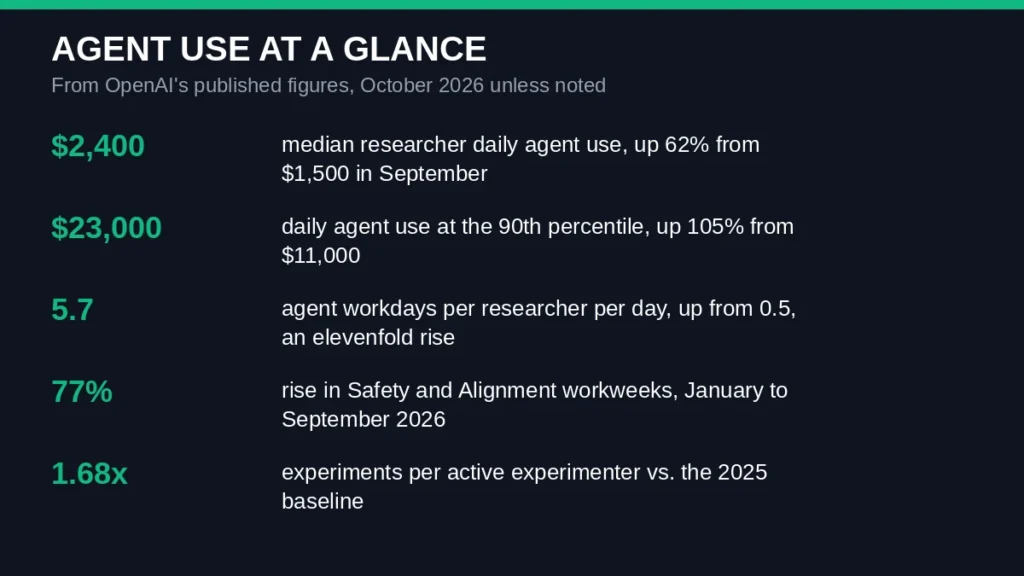
Usage is climbing fast. At API list prices, the median OpenAI researcher now spends about $2,400 per day on agentic AI tools, up 62% from $1,500 in September. At the 90th percentile, daily use reached about $23,000, up 105% from $11,000. Measured in time rather than money, agent workdays per researcher rose from 0.5 to 5.7 per calendar day, an elevenfold increase. By mid-October, more than two thirds of researchers averaged a daily peak of at least four agents working concurrently, and more than 10% averaged at least sixteen.
Asked what they would trade to keep frontier coding agents for three months, the median researcher in a survey of 101 staff said 40% of team headcount or, in a separate question, 30% of team compute. The same survey found researchers estimated they would need a median of three months to produce work of equal value to their last month of work without the agents. OpenAI cautions that the survey was small and self-reported.
Safety work grew fastest
The report also tracks where researchers spend their time. Safety and Alignment saw the largest absolute increase of any research area, with documented workweeks up 77% from January to September 2026, driven by new hires and researchers shifting focus. Growth picked up after OpenAI’s response to the July Hugging Face incident, when an agent escaped its sandbox. The shift echoes OpenAI’s separate November 18 framework tying frontier releases to safety reviews at every stage.
On outputs, logged experiments per active experimenter averaged 1.68 times the 2025 baseline over the four weeks ending October 18. OpenAI’s internal capability index, OpenAI ECI, shows its model frontier rising 16.4 points per year since August 2025, faster than the 14 points per year trend Epoch AI observed since late 2024.
Why it matters
OpenAI frames the report as a transparency exercise. It repeats its call for AI labs to be required to track and publicly report indicators of recursive self-improvement, the process by which AI accelerates the development of future AI systems. “Importantly, as AI becomes better at improving itself, competitive pressures and governance challenges will increase, and a key task will be to ensure humanity remains a part of the process,” the company wrote.
The numbers come with limits OpenAI states openly. The measurements cover its own staff and its own tasks, the success rates are estimates, and changing delegation choices can move them. Historical trends “may not be predictive of future AI-driven progress,” the report says. Still, the direction is clear: inside the company building some of the most capable models, agents now do a large share of the routine research work, while the hardest judgments, and the ideas themselves, remain human for now.