Meta has agreed to pause issuing its new nonvoting Class C shares while investors sue over the plan, a court-approved order in Delaware litigation says. Bloomberg reported that Meta will hold off on distributing the shares while the legal fight plays out, a setback for the stock plan Meta designed to fund its artificial intelligence expansion without diluting chief executive Mark Zuckerberg’s control.
The pause covers both a stock dividend and any other Class C issuance during pretrial and trial proceedings, according to the court-approved stipulated order. Trial is scheduled for April 19-23, 2027, in Wilmington. The order still lets Meta’s restated charter take effect on January 19, 2027, along with the amendment and restatement of its 2025 Equity Incentive Plan. If a ruling that the charter is invalid becomes final and cannot be appealed, Meta must promptly file corrections rescinding both the charter and a related preferred stock designation.
Why Meta wanted Class C shares
Class C was built as an AI funding tool. The shares would carry the same economic rights as Meta’s existing stock but generally no voting rights, with one Class C share declared for each outstanding Class A and Class B share. Meta’s board approved the recapitalization on October 19, 2026, and holders affiliated with Zuckerberg delivered written consent the next day through 315.8 million Class B shares representing about 56.1% of the company’s voting power. That consent was the only shareholder approval required, and no separate Class A vote was needed.
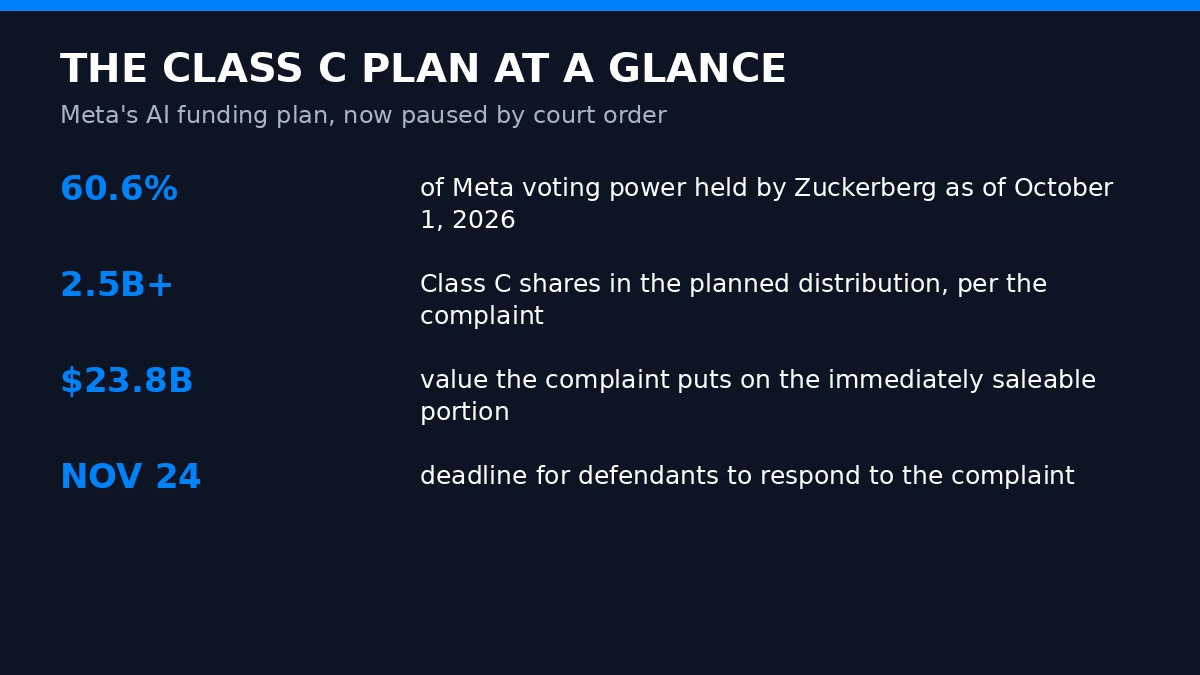
The Class C plan at a glance. Graphic: GPTOnline
The point was money for the AI buildout. Meta’s special committee presented the recapitalization as a way to finance AI-driven infrastructure and strategic initiatives without reducing existing shareholders’ voting power, and management wanted Class C available for future financing as early as the end of 2026. Meta disclosed that Zuckerberg held about 60.6% of its voting power as of October 1, 2026, and that he would not support a significant equity financing that reduced it. Under the Founder Alignment Agreement, 20% of the Class C shares going to Zuckerberg and his affiliated holders would be freely saleable, with another 2.5% released for each qualifying quarter of his continued full-time leadership, and all restrictions released after 32 qualifying quarters.
The investor challenge
Investors moved fast. On November 6, Chancellor Kathaleen St. J. McCormick consolidated ten lawsuits and appointed the California State Teachers’ Retirement System and PFA Pension as lead plaintiffs, designating the Steamfitters complaint as the operative one. That group holds more than 5 million Meta shares, worth over $3.2 billion. The complaint seeks to block the reclassification before more than 2.5 billion Class C shares are distributed and begin trading, arguing the deal would let Zuckerberg monetize more of his economic interest while keeping voting control. Based on Meta’s pre-announcement trading price, the complaint values the immediately saleable portion of Zuckerberg’s initial Class C distribution at about $23.8 billion.
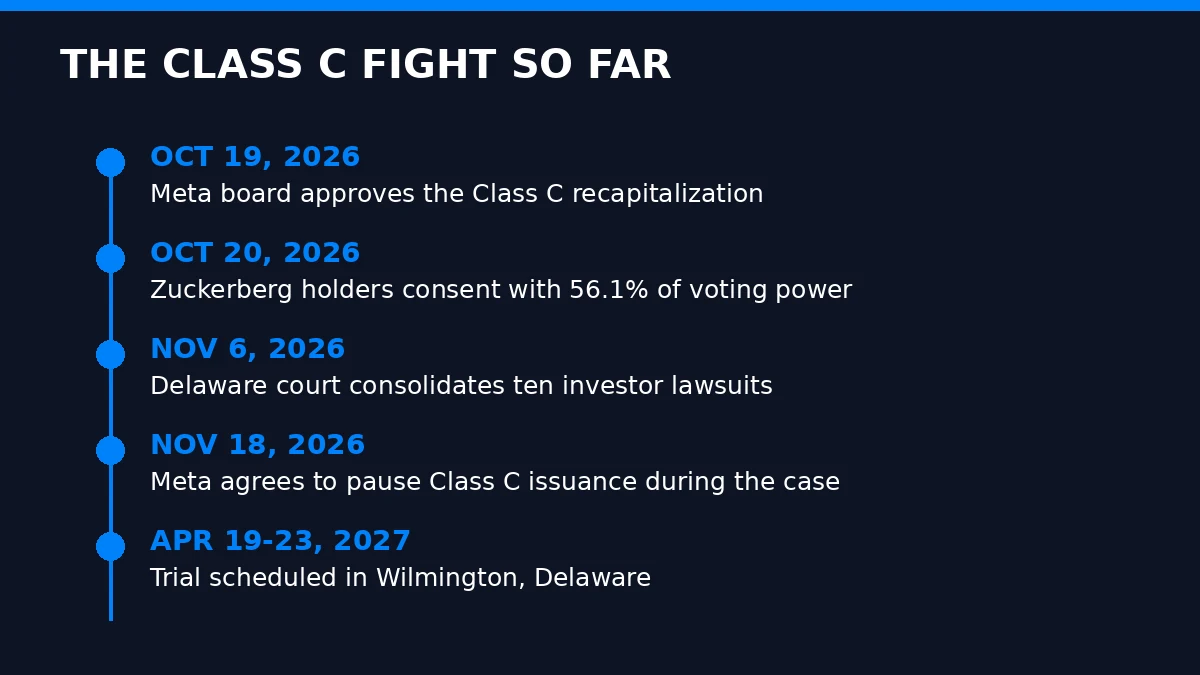
The Class C fight so far. Graphic: GPTOnline
The plaintiffs allege that Zuckerberg and the other directors breached fiduciary duties, that the special committee lacked independence and did not act in good faith, and that the transaction should have been conditioned on approval by unaffiliated Class A stockholders, who had no vote on the recapitalization. The case now runs on a tight schedule: defendants must respond to the complaint by November 24, 2026, fact discovery closes February 17, 2027, pretrial briefs are due April 13, 2027, and post-trial briefs April 30, 2027.
Why it matters
The pause does not kill Meta’s AI funding plan, but it delays the equity currency Meta said would support future AI growth, and it ties that financing option to a court examination of whether the deal protected unaffiliated shareholders. Meta still has other ways to raise money, and it said it had sufficient capital for its current needs, but the Class C structure was designed for scale: nonvoting stock it could sell, including to sovereign funds facing US rules on voting stock, without touching Zuckerberg’s vote. Until the Delaware court rules, that option stays on hold, and the trial in April 2027 will decide whether Meta can use it at all. The dispute is also a reminder that the AI spending race is now big enough to reshape corporate control itself, and investors are willing to litigate over who pays for it.