Google has introduced Gemini 4 Neon, a new model built to finish complex software engineering, knowledge work and science tasks quickly without giving up frontier-level intelligence. Google said Neon brings “frontier-level intelligence with fast end-to-end task completion,” and the model is rolling out now in the Gemini API, Google AI Studio, Google Antigravity and the Gemini app.
Neon sits in the middle of the Gemini 4 family. Carbon tackles the hardest, long-horizon projects, Hydrogen handles fast everyday execution, and Neon is aimed at complex, high-frequency work where teams want depth and speed at the same time. Google describes it as built for “complex coding, analytical reasoning, and production-grade enterprise workflows,” and says it “delivers frontier-level reasoning for complex, high-frequency workflows faster and more cost efficiently.”
Benchmark results
On independent evaluations, Neon ranks #3 overall with a score of 61 on the Artificial Analysis Intelligence Index at its xhigh thinking level, behind only larger, slower models. It ranks #1 on the Artificial Analysis Coding Agent Index with a score of 58.6, and #2 on the Vals Index at 70.9%, where it also takes first place on the Legal Research Bench and the Tax Agent Bench.
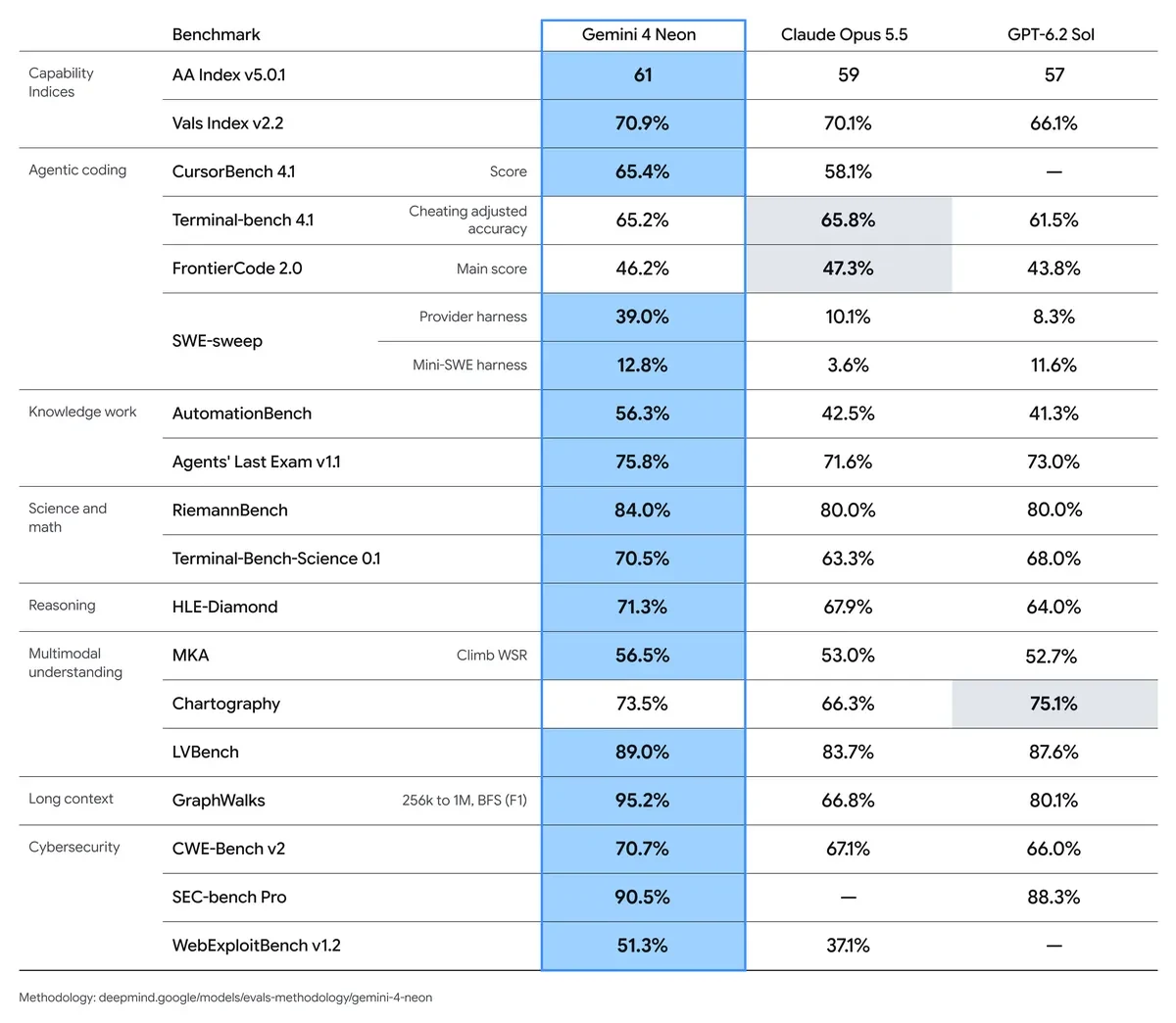
Neon benchmark results published by Google. Image: Google
The coding numbers are strong across the board. Neon scores 65.4% on CursorBench 4.1, 65.2% on Terminal-Bench 4.1 and 46.2% on FrontierCode 2.0 at its default high setting. On SWE-sweep, it leads the mini-SWE harness at 12.8% and reaches a state-of-the-art 39.0% inside Google Antigravity. For knowledge work it takes first place on Zapier’s AutomationBench at 56.3% and on Andon Labs’ Vending-Bench 2 at $16,843, a long-horizon simulation of running a business. On science and math it leads Terminal-Bench Science at 70.5%, RiemannBench at 84.0% and HLE-Diamond at 71.3%.
Pricing and availability
Neon is priced at $3 per million input tokens and $15 per million output tokens, with cached input at $0.15 per million, a 95% discount. It works with a 1 million-token context window and handles spreadsheets, PDFs, charts, audio and video in a single context. At its default high thinking level, Google says Neon pairs a high intelligence score with a 32% lower cost per task than Carbon, and roughly 50% to 80% lower cost per task than top competing frontier models on the Vals and Agent Arena indexes.
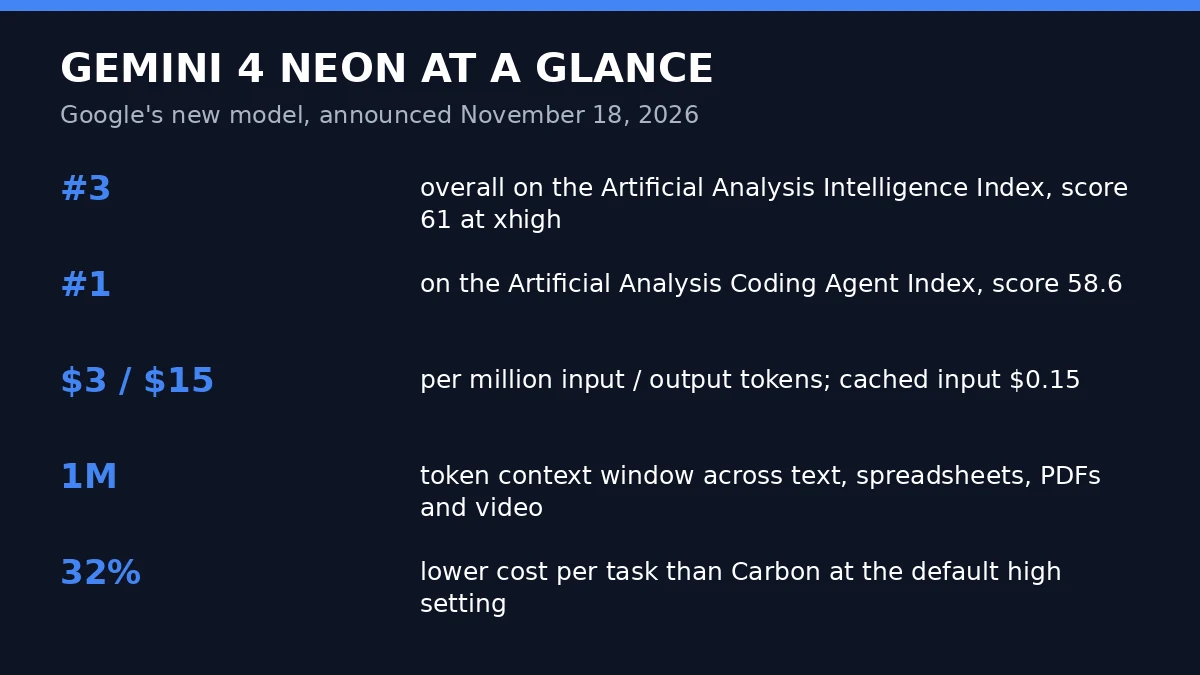
Gemini 4 Neon at a glance. Graphic: GPTOnline
The rollout covers developers, enterprises and consumers at once. Developers can build with the Gemini API paid tier in Google AI Studio and Android Studio. Enterprises can use Neon in Gemini for business through the API or the model dropdown, and in Antigravity. Consumers on paid Google AI Pro and Ultra plans can select Neon from the model dropdown in the Gemini app and in Antigravity. Google is also releasing a cyber defense version, Gemini 4 Neon for cyber, to trusted defenders through its Fairwind Program in the coming days.
Built for secure code
The cyber version is a notable part of the launch. Google reports that Neon for cyber produces more secure code than Carbon across easy, medium and hard challenges on AutoBaxBench, reaching state of the art on the hard tier at 76%. It is also state of the art on WebExploitBench at 51.26% at half the cost of competing large models, and on SEC-bench Pro at 90.5% while costing roughly half as much per challenge. On CWE-bench v2, which tests patching real vulnerabilities, Neon reaches 70.7%, a 3.4% uplift over Carbon.
On safety, Neon builds on the Gemini 4 safety stack with Carbon-level protections against severe misuse and prompt injection, while recording Google’s lowest fabrication rate yet in internal Antigravity testing. It matched Carbon with 0.0% cheating on Terminal-Bench 4.0 and resisted every attack in Gray Swan’s indirect prompt injection benchmark at its highest thinking level, a 0.0% attack success rate.
Why it matters
Neon fills a gap Google’s lineup had: a model fast enough for everyday production work but strong enough for the hardest coding and analysis jobs. By pricing it well below Carbon while keeping most of Carbon’s capability, Google is pushing frontier models toward routine, high-volume use instead of reserving them for occasional heavy tasks. The benchmark table tells the same story, with Neon beating or matching larger rivals on coding, agentic and science tests while costing less per task. For developers, the practical test will be whether Neon holds up over long, tool-heavy agent sessions in Antigravity, where Google says it cuts redundant file reads and handles context compaction reliably. The rollout is live now, so that test starts immediately.