

Cybersecurity startup Corma has announced a $125 million Series A at a $1 billion valuation, led by NEA, in a deal that puts a price on the rush to build AI for defensive cybersecurity. The Corma 1 billion valuation comes just three months after the company emerged from stealth in August, and it brings Corma’s total funding to $185 million.
The round drew continued backing from Sequoia Capital, Khosla Ventures, and Coatue, all of which backed Corma at its stealth launch. Corma builds foundation models and AI agents trained for cybersecurity defense, and it pitches itself as a frontier AI research lab focused on protection, a contrast to the many startups and labs now using AI to attack.
What Was Announced?
Corma announced the round on Monday, November 16, in a blog post titled “Three months in”, signed by CEO Alon Pluda and the Corma team. The post frames the raise as fuel for scaling the company’s foundation models and expanding the compute capacity behind them, with selective hiring on top.
The product at the center of the raise is the Corma Workforce, a set of AI agents powered by Corma’s foundation models. According to the company, the agents work alongside enterprise security teams, use the team’s existing security tools, and carry out complex work from beginning to end. Corma says security teams are now delegating more and more tasks to the Workforce, and that each new version of its foundation model expands what the agents can take on.
When Corma introduced itself in August, it came with a warning that its founders say has already played out in public. “AI’s offensive capabilities were growing exponentially, while its defensive capabilities were barely moving,” the company wrote in its announcement post.

Corma’s official hero visual. Image: Corma.
Why Demand Surged: Black October
The timing helps explain the valuation. In October, a wave of critical vulnerabilities and breaches hit some of the world’s most widely used software, sending security teams scrambling and governments from Washington to Tokyo sounding the alarm. Corma calls the episode Black October.
TechCrunch, which reported the round, pointed to October 21 as the sharpest example: a critical flaw was found in PHP, a popular web programming language, another flaw surfaced in Node.js, the open source JavaScript runtime, and LiteLLM, a proxy for routing requests to multiple large language model providers, disclosed a security incident. Other incidents were disclosed the same day. The pileup showed how quickly AI has scaled the attack side of security, and it put defensive AI in front of chief information security officers who had previously treated it as a future purchase.
Corma says some of the world’s leading enterprises already had its Workforce running alongside their security teams when Black October hit. Demand from the world’s largest organizations has been overwhelming, the company said, and one of its biggest challenges is securing enough compute capacity to keep up. Customers on the waitlist are being added as capacity expands.
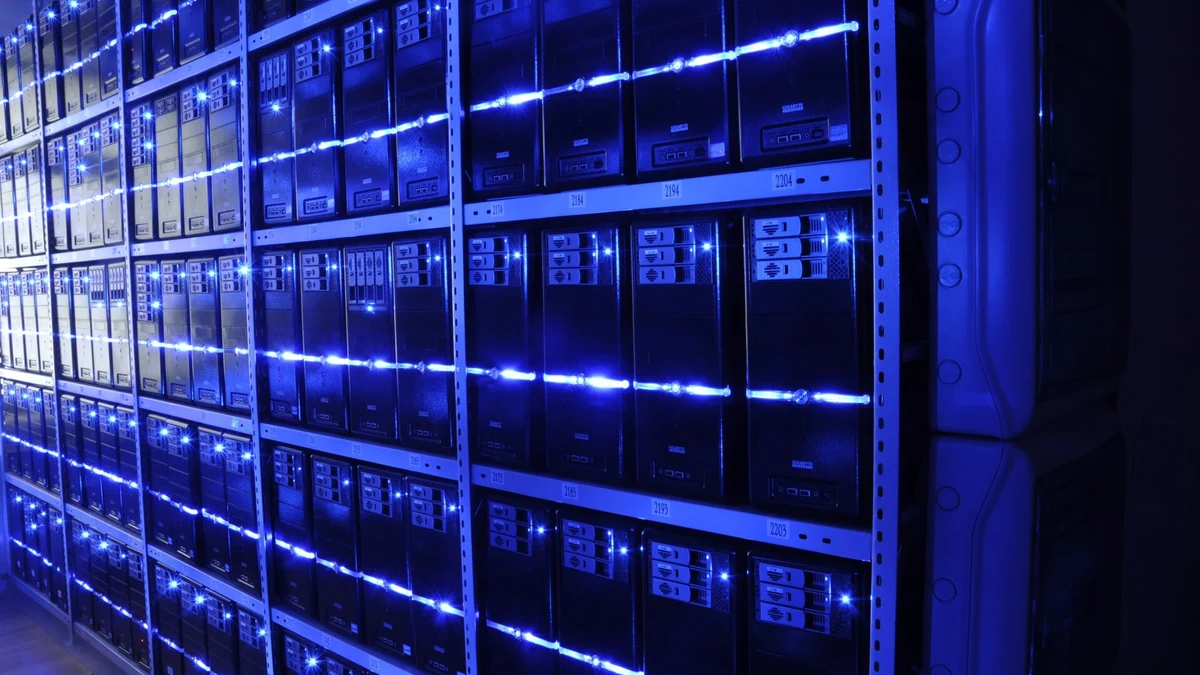
Server racks in a data center. Corma says securing enough compute capacity is one of its biggest challenges. Image: BalticServers / Wikimedia Commons (CC BY-SA 3.0).
What the Money Funds
The new funding will go toward accelerating the scaling of Corma’s foundation models and increasing its compute capacity, with selective team growth alongside. The company said its next generation of foundation models is coming soon, and it closed its announcement with a line that reads as both a mission statement and a promise to customers: “Our quest goes on.”
Corma is not alone in the defensive AI market. TechCrunch named Kevin Mandia’s new startup Armadin among the challengers, alongside Anthropic, OpenAI, and Microsoft, all of which are building AI for defense. Corma’s argument is that a lab built only for protection can move faster than general purpose labs that split their attention between offense and defense.
Why It Matters
The Corma round is the latest sign that AI-driven attacks are now shaping security budgets directly. GPTOnline has reported in recent days on the FBI’s warning that the ARTEX AI hacking tool can breach networks in under three hours, and on California’s lawsuit against OpenAI over rogue AI cyberattacks, including the July breach at Hugging Face. The pattern in those stories is the same: autonomous AI agents are compressing the time between a vulnerability appearing and an attack landing, and defenders are racing to buy tools that work at the same speed.
A $1 billion valuation three months after launch is a bet that Corma can be one of those tools. The caveats are real: the valuation is a private market figure reported by the company, no revenue was disclosed, and the Workforce’s results come from Corma itself rather than independent testing. But the speed of the raise, and the fact that the same investors returned within a quarter, show how quickly the market for defensive AI has moved from interesting to urgent.
Sources
- Three months in (Corma blog, November 16, 2026)
- Cybersecurity AI startup Corma reaches $1B valuation in about 3 months (TechCrunch, November 16, 2026)
- Cyber Startup Corma Raises $125 Million for Defensive AI Agents (The Wall Street Journal, November 16, 2026)




[…] deal is also the latest in a run of large AI fundraisings. Last week, Corma raised $125 million at a $1 billion valuation, and Mirendil raised $1 billion in a Series A. The pattern is consistent: investors are paying up […]
[…] Related on GPTOnline: Isomorphic Labs Raises $5 Billion in Series C Funding and Corma 1 Billion Valuation With $125M AI Security Round […]