Meta has released Muse Ember, its smallest and cheapest AI model to date, aimed squarely at the repetitive, high-volume work that AI agents do all day. Meta Superintelligence Labs announced the model on Monday, November 9, 2026, pricing it at $0.10 per million input tokens, a fraction of what larger frontier models charge.
Ember is the fourth model released under Meta’s Muse brand. The family began with the mid-weight Spark in April 2026, followed by Spark’s open-source twin Glimmer in August and the frontier model Wonder in October. Where Wonder is built to plan and reason through hard problems, Ember is built to execute, cheaply and at scale.
What Ember is built for
Meta describes Ember as a model “designed for complex reasoning execution and the work agents repeat all day: tool calls, coding subtasks, routing, extraction, and long document parsing.” The pitch is not raw capability but cost per task: an agent that makes thousands of small calls a day needs a model that is good enough and cheap enough to run constantly.
Ember is also multimodal. It works across text, images, and audio, so Meta says “agents can read screenshots, charts, and scanned documents, or work from voice memos, meeting recordings, and video without a separate model.” That flexibility matters for the volume jobs Meta is targeting, where an agent might sort through a pile of scanned paperwork one minute and triage meeting recordings the next.
Pricing and availability
Ember is available now on the Meta Model API and in Muse Code, Meta’s coding assistant. Pricing is $0.10 per million input tokens and $0.50 per million output tokens, according to Meta’s announcement.
For comparison, Meta’s larger Muse Spark 1.3 is listed at about $1.25 per million input tokens and $4.25 per million output tokens, according to published pricing. Ember’s input price is roughly one-twelfth of its bigger sibling, which is the whole point: when an agent runs the same small job ten thousand times, the per-call price decides whether the workflow is affordable at all.
How it compares
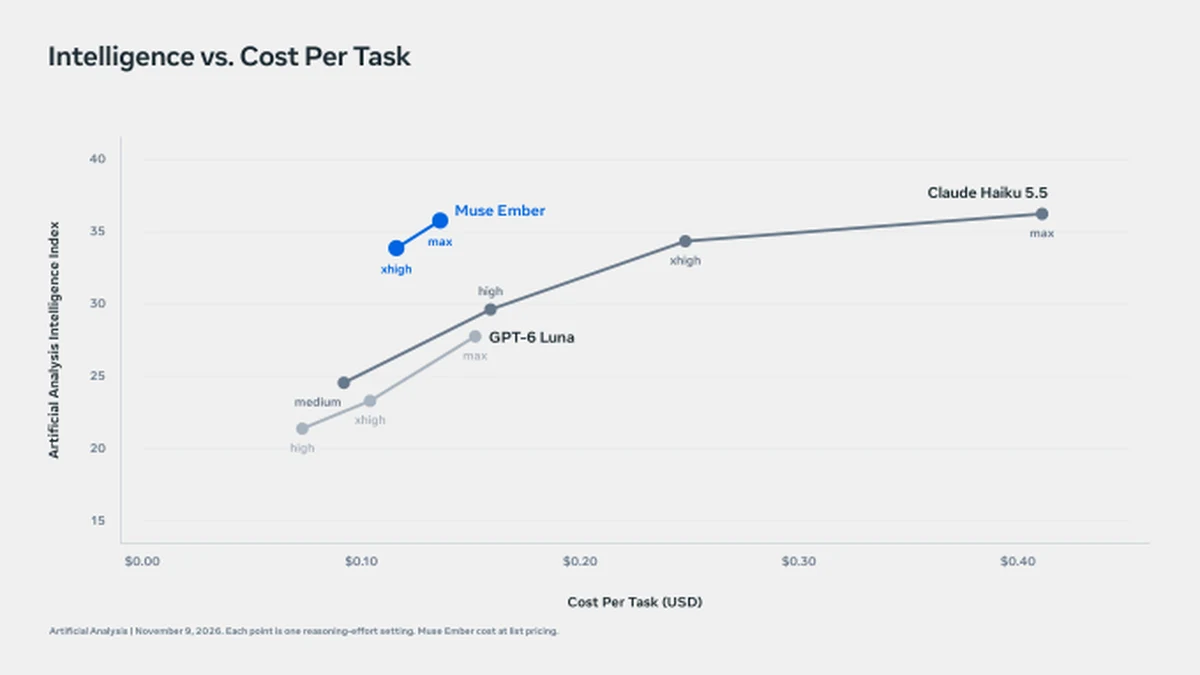
Meta is leaning hard on cost-per-task comparisons. Using Artificial Analysis composite benchmark scores, the company presents Ember as cheaper and smarter than Anthropic’s Claude Haiku 5.5 and OpenAI’s GPT-6 Luna. Meta says Ember achieves performance comparable to Claude Haiku 5.5 at roughly one-third of the cost per task, while scoring higher than GPT-6 Luna across all of Luna’s reasoning settings.
The company also claims Ember is cost-competitive with open-source rivals such as DeepSeek V4.1 Flash and GLM 5.3 Flash. One caveat: the comparison figures come from Meta’s own announcement, built on Artificial Analysis data, and no independent benchmark results for Ember itself have surfaced yet. The chart Meta published tells the story it wants told, and outside testing will show whether the value claim holds up in real workloads.
Built to work with Muse Wonder
Ember is not meant to replace Meta’s flagship. It is designed to pair with Muse Wonder inside an agentic harness, with the bigger model doing the planning and the smaller one doing the volume. As Meta puts it, “Muse Wonder plans, Muse Ember handles the volume.”
Take a customer-support agent. A heavier model might establish the rules for handling a particular issue, then hand the routine work to Ember to apply those rules across tens of thousands of cases. The same split applies to coding, document review, and data extraction: Wonder decides, Ember executes.
Why it matters
The launch shows where the model race is heading. Frontier capability still grabs headlines, but the money in agents is increasingly decided by unit economics. A model that is slightly less capable but dramatically cheaper can win the high-volume jobs that make agents commercially viable, and every major lab now has a small, cheap model fighting for that work.
For Meta, Ember is also a statement about its developer platform. The Muse family now covers the full range, from the open-source Glimmer to the frontier Wonder, and Ember gives the Meta Model API a low-cost entry point for developers building agents that need to run all day without running up a large bill. If the cost-per-task numbers hold outside Meta’s own charts, Ember could become the default workhorse for the routine half of agentic computing.