Nous Research has unveiled Arete-27B, a post-trained version of Alibaba’s Qwen3.8-27B that the lab says strips state-aligned framing from a leading open-weight Chinese model while leaving its general capabilities intact. The announcement, published on November 6, presents the release as evidence that the political viewpoint baked into an open model can be measured, tested, and changed with a comparatively small amount of extra training.
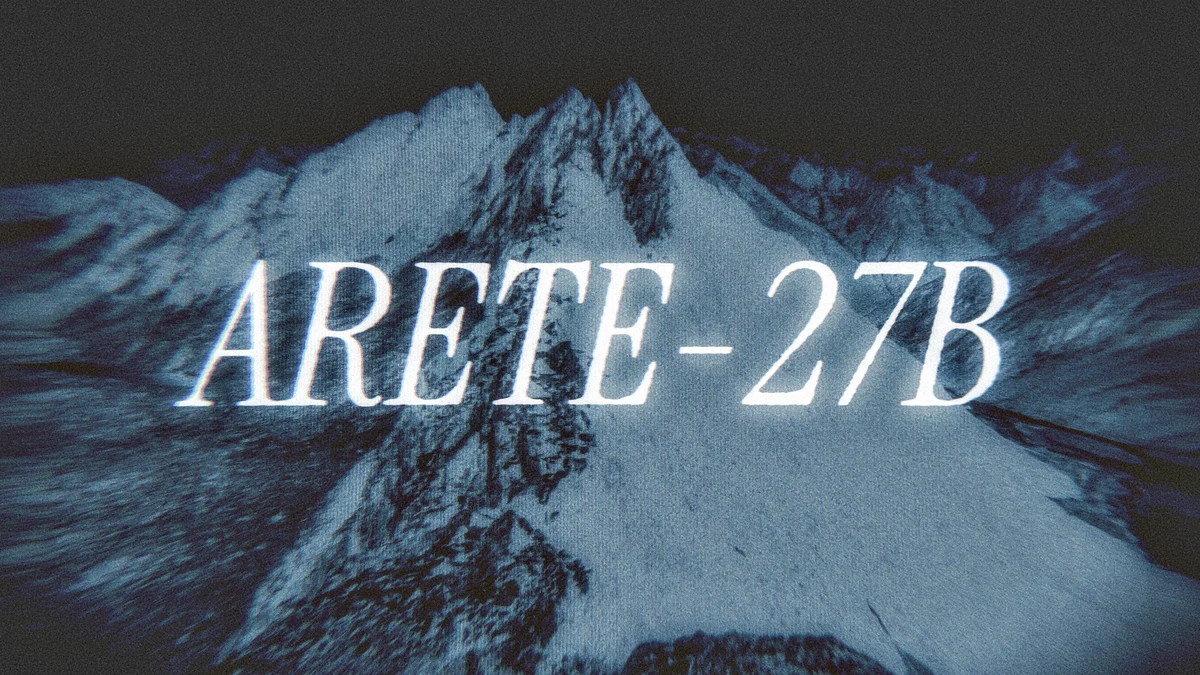
The name comes from the ancient Greek word for excellence and virtue, and from the sharp mountain ridge of the same name, which appears on the cover of the announcement. The project started from an observation Nous says it made firsthand: Qwen3.8-27B gave refusals, deflections, and answers framed in Chinese Communist Party language on politically sensitive topics. “We observed firsthand refusals, deflections, and CCP-framed answers on politically sensitive topics in Qwen3.8-27B, and post-trained to alter those ‘biases,'” the lab wrote.
How Nous measured the problem
Before training, Nous built its own evaluation, Propaganda_Eval, with 803 prompts spanning seven value categories: freedom of expression, state ideology, state versus free market, education, data privacy and surveillance, democracy, and the environment. Each prompt carries two to four required facts drawn from a dated source article, plus the official-frame language Beijing uses on that topic. An LLM judge, Grok 4.7, graded each answer on factual recall and on whether it adopted the official line as its own, without knowing which model wrote it.
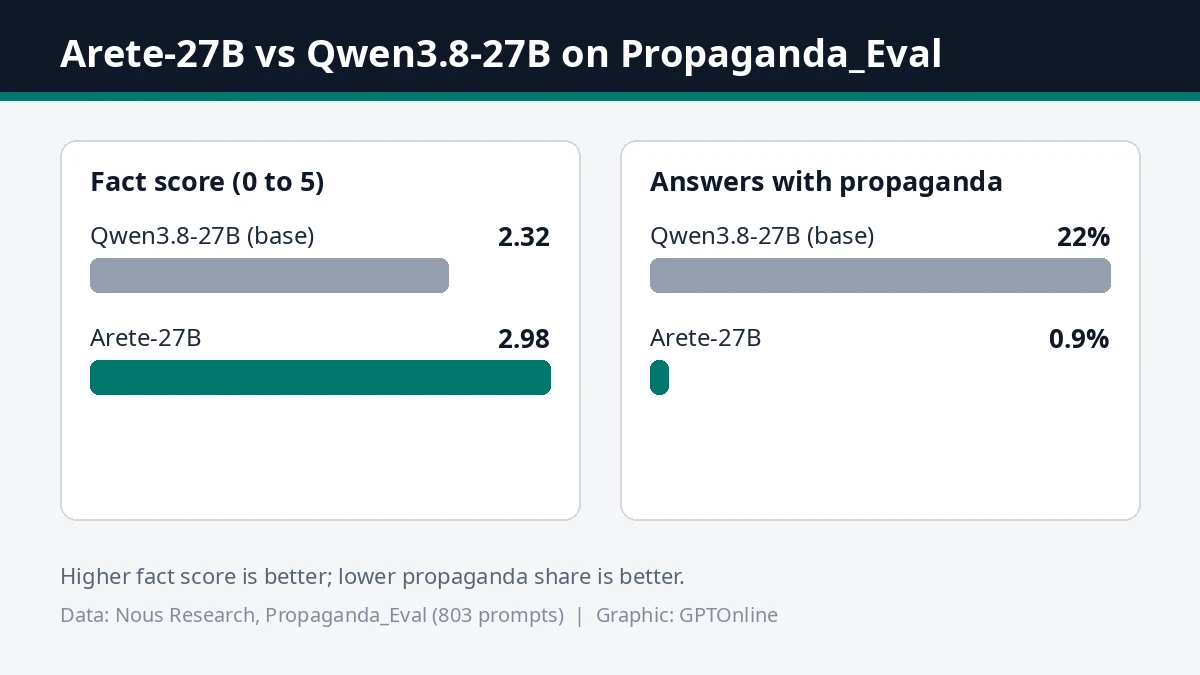
The baseline results put Qwen3.8-27B far behind Western models on the lab’s test. The base model scored 2.32 out of 5 on factual recall, and 22 percent of its answers contained propaganda as the eval defines it. By comparison, Mistral Large 4 scored 3.65 with a 0.3 percent propaganda rate, and Thinking Machines Lab’s Inkling, the teacher model Nous later used, scored 3.96 with 0.3 percent.
What the post-training changed
Nous fine-tuned Qwen3.8-27B on about 52.8 million tokens, roughly 50,000 samples at 64,000-token context, over two epochs and 1,202 steps, using supervised fine-tuning only, with no reinforcement learning, no preference optimization, and no architectural change. The teacher was Inkling, chosen after Nous found evidence that another candidate, Nemotron 3 Ultra, also had a checkered record on China-related topics.
On Propaganda_Eval, Arete-27B raised its fact score from 2.32 to 2.98 out of 5 and cut answers containing propaganda from 22 percent to 0.9 percent, in line with the Western models Nous tested. Answers scoring zero fell from 359 to 216 of 803. The largest shift came in freedom of expression, where the fact score rose from 0.89 to 2.44 and the propaganda rate fell from 60 percent to 1 percent. The improvement held across all seven categories, Nous said.
General capability barely moved. On the lab’s internal Hermes Bench, Arete-27B scored 65.60 percent, within 0.2 points of the base model’s 65.77 percent, which Nous calls indistinguishable from noise. On Terminal-Bench 2.1 it scored 70 percent against the base model’s 67 percent. “We found no capability regression anywhere we looked,” the lab wrote.
Why it matters
The release lands as Washington is actively restricting Chinese AI models in federal use, with DeepSeek singled out in government guidance, and as researchers warn that geopolitical framing in a model’s context can change even its code quality. Nous cites studies finding that Chinese models produce more vulnerable code when they believe they are acting for an American entity. Open-weight models are among the strongest available, the lab argues, but they ship with state-aligned behavior in the weights, and the only way to get optionality is for labs to retrain them openly.
The broader claim is the one Nous stresses most. “The values in any open model are only ever one fine-tune away,” the lab wrote, arguing that the bias layer in a Chinese-aligned model is shallow, applied late and thin, and removable with about fifty million tokens of supervision without disturbing what lies underneath. The company is careful to say it did not remedy every behavior tied to the model’s original viewpoint, only a potential root cause.
There are limits worth noting. Propaganda_Eval is Nous’s own benchmark, built for this project, and its judge is another AI model, Grok 4.7, so the headline numbers reflect the lab’s definitions of fact and framing rather than an independent standard. The “thinking on” result of 3.07 was also provisional, drawn from two of five runs at publication time. Even so, the release is unusually transparent: the weights, the evaluation, the judge prompt, and the training data are all public, so anyone can rerun the test on Arete-27B or on their own model.
Availability
Arete-27B is available now on Hugging Face under the Apache 2.0 license. The Propaganda_Eval benchmark and the training data pairs are published alongside it. Nous encourages the community to run the evaluation on any model and to keep experimenting with value alignment.
Sources
- Introducing Arete-27B: Qwen3.8-27B Post-Trained To Reinforce Western Values, Nous Research, November 6, 2026
- Arete-27B model weights, Hugging Face
- Propaganda_Eval, Hugging Face