An adviser to Europe’s highest court has backed publishers in a landmark copyright fight with Google, saying that the use of press articles by the company’s Gemini chatbot to answer user queries may infringe copyright “in certain circumstances.”
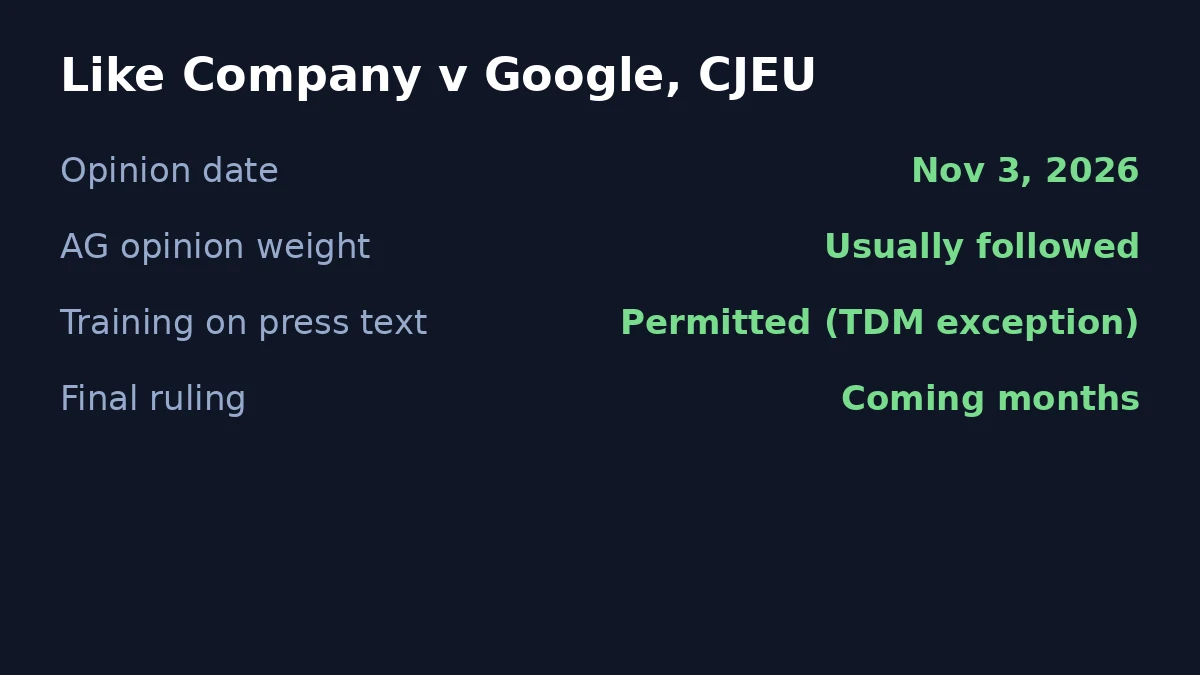
Advocate General Maciej Szpunar issued the opinion on Tuesday, November 3, advising the Luxembourg-based Court of Justice of the European Union (CJEU) in a case brought by Hungarian website operator Like Company against Google. Although opinions of the advocate general are not binding, the court’s judges follow them in the majority of cases, and a final ruling is expected in the coming months.
What the adviser said
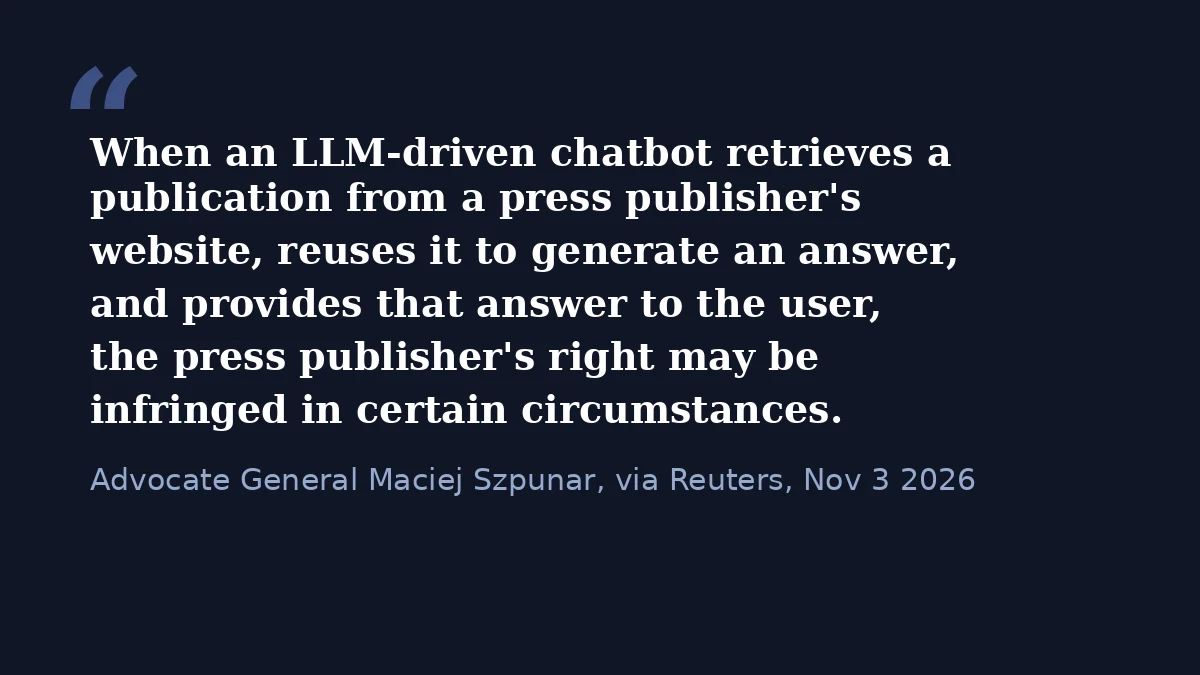
“When an LLM-driven chatbot retrieves a publication from a press publisher’s website, reuses that publication to generate an answer, and provides that answer to the user, the press publisher’s right may be infringed in certain circumstances,” Szpunar said, according to Reuters, which first reported the opinion.
The adviser drew a line between facts and expression: copyright rules do not protect the “mere facts” reported by press publications, but “only the specific form of expression,” he said. At the same time, he offered Google one important reassurance: using copyright-protected material to train large language models is “freely permitted under the text and data mining exception.”
In other words, training on published text remains lawful under EU rules, but what a chatbot does with that material at answer time, retrieving and reusing a specific publisher’s article to respond to a query, can cross into infringement territory when the protected expression itself is reproduced.
Why this case matters
The dispute captures the core tension between publishers and the largest AI platforms: newsrooms argue that chatbots answer questions with their reporting while diverting the readers and advertising revenue that fund the original work. A ruling against Google could force the tech giant to pay licensing fees for press content surfaced through Gemini, a model that other publishers across Europe would likely cite in their own claims.
The timing is notable. News publishers have spent the last two years striking deals, or threatening litigation, over AI training data. This case shifts the spotlight from training, where Szpunar says the law gives AI companies a clear exception, to the retrieval and generation layer, where the legal picture is murkier. If the court follows the opinion, chatbot operators will need to distinguish carefully between summarizing facts and reusing protected expression.
What happens next
The CJEU will rule in the coming months, and under the court’s usual practice the judgment is likely to track the advocate general’s reasoning. Google has not yet commented publicly on the opinion. For publishers like Like Company, even a non-binding opinion is leverage: it sets the terms of the debate and signals to negotiators and regulators that the press publisher’s right, introduced in the EU’s 2019 copyright directive, has real teeth against AI-generated answers.
The case will be watched closely beyond Europe. Courts and regulators in the US and elsewhere are wrestling with the same question, and a European ruling that chatbot answers can infringe a publisher’s neighboring right would become a reference point for licensing negotiations worldwide.
Sources
- Google’s use of press by AI chatbot may infringe copyright rules, EU court adviser says, Reuters, November 3, 2026