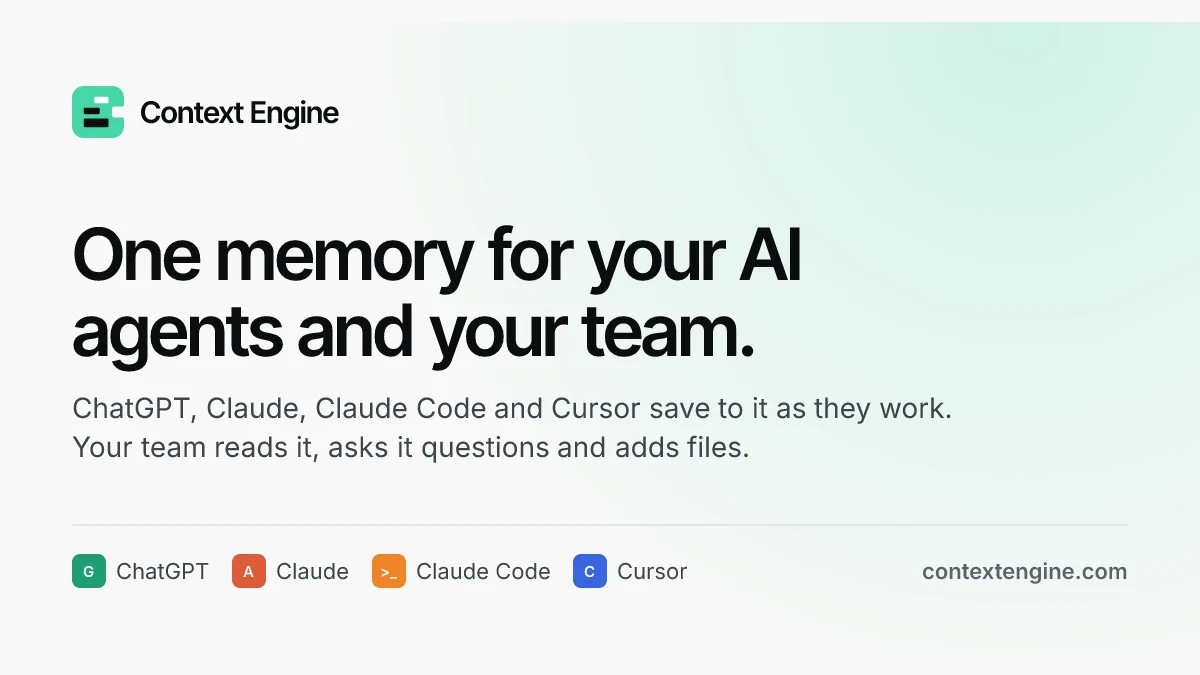
Context Engine launched on Product Hunt on October 23, 2026, finishing ninth on the daily leaderboard. It is the memory your AI tools and your team share. Claude Code forgets what you decided yesterday, Cursor does not know what ChatGPT learned this morning, and what one person’s AI learns stays in that person’s chat history. Context Engine fixes that: your tools save what matters into it as they work, and the next session starts with all of it, while anyone on your team can read the same memory.
Note: this is the Context Engine built and run by Relote at contextengine.com. It is a different product from Neo4j’s Context Engine.
How it works
- Connect your AI tools once: ChatGPT, Claude, Claude Code and Cursor connect in a few clicks or one command, through MCP, the standard they already speak. Anything else that speaks MCP or HTTP connects with a key.
- They remember as they work: as you work, your tools save what matters: a decision, a customer’s request, a new contact. Each memory has a type, shows which tool saved it, and keeps its history. You can also drop in files, a whole folder or a .zip.
- Engines: an engine is a memory with a purpose, described in a sentence or two. Keep one for yourself, one per client or project, or one for a team. Walls between them keep each client’s memory apart, and a memory moved to another engine takes its history with it.
- The next session picks up where the last one stopped: when a tool starts, it gets a short brief of what happened recently and what changed since its last visit. If it needs more, it searches the memory, matching meaning as well as exact words.
- Ask your memory: ask in plain words, and every answer names the memories it came from. It also writes daily and weekly summaries, links related memories, and catches duplicates.
- It stays organised: Context Engine writes summaries, links related memories and catches duplicates, so what was saved last month is still useful this month.
Security and privacy
Every engine gets its own database, its own search index and its own running copy of the service, so it never shares a table with anyone else’s data. Your content is sent to models only to answer you, and is never used for training, sold or used for advertising. You can export an engine any time as one ZIP of Markdown and JSON that opens without them, and deleting an engine is scheduled a day ahead so you can export first. Two-step sign-in is built in, and you can choose the EU at setup to keep your database and files there.
Who it is for
Context Engine targets people who build with AI, people who work for several clients, and teams: Claude Code and Cursor share what you decided, one engine per client keeps nothing crossing, and your whole team shares one memory on every plan, at no cost per person.
Pricing
Context Engine charges per engine, never per person: people are free on every plan. Free: $0 forever, no card and no time limit, with 1 agent per engine (plus 1 for each friend you refer, up to 3), 1 GB of memory per engine, and unlimited users. Pro: $12 a month or $99 a year per engine, with 10 agents per engine and 25 GB of memory. Unlimited: $39 a month or $299 a year per engine, with unlimited agents and 100 GB of memory. Enterprise: from $6,000 a year per install, on your own server, installed and run by Relote, with single sign-on, roles and an audit log. Prices are in US dollars, before VAT or sales tax. Pricing may change, so check contextengine.com/pricing for current terms.
Sources
- Product Hunt daily leaderboard, October 23, 2026 (Context Engine ranked 9th)
- Official website: contextengine.com (features and pricing verified October 25, 2026)