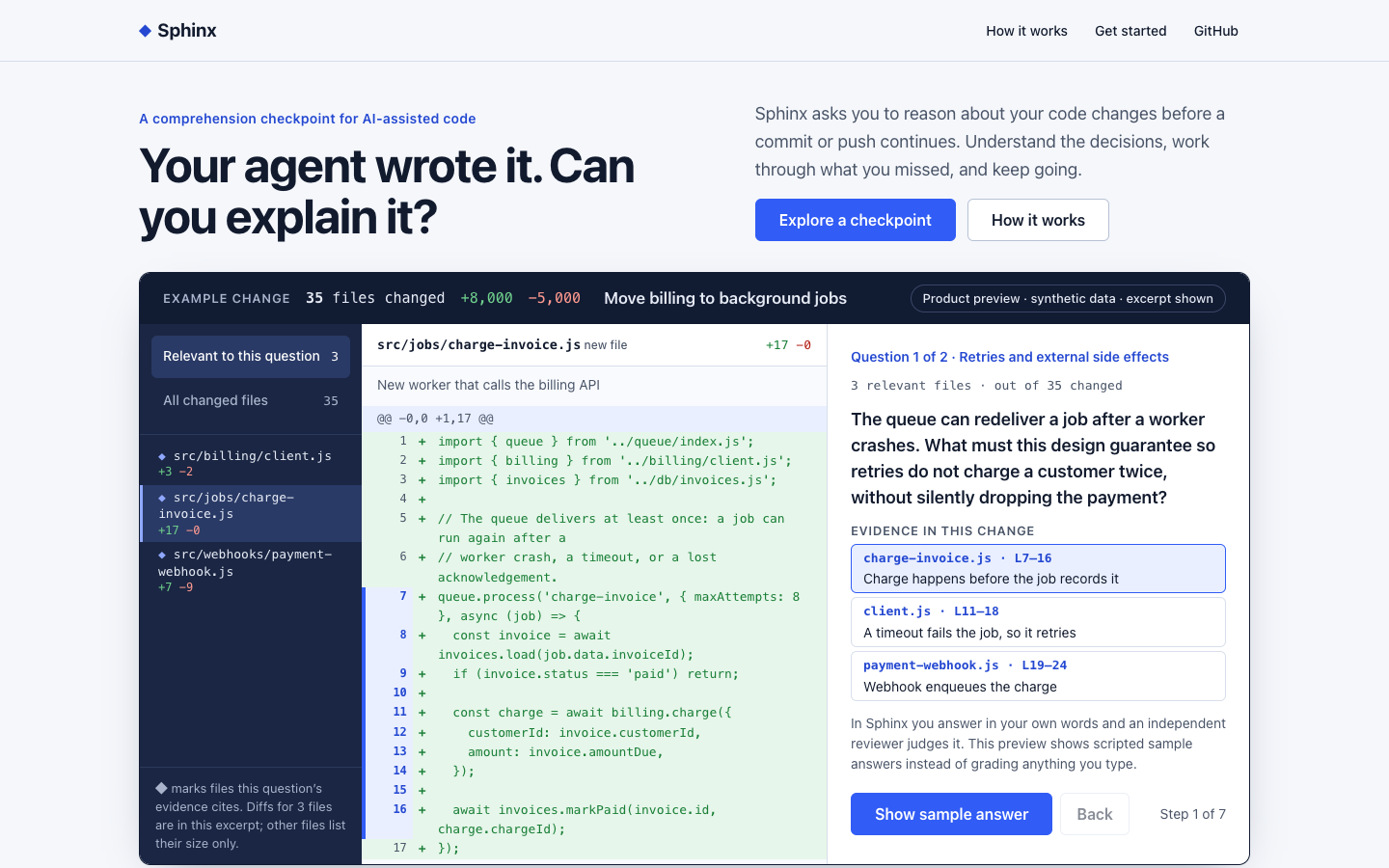
An AI assistant can produce a plausible code change faster than its reviewer can understand it. Sphinx addresses that gap with a comprehension checkpoint: before a configured Git operation continues, a separate AI reviewer asks questions about the change.
This is the Sphinx project published as sphinx-understand, not the similarly named documentation generator. Its official website describes a hook-based workflow in which a reviewer reads the diff without the coding conversation, asks about behavior and failure cases, and offers another attempt when an answer misses the point. This article is based on documentation; we have not installed or tested it.
A recent tool, not a proven security gate
The official npm registry history records version 0.1.0 on October 16, 2026. At our October 24 check, the latest listed version was 0.1.15. Rapid iteration is useful context, but a recent release and community attention are not evidence that a tool prevents bad code from shipping.
The project README explicitly frames the checkpoint as practice, not a security boundary. Local hooks can be bypassed, an answer can receive outside help, and the evaluator can be wrong. Passing a questionnaire does not establish authorship, unaided understanding or production readiness.
What setup changes
The documented requirements are Node.js 22.19 or newer, Git, and macOS, Linux or WSL. Native Windows is not supported. Installation sets a user-level Git hooks path and can affect multiple repositories, so this is not simply a browser quiz. Review existing hooks and team policy before installing it.
Use a disposable repository first, with no private code or credentials. A useful evaluation question is whether the checkpoint helps you explain a small change more clearly—not whether you can make a questionnaire disappear as quickly as possible.
Example: understand a search-filter change
Imagine you asked a coding assistant to add a “hide archived items” filter to a small catalog app. The patch looks tidy, but you are unsure how it interacts with pagination. The following is an original hypothetical exercise, not a recorded Sphinx session.
Start with the behavior you expect
Write down the rule in plain language: archived items should not appear when the filter is enabled, and the page count should describe the filtered results. Keep that statement separate from the implementation so you can compare intent with code.
Reason through a concrete edge case
A useful practice question would be: “If the first page contains mostly archived items, does filtering happen before pagination or afterward?” Read the relevant functions rather than guessing from their names. If filtering occurs after the page is selected, the user might see a nearly empty page even though more matching items exist elsewhere.
Check the explanation against evidence
Trace where the list is filtered, where the total is calculated and what the next-page control uses. Then add or review a test for that situation. If an AI reviewer gives a conflicting explanation, investigate the code and test result; do not assume the automated grade settles the question.
Keep the normal review process
Use what you learned to improve the PR description or ask a teammate a more specific question. Continue ordinary tests, review and approval. A comprehension exercise should strengthen those steps, not replace them.
Privacy and model costs
The README warns that a configured reviewer provider receives code and related context, including answers. Default file exclusions help, but an ignored-file rule cannot catch a secret pasted into an ordinary source file. Do not submit confidential repositories without an approved provider and handling process.
The separate configuration and cost documentation explains the model choices. Signed-in Claude or Codex routes use the account’s allowance; OpenRouter and other endpoints have their own access and billing requirements. Even a free OpenRouter route requires a key and is subject to availability and limits.
Model calls have no default cap. Configure appropriate limits and monitor usage before adopting it across daily work. Free source code does not mean unlimited free inference, and we are not quoting a fixed per-review price.
Who is it for?
Sphinx may suit developers who want a structured pause to reason about agent-assisted changes. It is less appropriate as a mandatory proof that someone understands code, or as a replacement for security review. The project is MIT licensed; model services remain separate. Compare other development approaches in our AI tools directory.
Image: official Sphinx repository product preview with synthetic example data, not a GPTOnline test. Copyright 2026 Sphinx contributors; used unchanged under the MIT License.