
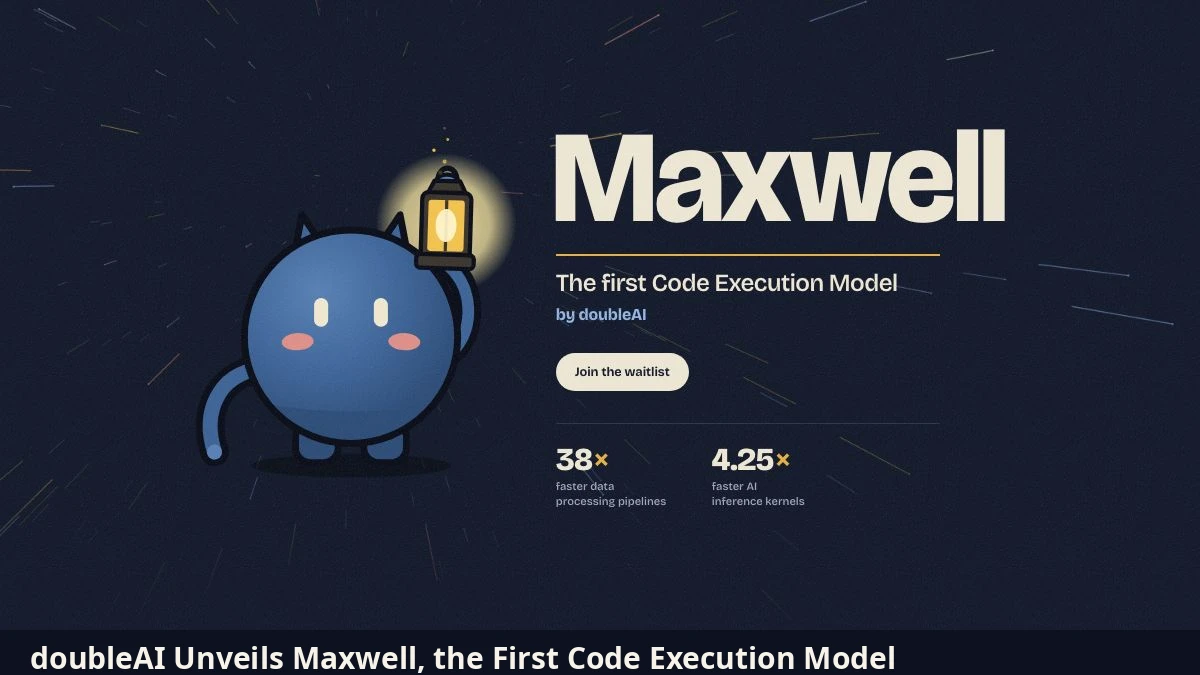
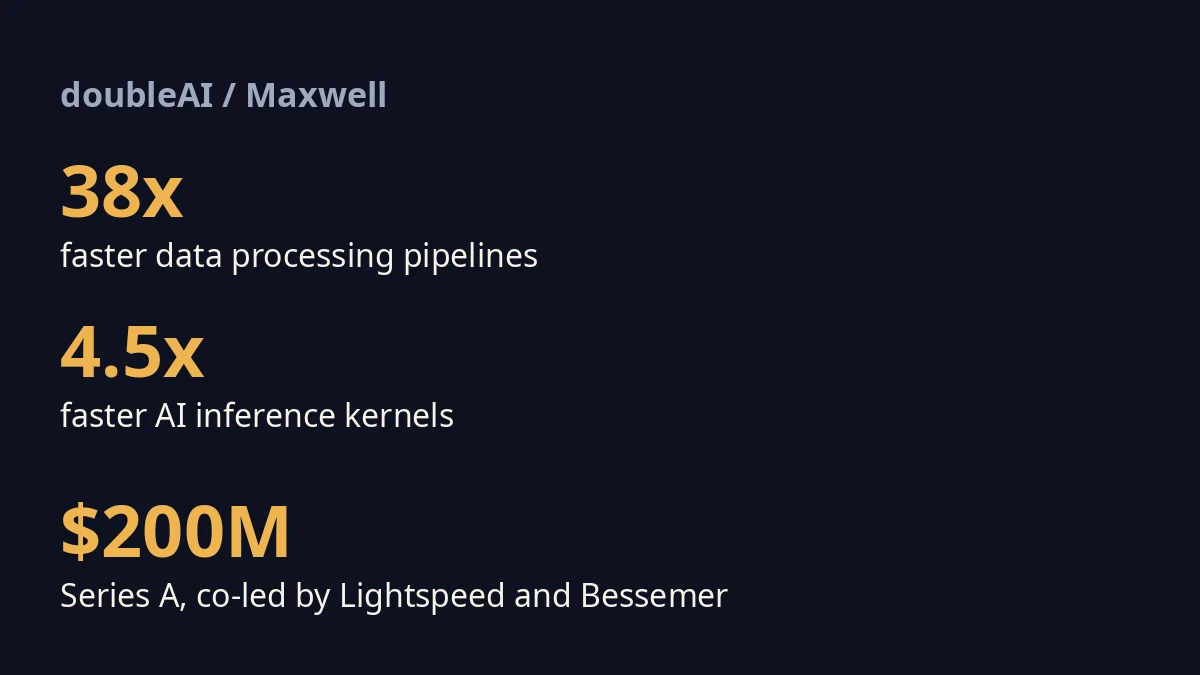
Amnon Shashua, the founder of Mobileye, has unveiled his next company. On October 19, his Tel Aviv-based venture doubleAI announced $200 million in Series A financing alongside a product launch: Maxwell, the first member of a new AI category the company calls Code Execution Models (CEMs). The round was co-led by Lightspeed Ventures and Bessemer Venture Partners, with Dell Technologies Capital, Greenfield, NVIDIA, Pitango and BRM joining.
Shashua, who stepped down as CEO of Mobileye and departed his roles at AI21 earlier this year, is betting that the next frontier in AI is not writing code but making it run better. While coding agents like those from Cursor or GitHub Copilot act on behalf of the programmer, a Code Execution Model works on behalf of the hardware. As Shashua put it in the announcement: “AI has changed how software is written, but not how it runs. Code Execution Models change that. CEMs, and Maxwell in particular, are agents on behalf of the hardware as opposed to code agents that are on behalf of the human user. In other words, they are the first AI that works for the machine, not the programmer.”
What Was Announced?
doubleAI, officially AA-I Technologies Ltd., came out of stealth with two disclosures: the funding round and the Maxwell launch. The company says Maxwell is now open for early access at heymaxwell.ai. Reporting by CTech puts doubleAI’s valuation at more than $1 billion, making the roughly 40-person company one of the most valuable AI startups to emerge from Israel this year.
Investor appetite appears strategic as much as financial. NVIDIA and Dell Technologies Capital both participated, and Dell’s venture arm led doubleAI’s earlier seed round, a first for the fund in backing a model-building company, its managing partner Yair Snir told Dealroom. The Wall Street Journal reported that doubleAI plans to spend half of the new round on 1,000 NVIDIA B300 Blackwell graphics processors, according to the Daily AI Brief.
How Maxwell Works
Conventional coding agents operate on source code. Maxwell operates a level below: it continuously analyzes a running program, the hardware underneath it and the data flowing through it, then rewrites the machine instructions (the binary) to fit those conditions. The source code stays exactly as it was; only the instructions sent to the CPU or GPU evolve, even while the program is in production. doubleAI says this makes code “a living thing that shifts and improves as it runs.”
The boldest claim is about trust. Changing software while it runs is dangerous, because optimizations get no human review and a mistake could corrupt results. doubleAI says Maxwell formally and mathematically proves that every rewrite leaves the program’s behavior unchanged, a verification breakthrough that lets AI make changes no human would sign off on. Every proven, faster version then becomes the starting point for the next round of optimization, so programs keep getting faster the longer they run.
The numbers are striking, though they are company-reported and independent verification remains limited. In its announcement, doubleAI says Maxwell made data pipelines over 38x faster and AI inference kernels over 4.5x faster on real-world workloads. Reporting by SiliconANGLE adds specifics: Maxwell sped up 55% of the algorithms in NVIDIA’s cuGraph library by at least two times, improved the pandas data science toolkit’s PDS-H query benchmark by a factor of 38, and nearly doubled the video generation speed of LTX-2.5, an open world model, with the gains documented in a technical post on doubleAI’s own research site.
Why It Matters
Compute has become one of the scarcest resources in technology. NVIDIA, cloud providers and open-source projects are already chasing efficiency through optimized kernels and GPU scheduling, but they optimize the stack from the top down. doubleAI’s pitch is orthogonal: instead of rewriting code or managing infrastructure, tune the running program itself. If the formal-verification claim holds up under independent scrutiny, Maxwell could unlock a large share of compute that currently sits idle, as “much of the world’s compute goes to running code far more slowly than it could,” Shashua noted, adding that “every program Maxwell speeds up gives some of that back.”
The business model is equally distinctive: doubleAI plans to charge customers a share of the computing cost savings it delivers, aligning its revenue with the value it creates. That positions it against the backdrop of a compute-hungry AI industry where hyperscalers are spending hundreds of billions on data centers. If Maxwell delivers even a fraction of its reported speedups across enterprise workloads, software-level efficiency becomes a strategic lever, not just an engineering nicety.
Questions remain, and the company will have to answer them. The performance figures come with limited public detail on tests and baselines, and enterprise adoption depends on customers trusting AI to touch production binaries. Still, the combination of Shashua’s track record, the formal-verification framing and the caliber of investors behind the $200 million round makes doubleAI one of the most significant AI debuts of October.
Sources
- doubleAI Unveils The First AI That Lives Inside Running Code, doubleAI official announcement via Business Wire, October 19, 2026
- Nvidia, Dell back $200M round for AI model developer doubleAI, SiliconANGLE, October 19, 2026
- Shashua’s doubleAI unveils AI models that optimize how software runs, CTech/Calcalist, October 19, 2026
- Mobileye founder’s doubleAI raises $200M to cut compute costs by optimising running code, Dealroom News
- Maxwell Makes LTX-2.5 Generate 4K Video Nearly 2x Faster, doubleAI research blog