
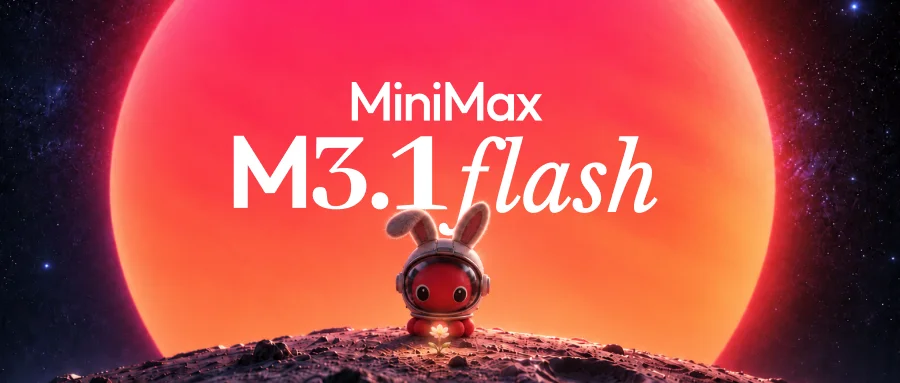
For weeks, one of the most used AI models on the internet had no name. It appeared on routing platforms as “Space Bunny,” topped usage leaderboards, and was widely assumed to be a stealth test by one of the major labs. On October 19, MiniMax (0100.HK) ended the guessing: in its launch post, covered by Unite.AI, the Chinese company confirmed that Space Bunny was an early version of its new model, M3.1 Flash.
According to OpenRouter, which hosted the stealth run, Space Bunny was its number one model for 10 straight days before leaving the platform on October 5. It returned on October 19 as M3.1 Flash. MiniMax says the public test was more than marketing: feedback from the stealth period helped it cut time to first token by 38% and lift throughput by 45% before launch, figures OpenRouter reported alongside the reveal.
The pitch: flagship-adjacent agents at Flash prices
MiniMax describes the model as a “generational leap” in agentic tasks, coding, computer use and cybersecurity, language echoed in the company’s statement to Reuters. The operational claims are specific. Online inference is nearly three times faster than the previous M3, with output speeds that MiniMax says can exceed 200 tokens per second. Pricing is flat: $0.15 per million input tokens and $0.60 per million output tokens, with cached input at $0.015 and no surcharge for long contexts across a 1 million token window. The company says the total cost of agentic workloads falls by 70% compared with its predecessor, and Artificial Analysis puts the average cost of an Intelligence Index task at about $0.22, down from $0.51 for M3.

The benchmark table in MiniMax’s launch materials, reproduced in MarkTechPost’s coverage of the release, is self-reported and should be read that way. It credits M3.1 Flash with 73.7% on DeepSWE v1.1, 62.2 points on Automation-Bench and 38.1 on Terminal-Bench 4.0, and MiniMax cites a score of 42 on the Artificial Analysis Intelligence Index, 13 points above M3. None of these figures has been independently verified yet, and the comparisons were run under conditions MiniMax chose.
Availability, and what is still missing
M3.1 Flash is live now through the MiniMax API, the M Plan subscription and the MiniMax Code desktop app, with both OpenAI-compatible and Anthropic-compatible interfaces. Two pieces of the release are still promises rather than products. The model weights are scheduled for release on October 23, with the license not yet disclosed, and MiniMax says a more capable Pro model will follow later, without a date. Until the weights and independent evaluations arrive, M3.1 Flash is a strong claim supported mainly by the company’s own numbers and by one unusual piece of evidence in its favor: for 10 days, developers used it heavily without knowing whose it was, and kept choosing it.

Sources
- Reuters, “China’s MiniMax launches updated AI model M3.1 Flash, claims major improvements,” October 19, 2026: https://www.reuters.com/world/asia-pacific/chinas-minimax-launches-updated-ai-model-m31-flash-claims-major-improvements-2026-10-19/
- Unite.AI, “MiniMax Launches M3.1 Flash, Revealing Space Bunny Stealth Model,” October 19, 2026: https://www.unite.ai/minimax-launches-m3-1-flash-revealing-space-bunny-stealth-model/
- MarkTechPost, “MiniMax Just Launched M3.1 Flash,” October 19, 2026 (launch specifications and the company’s comparison table): https://www.marktechpost.com/2026/10/19/minimax-m3-1-flash-release/