
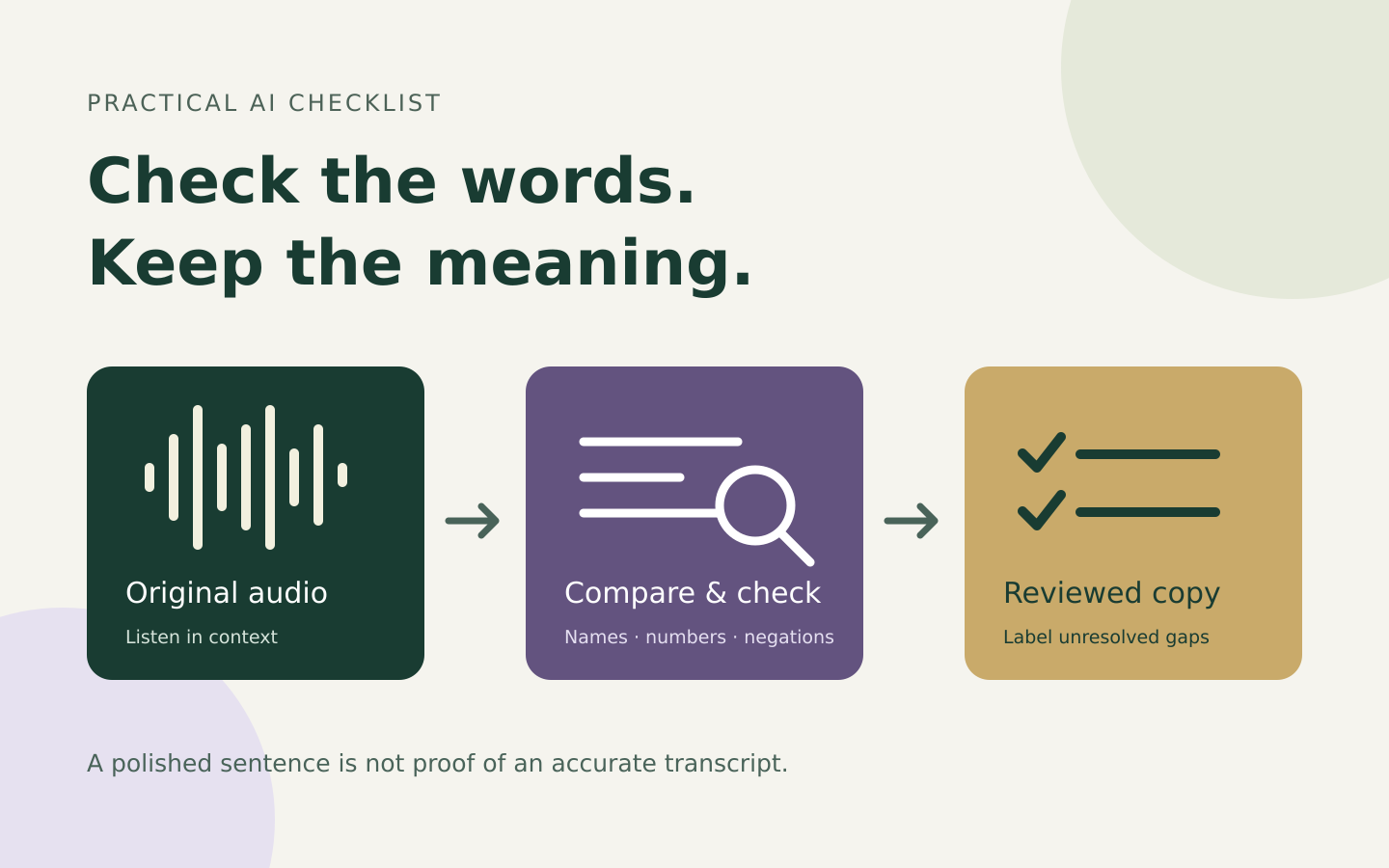
An AI transcript gives you a useful place to start reviewing a recording. Before forwarding it, check whether the text preserves what people actually said, who said it, and where the audio remains uncertain. Smooth sentences alone cannot answer those questions.
There are documented reasons for caution. OpenAI’s Whisper model card describes possible text that was never spoken, repetitive output, and uneven performance across languages and accents. Those findings concern Whisper; they are not a measured error rate for every transcription app. The workflow below is a practical editorial checklist.
1. Confirm permission and keep the source
Before recording or uploading audio, confirm that participants have agreed to the intended use. Before sharing the transcript, check the audience and whether the conversation contains details that should stay private. Permission to record a meeting should not be treated as blanket permission to distribute it.
Keep an unchanged copy of the recording and the initial transcript in an approved location. Work on a separate review copy. Note the recording date, language, and whether the tool produced a transcription or a translation. A translated transcript needs someone able to check the original language.
2. Listen while following the text
Play the recording from the beginning and read along. Use timestamps to mark passages that need another listen. Slow playback when it helps, and replay a short stretch before and after the disputed words so you hear the surrounding sentence.
Watch for text appearing during silence, a sentence repeated without a matching repetition in the audio, and a sudden jump that suggests missing speech. Verify each suspicious passage by listening. Do not delete unusual wording merely because it sounds awkward on the page.
If time allows only a partial review, label the checked time ranges. A spot check leaves the rest unverified. For anything that will become a quotation or a consequential instruction, check the complete relevant passage and its context.
3. Review the details that change meaning
- Names and terminology: Check unfamiliar people, organizations, and product names. Use an approved reference to confirm spelling after establishing what was said.
- Numbers and units: Replay prices, dates, quantities, percentages, and measurement units. Check whether a later statement corrected an earlier figure.
- Negations and conditions: Listen closely for words such as not, unless, before, and only. Keep conditions attached to the actions they qualify.
- Speaker labels: Confirm who is speaking at each transition. When identity is unclear, use an uncertainty label rather than assign the sentence to the person you expect.
- Overlapping or missing speech: Mark an unclear passage with its timestamp. Leave the gap visible instead of inventing a plausible completion.
4. Make corrections visible: a fictional example
The following example is entirely invented.
Imagined audio at 03:12: “I can send fifteen samples on Thursday, but don’t include the blue version.”
Unreviewed draft: “I can send fifty samples on Tuesday. Include the blue version.”
Checked transcript: “I can send fifteen samples on Thursday, but don’t include the blue version.”
This correction changes a quantity, a day, and an instruction. In a real review, record the timestamp and the changes so another reader can locate the evidence. If the quantity remains inaudible, write something like “[quantity unclear, 03:12]” and ask for clarification.
5. Decide how much editing the document allows
A verbatim transcript aims to preserve the spoken wording, including relevant false starts and repetitions. A readability-edited transcript may remove fillers or add punctuation, but readers should be told about that editing. Keep a separate version if you also want polished meeting notes.
Avoid quietly changing a hesitant suggestion into a firm commitment. Preserve qualifications and corrections even when a shorter sentence would look cleaner. When you turn the transcript into a summary, use a separate meaning-change check.
6. Send a transcript with a clear review status
Before sharing, state whether the text is fully reviewed or partially checked, identify unresolved passages, and explain any readability edits. Remove unnecessary private details from the sharing copy, and confirm the recipients.
Finally, separate accurate transcription from factual accuracy: someone can clearly say something incorrect. Check external claims separately, using a citation-verification workflow when sources are involved. Your finished transcript should make both the verified wording and the remaining uncertainty easy to see.