
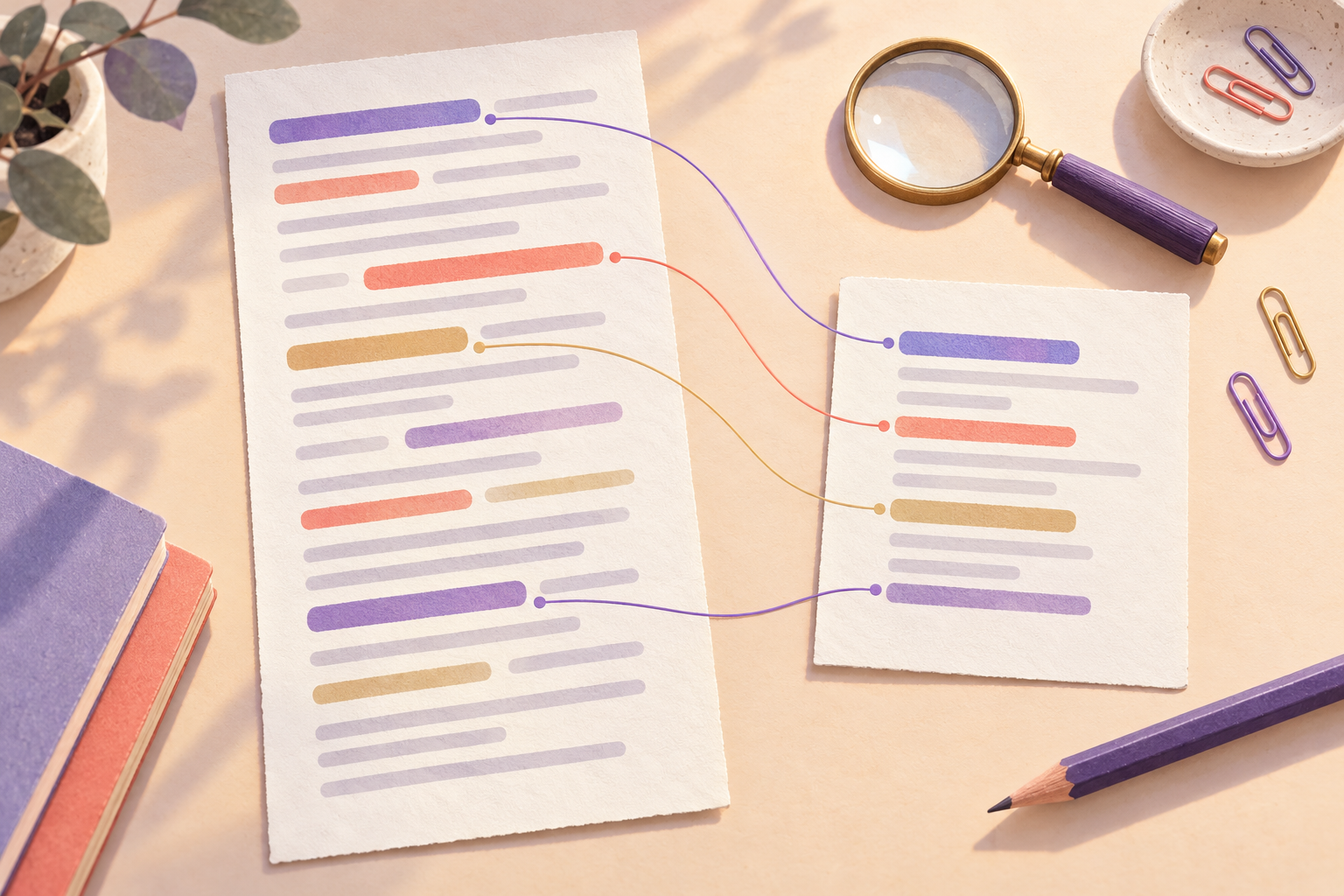
Original AI-generated editorial illustration for GPTOnline.ai; conceptual artwork, not an AI test result.
A summary can keep the topic of a notice while changing what a reader would actually do. The useful question is not just “Does this sound right?” It is “Would someone act differently after reading this version?”
This worked example follows one short fictional community notice from source to flawed summary to a repaired version. All names, dates, figures and quotations in the exercise are invented for illustration. The flawed text was deliberately written for this article; it is not a recorded output or test of an AI product.
Published October 16, 2026.
The source: a fictional repair event notice
Imagine you need a short announcement for a neighborhood newsletter. Your only source is the following notice.
Willow Community Repair Morning
The next repair morning is planned for November 14, from 10 a.m. to noon, subject to confirmation of the venue. A venue update will be posted by November 7.
Twenty repair slots are available. Each household may book one slot for one small, non-electrical item. Clothing and simple wooden objects are welcome; electrical appliances and safety equipment are excluded. A booking reserves an assessment, not a guaranteed repair.
At the previous event, volunteers assessed 24 items and repaired 18 during the session. Six items needed parts or specialist work. These figures describe items, not the number of visitors.
There is no assessment fee. If an item needs parts, its owner must approve and pay for them separately. Organizer Mira says, “We hope more neighbors will learn a repair skill.” The group has not measured how many participants learned a skill.
Booking opens November 8, after venue confirmation. Walk-ins may be assessed only if time remains after booked appointments.
The flawed summary
Here is a deliberately flawed version. Read it once before looking at the repairs.
Willow’s free repair morning will take place on November 14 from 10 a.m. to noon, with space for 20 people. Bring one broken household item, including appliances. The last event helped 75% of visitors learn a new repair skill, according to organizer Mira. Repairs and replacement parts are free. Book now, or drop in without an appointment for a guaranteed repair.
The summary sounds like a plausible event announcement. However, it changes the event’s certainty, capacity, eligible items, results, costs and access rules. One number is calculated correctly and still attached to the wrong claim.
Repair the meaning, one passage at a time
1. “Will take place” removes a condition
The source says the event is planned and depends on venue confirmation. A definite “will” tells readers the date is settled. Keep the condition close to the date: “The event is planned for November 14, subject to venue confirmation.” The November 7 update is useful because readers need to know when to check again.
2. “20 people” changes the unit
The capacity is 20 repair slots, with one slot for one item per household. The source does not state a visitor limit. Replacing “slots” with “people” could mislead someone who wants to accompany another household member. Use “20 assessment slots, one item per household” without inventing a headcount.
3. “Including appliances” reverses an exclusion
Electrical appliances are explicitly excluded, along with safety equipment. “Household item” is too broad on its own. A short summary can still name the permitted scope: “small, non-electrical items such as clothing or simple wooden objects.” Retain the exclusions if the announcement is meant to tell readers what to bring.
4. “75% learned a skill” invents an outcome
Eighteen of 24 assessed items were repaired: 18 ÷ 24 = 75%. That is an item-repair proportion for the previous event. It is not a percentage of visitors and it does not measure learning. The source specifically says skill learning was not measured.
Mira’s statement expresses a hope. It cannot support a measured success claim. Either omit the previous-event result from this short announcement or write “Volunteers repaired 18 of 24 items assessed at the previous event.” Keep the remaining six items’ need for parts or specialist work if discussing that result in detail.
5. “Parts are free” expands the offer
Only the assessment has no fee. Parts require the owner’s approval and separate payment. A reader could make a different spending decision after seeing the flawed version. Replace it with “Assessment is free; any parts require separate approval and payment.”
6. “Book now” changes the timing
The source opens booking on November 8, after venue confirmation. “Now” is unsupported and quickly becomes stale in a reusable announcement. Give the stated date and condition rather than guessing whether booking is already open.
7. “Guaranteed repair” promises an outcome
A reservation is for assessment, not a successful repair. Walk-ins are conditional on remaining time after booked appointments. A concise repair is “Walk-ins may be assessed if time remains; repairs are not guaranteed.” This preserves both the access condition and the outcome limit.
A corrected newsletter summary
The intended audience needs the date, eligibility, cost and booking rules. The previous event’s result and organizer’s hope can be left out because they do not change those practical instructions.
Willow’s repair morning is planned for November 14, 10 a.m.–noon, subject to venue confirmation; an update is due November 7. Booking opens November 8 after confirmation, with 20 assessment slots, one small non-electrical item per household. Clothing and simple wooden objects are welcome; electrical appliances and safety equipment are excluded. Assessment is free; parts require separate approval and payment. Walk-ins may be assessed if time remains after bookings. Repairs are not guaranteed.
This version is longer than the flawed summary because it restores several conditions. If you need fewer words, remove a lower-priority detail deliberately. Do not shorten “free assessment” to “free repairs” or turn conditional access into a promise.
A shorter version for a calendar listing
Willow repair morning: November 14, 10 a.m.–noon, venue pending. Check the November 7 update; booking opens November 8 after confirmation. Free assessments for eligible small non-electrical items; parts may cost extra. See the full notice for exclusions, booking limits and walk-in conditions. Repairs are not guaranteed.
A real calendar entry should link directly to the full notice. This fictional version has no real event page. The shortened version acknowledges omitted details instead of pretending to be a complete set of instructions.
Use the same editing move on your own summary
Put the source and summary side by side. For each sentence that affects a reader’s decision, identify the supporting source passage. Then ask whether the summary preserved its subject, unit, time, condition and degree of certainty. If a sentence has no support, remove it or mark the gap for follow-up rather than filling it with a plausible guess.
This exercise checks faithfulness to the supplied text. It does not establish that the original notice is accurate or up to date. Before acting on a real event, price or policy, check the current authoritative source as well.
OpenAI’s accuracy guidance cautions that ChatGPT can give incorrect or misleading answers and recommends checking important information. The worked repairs above are original editorial examples, not findings from that guidance or a comparison of AI systems.
If you are deciding whether an assistant fits a recurring task, our AI assistant acceptance-test worksheet addresses that broader evaluation. Here, the deliverable is simpler: a summary whose wording stays within what its source actually says.
[…] a worked example of checking whether an AI draft preserves its source’s meaning, read How to Catch Meaning Changes in an AI Summary. The example is separate from Hypertxt and does not measure this […]