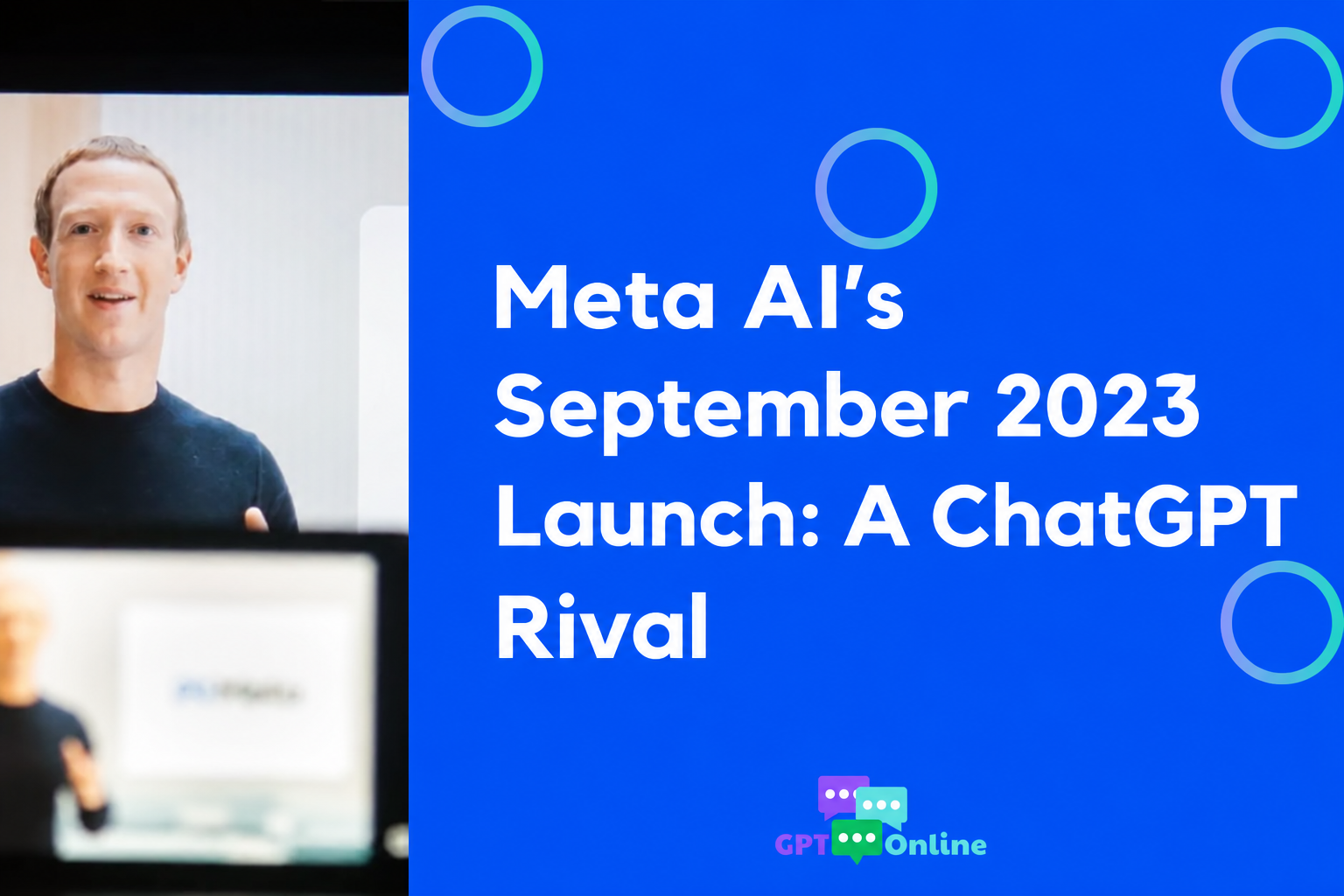
On September 27, 2023, Meta introduced its virtual assistant, Meta AI, as a competitor to OpenAI’s ChatGPT. The launch announcement described answers informed by Microsoft’s Bing search engine and image creation from text prompts. It marked a significant step in the increasingly competitive landscape of AI chatbots.
Powered by a custom model using technology from Llama 2 and Meta’s further language-model research, Meta AI extended beyond simple text interaction. It could generate images using Emu, a newly developed image generator. Meta’s Emu research paper described pretraining on 1.1 billion image-text pairs; contemporary reporting also described the use of publicly shared Facebook and Instagram material.
Initially announced in beta for US users across Messenger, Instagram, and WhatsApp, Meta AI could be integrated into group chats for tasks such as planning travel. Meta also announced voice access through its Ray-Ban Meta smart glasses, scheduled for October 17, 2023, with the AI features initially limited to a US beta.
The introduction of Meta AI placed the social networking giant in competition with ChatGPT and other conversational and image-generation products. This was a launch-era competitive comparison, not a benchmark showing that one assistant was superior.
Meta CEO Mark Zuckerberg announced Meta AI at Connect on September 27, 2023, alongside the Meta Quest 3 headset and new smart glasses. The event also included a series of generative AI updates, including two planned photo-editing tools for Instagram.
Backdrop could replace a photo’s scene or background based on a text prompt, including a scene surrounding the subject with puppies. Restyle applied a described visual style, such as watercolor. These were distinct editing functions in the launch announcement.
To help distinguish AI-generated imagery, Meta’s September 2023 safety explanation described visible markers for images created or edited by Meta AI, Backdrop and Restyle, as well as work on additional information embedded in image files. Those plans should not be read as a guarantee that every AI image can be reliably identified.
Meta also announced 28 additional AI characters with distinct backstories. Some were portrayed by celebrities and creators, including Naomi Osaka and Tom Brady; they were not simply chatbots speaking as those people themselves. The characters began a US beta rollout on Messenger, Instagram and WhatsApp.
Meta emphasized making model weights available under its licenses. The first LLaMA, announced in February 2023, was released for approved research use under a noncommercial license. Llama 2 followed in July 2023 for research and commercial use subject to Meta’s license terms. This differs from describing the models as unrestricted open-source software.
In WIRED’s September 2023 reporting, Nathan Lambert, then an AI researcher at Hugging Face, saw Meta’s model strategy as a way for large companies to move faster. The same report described Holly Elmore’s concerns about the risks of distributing powerful models. These were attributed views, not proof that Llama was already deployed in every Meta service.
Meta AI was not the company’s first foray into AI assistants. In 2015, Facebook introduced a virtual assistant named M that combined software with human assistance. Its human-assisted beta ended in 2018; that closure should not be confused with the immediate disappearance of all automated M suggestions in Messenger.
The September 2023 launch marked Meta’s renewed push into AI assistants. The features, beta restrictions and plans described here reflect that announcement, not the current state of every Meta product.