Clear prompts can make ChatGPT more useful for business tasks, but they do not guarantee accurate answers or business results. This June 2023 article presents Lasse Linnes’s four-part prompting framework, reported by Jodie Cook in Forbes on June 22, 2023. Linnes, founder of Insidr.ai, grouped prompts into information, creative, instructional and problem-solving tasks. These are practical categories, not an exhaustive or scientifically established classification. The prompt examples below are this article’s adaptations, not verbatim quotations from Linnes.
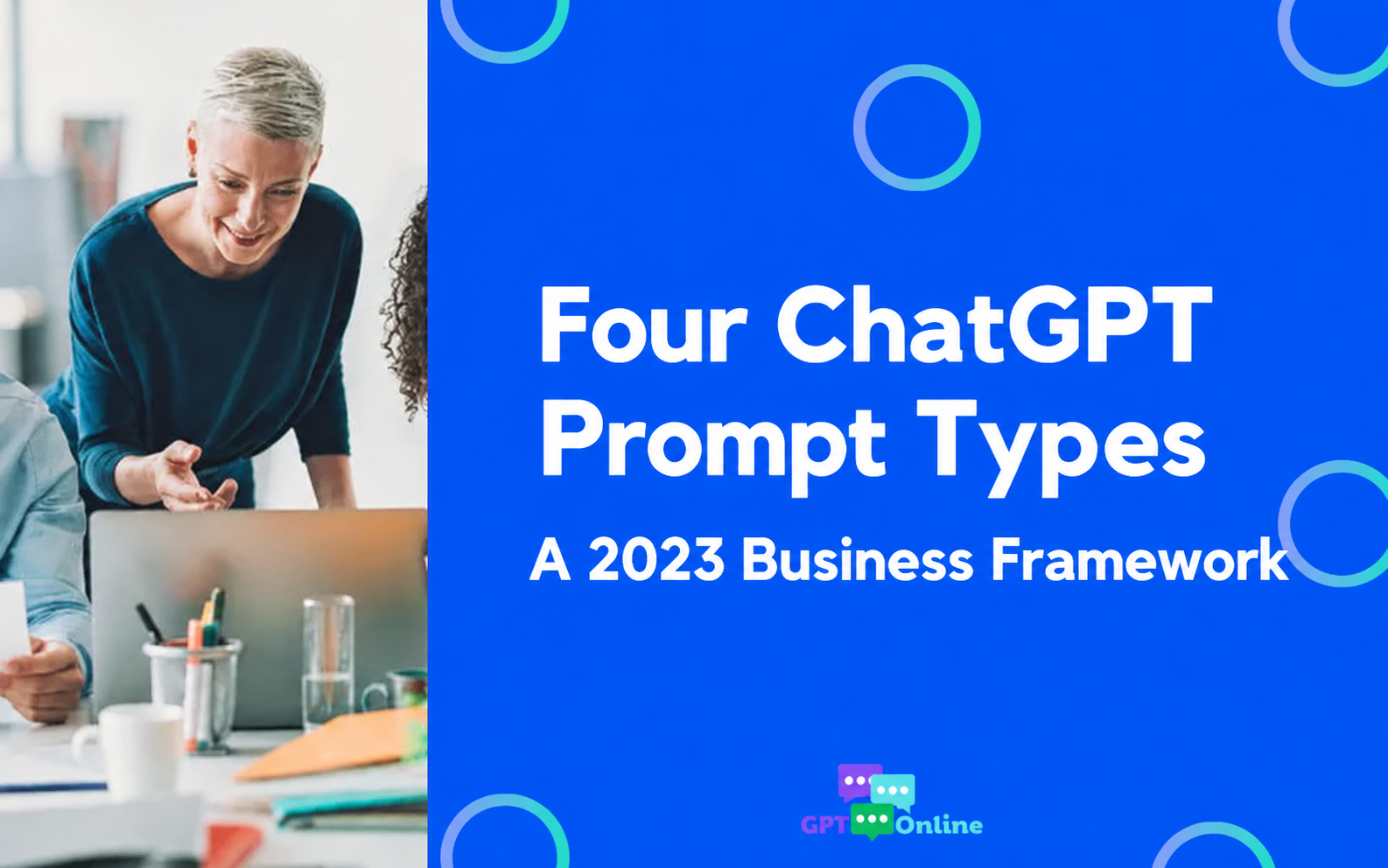
Four ChatGPT Prompt Types: A 2023 Business Framework
The GPTOnline cover illustrates this June 2023 prompting framework. It is an editorial design, not a demonstration of business results or a claim that these four categories are universal rules.
The Art of Information Prompts: Unleashing Knowledge
When seeking specific information or a concise summary of a particular topic, information prompts are your go-to tool. Linnes suggests asking for a small set of key insights using a 20/80 framing. Those percentages are a prioritization heuristic, not a measured guarantee of understanding. For example, by using the prompt “I want to learn about [insert topic]. Please share the top 20% of key learnings on this topic which will help me comprehend 80% of it.,” entrepreneurs can obtain a high-level account of the subject presented in a memorable and relatable format. Furthermore, information prompts prove invaluable when summarizing books, transcripts, articles, or complex documents. Provide the relevant text you are authorized to share and check the summary against it. Naming a book and author alone does not establish that the model has access to the full text or can summarize it accurately.
Fueling Creativity with Creative Prompts
The realm of creative prompts opens the doors to a world of imaginative and captivating content. From storytelling to scriptwriting, entrepreneurs can leverage ChatGPT’s creative prowess to enrich their business endeavors. Linnes outlines three primary creative prompts: script, message, and blog. For instance, when crafting a YouTube script, entrepreneurs can employ a prompt such as “Write a script for a YouTube video guiding beginners on creating their first Facebook ads. The video should be concise, no longer than 5 minutes, and easily comprehensible to a 10-year-old.” Similarly, in the realm of blog writing, Linnes suggests a prompt like “Compose a [word count] blog post delving deep into [specific topic]. Adopt a [desired tone] to captivate [target audience]. Include sections such as [specified subheaders], focusing on the primary keyword [primary keyword] mentioned [number] times, while incorporating secondary keywords [secondary keywords] [number] times each.” By providing sufficient context and guidance, entrepreneurs can request more relevant drafts. The keyword repetition in this historical example is not an SEO requirement: prioritize helpful, natural writing rather than a fixed keyword count, consistent with Google’s guidance on generative AI content.
Unveiling Step-by-Step Instructions with Instructional Prompts
Entrepreneurs seeking to acquire new skills or step-by-step guidance can use instructional prompts to request a starting sequence of steps. Linnes recommends employing instructional prompts when requesting comprehensive tutorials on specific subjects. Whether it’s setting up a Facebook ads campaign or creating a social media strategy for a specific business, instructional prompts can offer clear, concise instructions tailored to the entrepreneur’s requirements. For example, entrepreneurs can prompt ChatGPT with queries like “Provide a step-by-step guide on setting up a Facebook ads campaign for a company” or “Offer a detailed tutorial on creating a social media campaign for a [specific business type] targeting [the specific audience].” Check generated steps against current platform documentation before using them, particularly when a tutorial involves spending money or changing account settings.
Solving Challenges with Problem-Solving Prompts
When entrepreneurs encounter challenges or seek solutions to specific problems, problem-solving prompts can act as a guiding light. Treat ChatGPT as a source of ideas to evaluate, not a verified business adviser. By formulating problem-solving prompts effectively, entrepreneurs can gain fresh perspectives and explore new ideas. For instance, if you’re facing stagnant website traffic, a prompt like “Suggest effective strategies to increase organic traffic to my website, considering its size and purpose” can provide actionable recommendations. Similarly, when planning marketing activities on a limited budget, entrepreneurs can prompt ChatGPT with queries such as “Recommend three distinct marketing strategies for my e-commerce beauty company, which has a $5,000 budget over the next three months.” By embracing problem-solving prompts, entrepreneurs can tap into ChatGPT’s ability to break down complex issues and propose innovative solutions.
The art of prompting involves choosing a task, providing relevant context and reviewing the result. These four categories can help organize requests, but a well-written prompt does not make every answer correct. Verify facts, test suggestions on a small scale and keep confidential business or customer information out of tools not approved for that purpose.