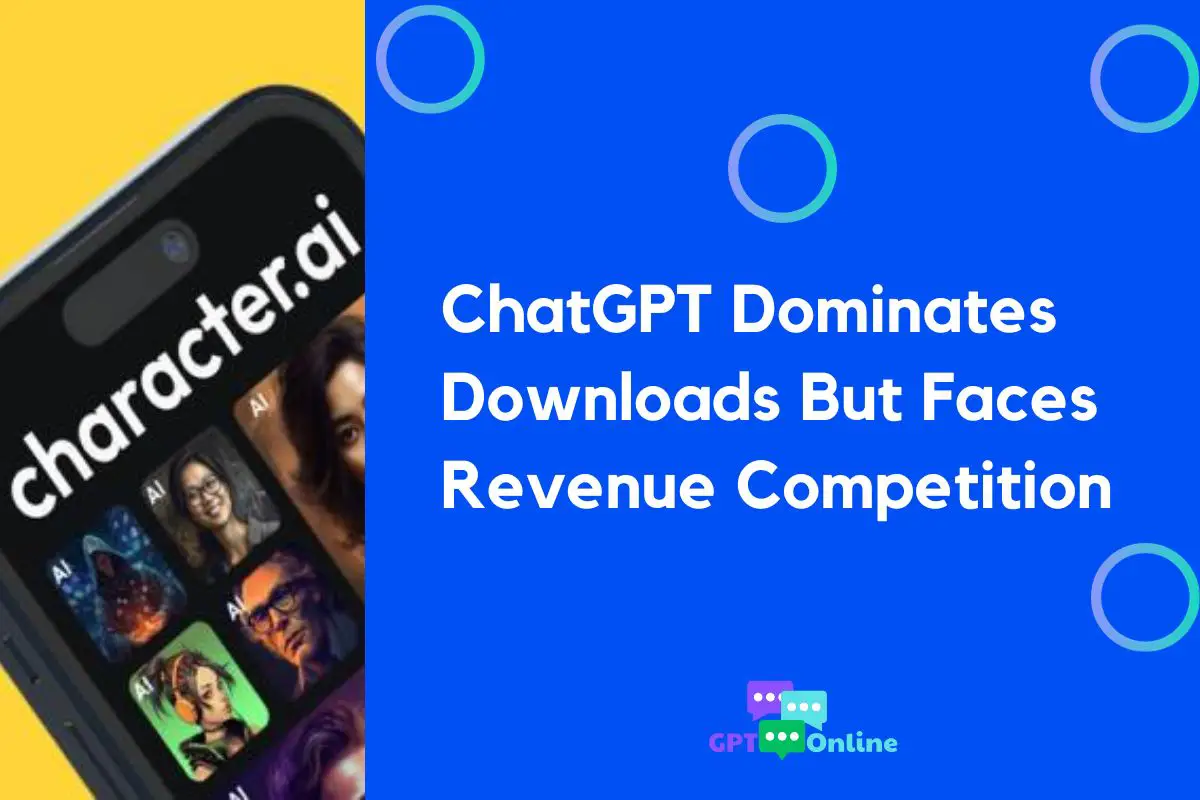
The retained GPTOnline editorial comparison cover includes a Character.ai-branded phone image. It is not a ChatGPT interface screenshot or evidence of current market rankings.
Historical snapshot: The figures below are Apptopia estimates cited in contemporary reporting dated October 30, 2023. They are not current rankings or audited company results. The original dataset has not been independently reproduced here.
OpenAI’s AI chatbot, ChatGPT, was reported to lead the sampled AI chatbot apps in monthly mobile downloads in September 2023, outstripping other AI chatbot apps. Despite this, some competing apps had higher estimated mobile consumer spending. A number of photo AI apps and other AI chatbots have managed to exceed ChatGPT’s mobile consumer spending in the report, even though it has firmly established itself as a go-to name in the AI chat experience.
ChatGPT’s mobile app made its debut in May 2023 and has seen an impressive growth trajectory in both downloads and revenue. In its inaugural month, only available on iOS, the app achieved 3.9 million downloads, which ballooned to 15.1 million by June, according to an AI app market analysis by Apptopia. After a slight dip in July, ChatGPT bounced back, topping 23 million downloads during September 2023. These figures describe monthly installs, not cumulative lifetime downloads or unique people.
The app’s usage mirrored its download growth, with monthly active users skyrocketing from just over 1.34 million in May to nearly 39 million in September. The app’s consumer spending followed suit, starting at $352,929 during its launch month and reaching nearly $2.39 million for October through October 24, 2023, when the reported dataset ended. This partial-month figure should not be compared as if it covered a full month.
Despite these impressive numbers, ChatGPT was not the highest by estimated mobile consumer spending in that September comparison. Apps such as “Chat & Ask AI” and “ChatOn — AI Chat Bot Assistant” surpassed ChatGPT’s reported September mobile spending of $1.98 million, pulling in nearly $3.38 million and $2.11 million respectively. Other competitors, like “AI Chatbot — Nova” and “AI Chatbot: AI Chat Smith”, are also hot on ChatGPT’s heels.
The mobile platform is a competitive space for AI chatbots, with at least five apps exceeding 2 million downloads in September. Many of these are generically named apps like “Chat & Ask AI,” “ChatOn — AI Chat Bot Assistant,” “AI Chatbot — Nova,” and “AI Chatbot: AI Chat Smith.” The article suggested that generic names might help with app-store search terms such as “AI Chat”; it did not establish that naming caused the reported downloads. While their download numbers still fall short of ChatGPT’s 23 million, they indicate a robust market for AI apps beyond OpenAI’s creation.
Moreover, backed by a16z, the chatbot startup Character.ai is also in the race with 2.39 million downloads as of September. This app enables users to interact with and create their own AI personas.
These apps not only have high download numbers but also boast a significant active user base. For instance, Poe, a chatbot app from Q&A site Quora, was estimated to have over 1.18 million monthly active users (MAUs) in September, compared to ChatGPT’s nearly 39 million MAUs.
The competition doesn’t end with chatbots. AI photo apps, which utilize AI technologies for editing effects or personalized images, operate in an adjacent space and are giving ChatGPT a run for its money across metrics such as downloads, usage, and in-app purchase revenue.
In spite of the stiff competition, with 23 million downloads in September, ChatGPT continued to lead the pack. However, viral apps like “Remini” are inching closer to ChatGPT’s installation numbers, making the AI app market an exciting space to watch.
Scope matters: downloads, active users and mobile consumer spending measure different things. Mobile spending is not profit or all of OpenAI’s revenue; web subscriptions, API and other business revenue fall outside this comparison. OpenAI’s May 18, 2023 announcement confirms the iOS launch date.